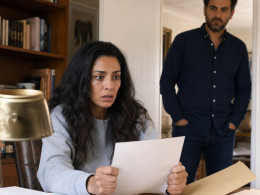




Not Here. Not Now.
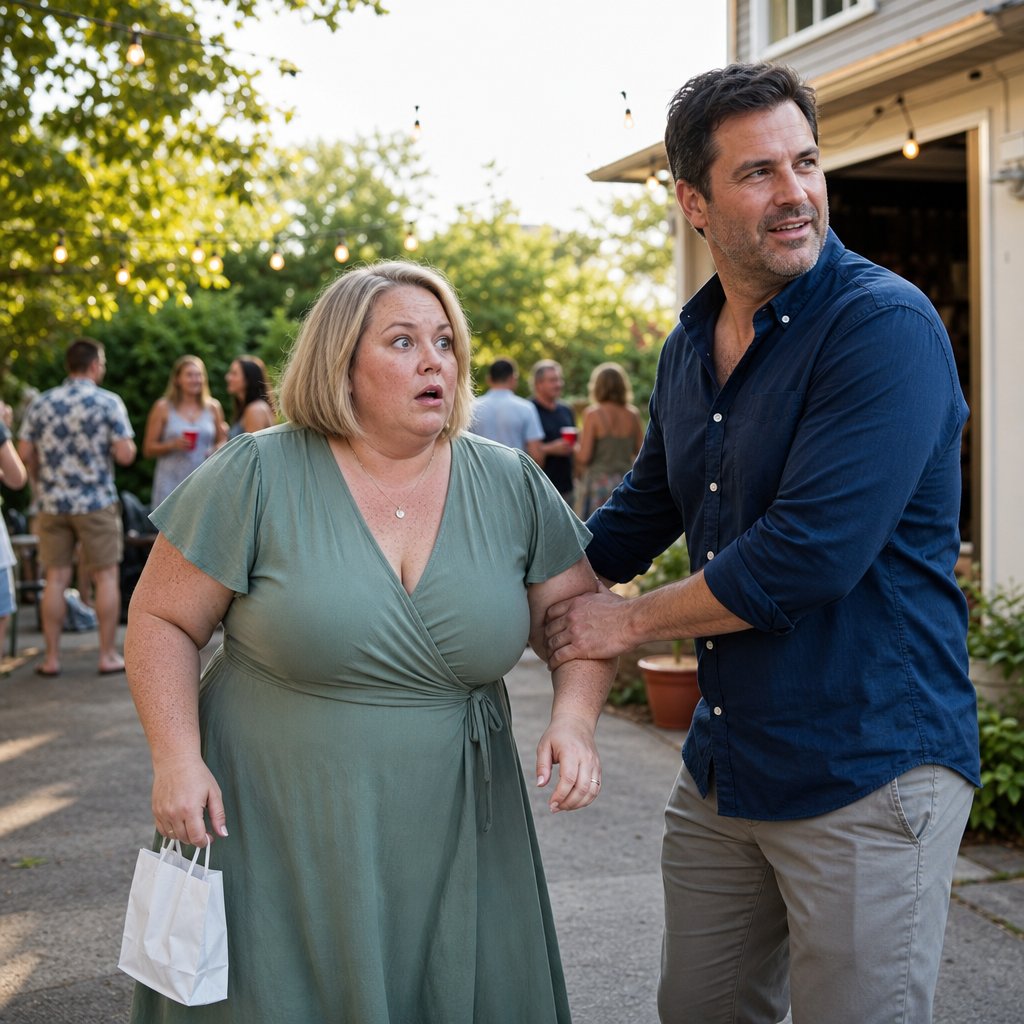
Caleb had me by the elbow in the driveway like I was a drunk cousin he needed to steer away from the neighbors. His fingers dug through the sleeve of my soft green wrap dress, right into the tender part of my arm, and his smile was still plastered on for anyone looking through the kitchen window.
“Not here. Not now. Please,” he hissed, breath sharp with the gin he’d been pouring like it was holy water. His eyes weren’t apologizing. They were measuring. Counting exits. Managing me.
I had a little white gift bag in my other hand—the one with the tiny onesie inside, folded so perfectly it looked like a promise. I’d been rehearsing the announcement in my head for days, my heavyset body humming with that secret, electric joy. I’d imagined cheers. My sister crying. Caleb’s hand on my belly like we were finally, finally a team.
Instead, he leaned closer and lowered his voice like he was giving a hostage negotiator instructions. “Just… wait. Okay? I need you to wait.”
I stared at his wedding ring as it flashed in the porch light, and a sick thought landed: he wasn’t begging for forgiveness. He was begging for control.
Then his gaze flicked past me—over my shoulder—like someone had just pulled into the street, and his grip tightened as if he could physically stop whatever was coming up the driveway.
The Same Sentence Twice
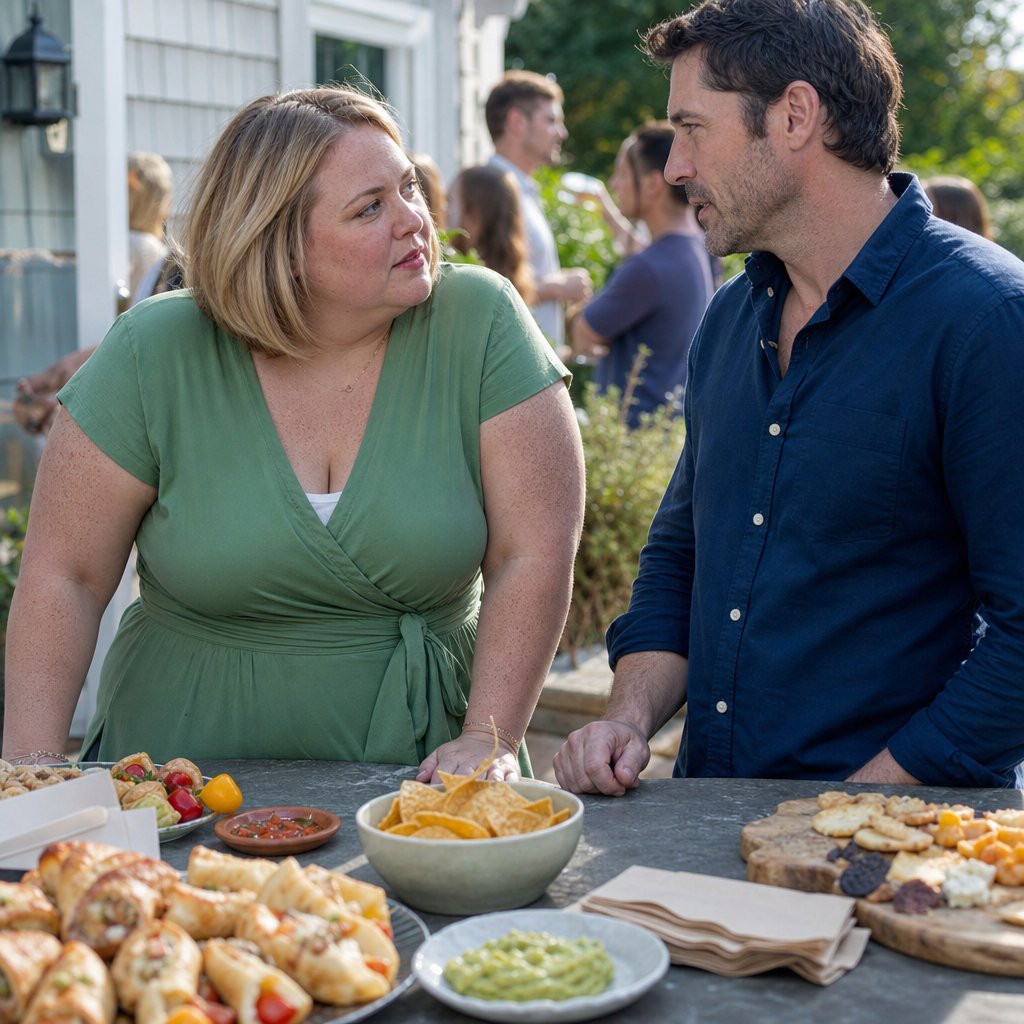
I went back to the appetizer table like I was on autopilot, smiling too wide at people who didn’t deserve my panic. The air smelled like charcoal and citrus, and the platter of bruschetta looked suddenly obscene—tiny perfect bites while my life cracked open.
Caleb followed, a step behind, acting like he wasn’t just manhandled me in the driveway. He slid his phone out like he needed a lifeline, thumb moving fast. I told myself not to look. I told myself to breathe.
But the screen angled toward the bowls of chips for one stupid second, and I saw it—one message preview, then another, stacked like a cruel little echo.
We need to talk before you announce.
Same sentence. Same urgency. Two different contacts.
My stomach dropped so hard I actually put a hand on the table to steady myself. The baby was so new, so fragile, that my first instinct was to protect it from the shock like shock could seep through my skin.
I looked up at Caleb’s face. He was laughing at something my cousin said, teeth showing, eyes bright—performing husband, performing host. But his thumb kept moving like he was putting out fires in two different houses.
I didn’t even know who I was more afraid of in that moment: the person texting him, or the person Caleb had become without me noticing.
Then Caleb’s laughter hitched, just barely, and he turned the phone face-down on the table like it had burned him.
Board Drama, Sure

“It’s nothing,” Caleb said, too quickly, like he’d practiced the rhythm of denial. He reached for the phone again and tucked it closer to his body, shoulders squaring like I was a threat.
I kept my voice light because that’s what women do when they’re trying not to ruin a party. “Two people told you the same thing. Before I announce. What is that about?”
He gave a laugh that didn’t touch his eyes. “It’s board drama. Foundation stuff. You know how it is.”
I didn’t, actually. I knew how my husband used to tell me everything—how he’d rant about donors and budgets while I made tea. I knew how he used to reach for my hand without thinking. This version of him was all angles and guardrails.
“Board drama,” I repeated, tasting it. It tasted like a lie someone thought I’d swallow because it sounded grown-up.
I reached for the phone, not even to take it—just to turn it over, to see the names, to anchor myself in something real.
He snatched it so fast his elbow clipped my drink. The plastic cup toppled, pale rosé flooding across the table, soaking napkins and dripping onto the patio stones like a blush spreading.
“Jesus, Nina,” he snapped, loud enough that my aunt turned her head.
My cheeks burned. My hands shook. His panic didn’t match “board drama.” It matched a man protecting a second life.
Caleb leaned in, voice sweet again for the audience, but his eyes warned me. “Not now,” he murmured—then, under his breath, “Don’t do this.”
And that was the moment it hit me: he wasn’t scared of me finding out. He was scared of me finding out in front of everyone.
Two Phones Behind The Shed
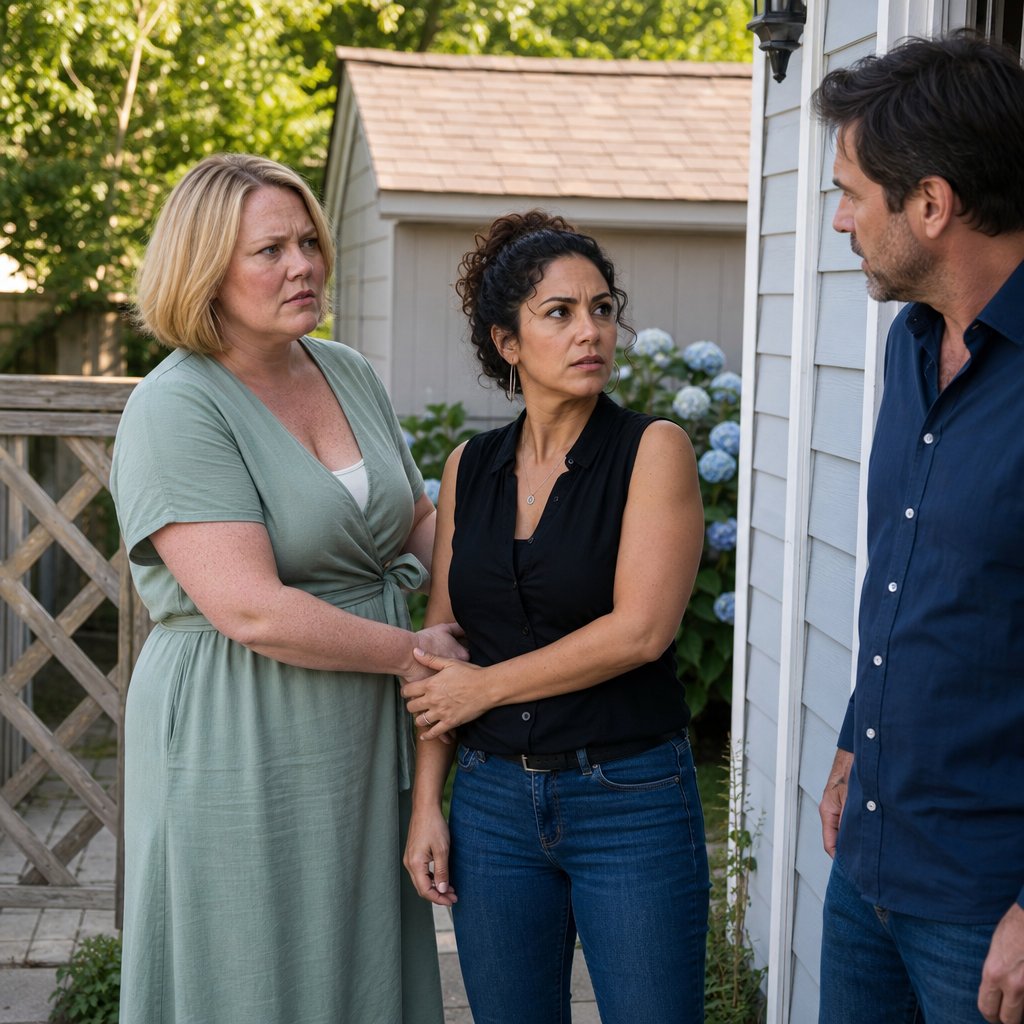
Tessa found me by the side gate where the noise dulled and the air smelled like cut grass and propane. She was my friend from work—sharp eyeliner, dark curls pinned up, the kind of woman who noticed everything and pretended she didn’t. Tonight she looked pale under her bronzer.
“Nina,” she said, grabbing my wrist gently, like she was afraid I’d bolt. “I need to tell you something before you do… whatever you’re about to do.”
My throat tightened. “If this is about the announcement—”
“It’s about Caleb.” Her voice dropped. “I went around back to take a call and I saw him behind the shed.”
My stomach went cold. The shed door was half-hidden by hydrangeas, the kind we planted together because he said he wanted the yard to look ‘established.’
“He had two phones,” Tessa said, quick and clipped, like ripping off a bandage. “He kept switching between them. Like one was the normal one and the other was… the real one.”
I stared at her, waiting for the punchline that didn’t come. “Two phones,” I repeated, because my brain needed to hear it twice to accept it.
Tessa nodded, eyes shining with that mix of guilt and fury you get when you’ve witnessed something you shouldn’t have. “And he wasn’t just checking them. He was answering. He looked… scared. Like someone was pressing him.”
A laugh bubbled up in me, ugly and disbelieving. Caleb, scared? My Caleb who corrected waiters and made speeches at fundraisers?
“I’m sorry,” Tessa whispered. “I didn’t want to ruin your night, but—Nina, he’s hiding a whole channel. And I think it’s about your announcement.”
We both turned at the same time because the back door opened, and Caleb stepped out, scanning the yard like a man counting heads.
Donors, And Blame
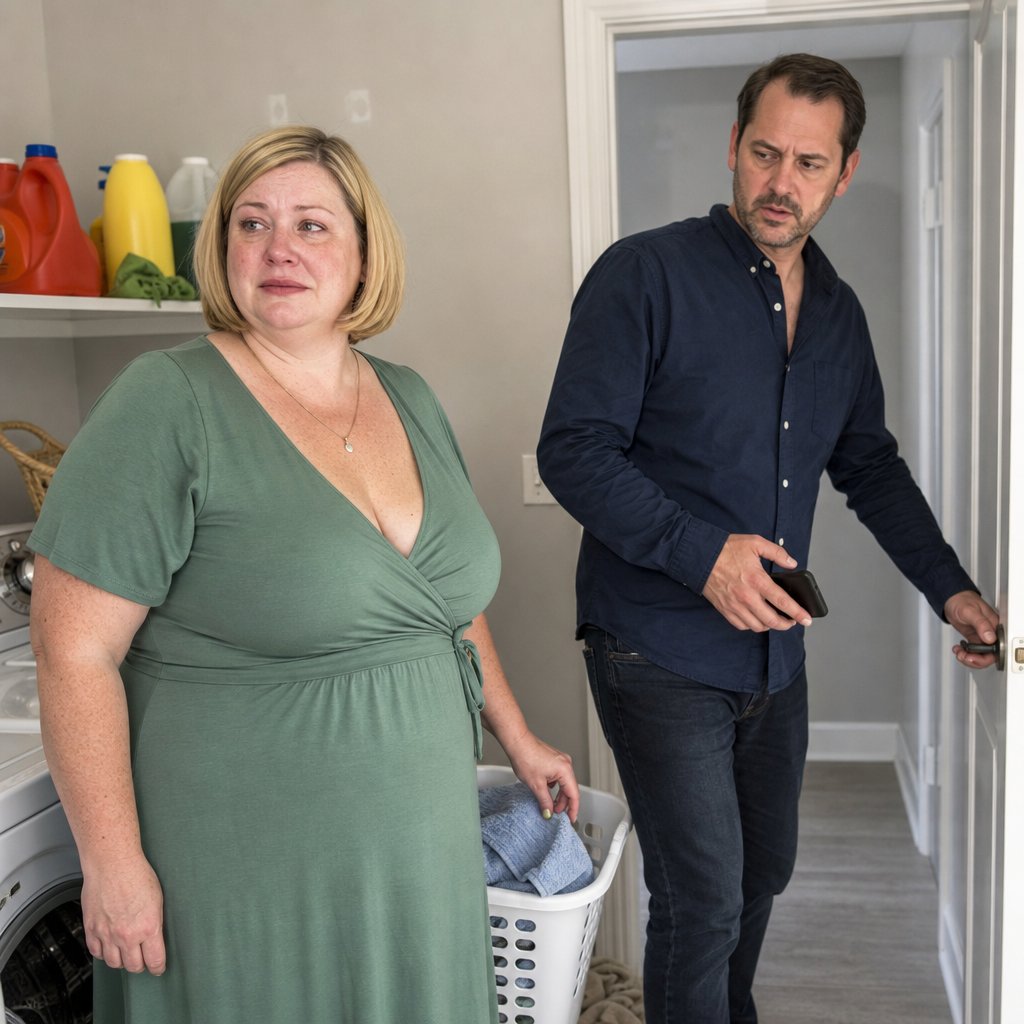
I cornered Caleb in the laundry room because it was the only place in the house where the music from outside turned into a muffled thump and no one casually wandered in for more ice. The air smelled like detergent and warm lint, and the dryer hummed like it was trying to drown out my heartbeat.
“Two phones,” I said, flat. “Explain it.”
Caleb’s face did that thing it did when he was about to go onstage: a quick reset, jaw loosened, eyebrows lifted like I was being unreasonable. “Who told you that?”
“Does it matter?”
He exhaled hard through his nose and pulled a second phone from his pocket like it was a magic trick he’d been forced to reveal. “It’s for donors,” he said. “High-net-worth people. They don’t want their assistants seeing everything. It’s private.”
I stared at it. A plain black rectangle. No case. No family photo on the back like his regular phone. It looked sterile. Secret.
“So private that you hide behind the shed?” My voice cracked on the last word, and I hated that he heard it.
His eyes narrowed. “You’re embarrassing yourself.”
That landed like a slap. Not I’m sorry. Not you’re right. Just—my feelings were the problem.
“I’m pregnant,” I whispered, like maybe the truth would soften him, like maybe he’d remember who I was.
For a fraction of a second, something flickered in his face—panic, not joy. He stepped closer, lowering his voice into something almost kind. “Nina. Please. Don’t make this about you right now.”
My vision blurred. “About me?” I repeated, tasting the insanity of it.
He reached for the door handle like he was about to leave me in there with the detergent and my humiliation, and I realized he wasn’t just hiding a phone. He was hiding the version of him that didn’t need me at all.
The Uninvited Woman Watching
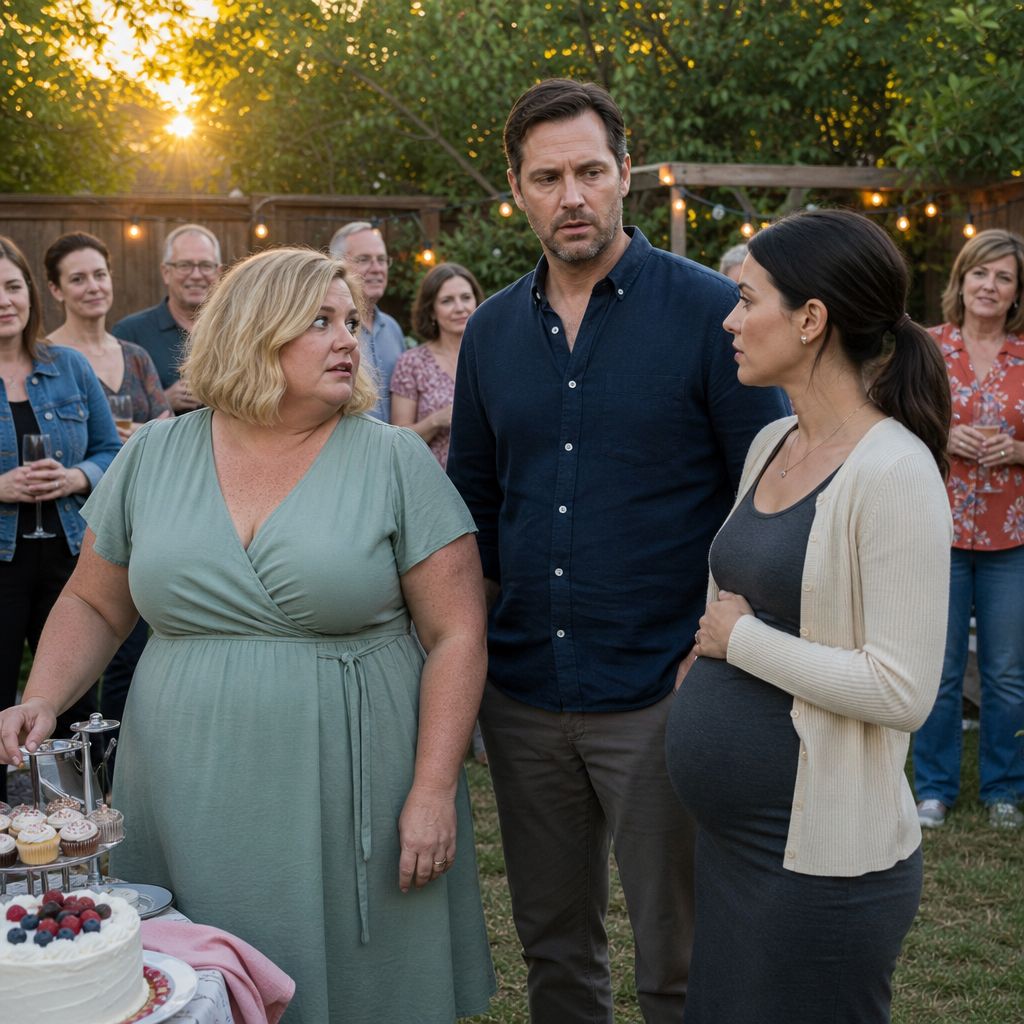
By the time the sun started sliding down, everyone was corralled into the backyard for what my sister called the “photo moment.” Someone had dragged the patio chairs into a sloppy semicircle, and the sky behind the trees was turning that syrupy orange that makes people sentimental.
I stood near the little table where the dessert sat under a plastic dome, my fingers digging into the edge so I didn’t float away. Caleb had insisted we do this outside. He’d insisted we wait. He’d insisted on control, control, control.
“Okay!” my sister called. “Everybody in! Nina and Caleb, center!”
Caleb’s hand found my lower back, guiding me forward like a prop. His palm was warm, familiar, and it made me want to scream.
That’s when I saw her—at the edge of the crowd, just beyond the string lights, not holding a drink, not laughing, not even pretending. A slim woman in her early 30s with glossy dark hair pulled into a low ponytail, wearing a cream cardigan over a fitted charcoal dress. She had her hand on her stomach like it was instinct, like she was protecting something that already mattered more than this party.
Her eyes weren’t on me. They were locked on Caleb with a look I recognized in my bones: expectation. The kind you have when someone promised you something and is late delivering it.
I followed her gaze to Caleb’s face.
He’d gone white. Not startled-white. Caught-white.
And as the crowd started counting down for the photo, he whispered, so low only I could hear, “Don’t.”
‘From The Foundation’
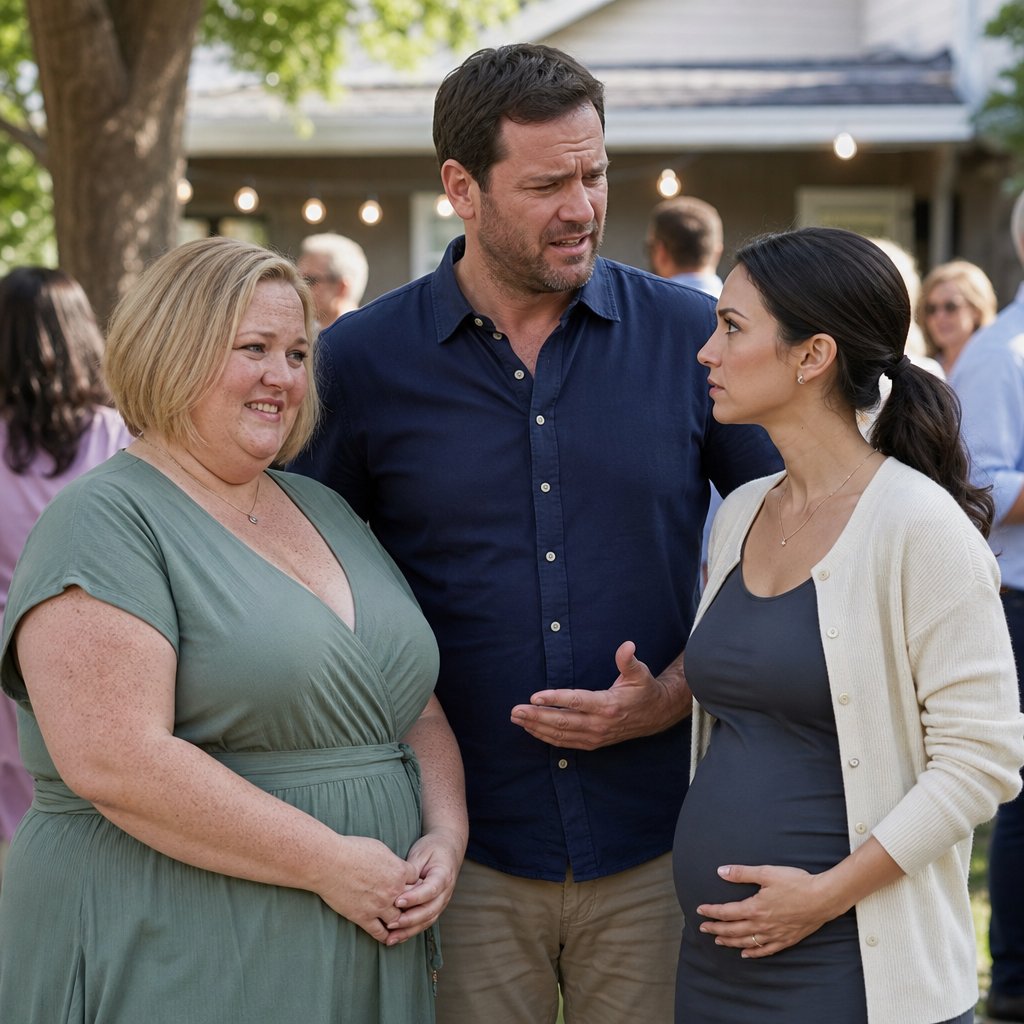
Caleb moved before I could. He slipped out of the semicircle like he was going to greet a donor, shoulders back, smile ready. Except it wasn’t a real smile—it was the one he wore at galas when he needed people to believe him.
I watched him approach the woman at the edge like my body had turned to concrete. The air felt too thick to breathe. Somewhere, someone’s kid was whining about a sparkler, and the normalcy of it made me feel insane.
He touched her elbow—too familiar, too practiced—and steered her a step closer to the group, like he was repositioning a piece on a board. Then he turned and waved me over with two fingers, the same gesture he used when dinner was ready.
I walked up because apparently I was still playing my role.
Up close, she was even prettier in that polished, expensive way. Her makeup was soft, her lips pressed tight, eyes glossy like she’d cried in the car. She smelled faintly like vanilla lotion, and her hand stayed on her stomach like it was a shield.
“Nina,” Caleb said, voice cracking on my name like it was an inconvenient word. “This is Maris. From the foundation.”
Maris’s gaze flicked over my face—my freckles, my forced smile, the way my hands hovered protectively near my own middle without me even realizing it. Something like pity flashed there, quick as lightning.
“Hi,” I managed.
“Hi,” she replied, and her voice had an edge, like she’d swallowed a scream and it was still scraping her throat.
Caleb kept talking too fast, filling the space with nonsense about committees and donors, like vocabulary could erase whatever was happening between them.
But I wasn’t listening. I was watching his throat bob as he swallowed. I was watching Maris’s fingers flex against her stomach. I was clocking, with a cold clarity, that Caleb wasn’t explaining.
He was performing.
And Maris looked like she was done watching the show.
She Came With Proof

Someone clinked a glass for attention, and I thought—stupidly—that maybe we’d pivot back to my moment. Maybe Caleb would finally put his hand on my belly and say the words out loud. Maybe the universe would give me one clean thing.
But Maris stepped forward before anyone could cue us.
She took a glass from a passing tray like she belonged here, like she’d been invited to every holiday and every family photo. Her fingers were steady. Her smile was not.
“Since we’re sharing news…” she said, voice carrying over the murmurs.
I felt Caleb’s hand clamp down on my back again, too hard, like a warning disguised as support.
Maris turned slightly so the whole semicircle could see her, the cream cardigan catching the last light. “I’m pregnant.”
The word hit the yard like a dropped plate. Silence first—then a ripple of shocked little sounds. My sister’s mouth fell open. My aunt’s eyebrows shot up so high they nearly disappeared into her hairline.
Caleb made a strangled noise, like his lungs forgot their job.
Maris reached into her purse and pulled out an ultrasound printout, already unfolded, already ready, like she’d rehearsed this in the mirror. She held it up—not toward me, not toward the crowd—toward Caleb.
And the look on her face said this wasn’t an announcement.
It was a detonation.
I stared at the black-and-white image in her hand, my own secret suddenly feeling like a joke someone told at my expense, and I heard Caleb whisper my name like it was a plea.
He Rewrote My Life
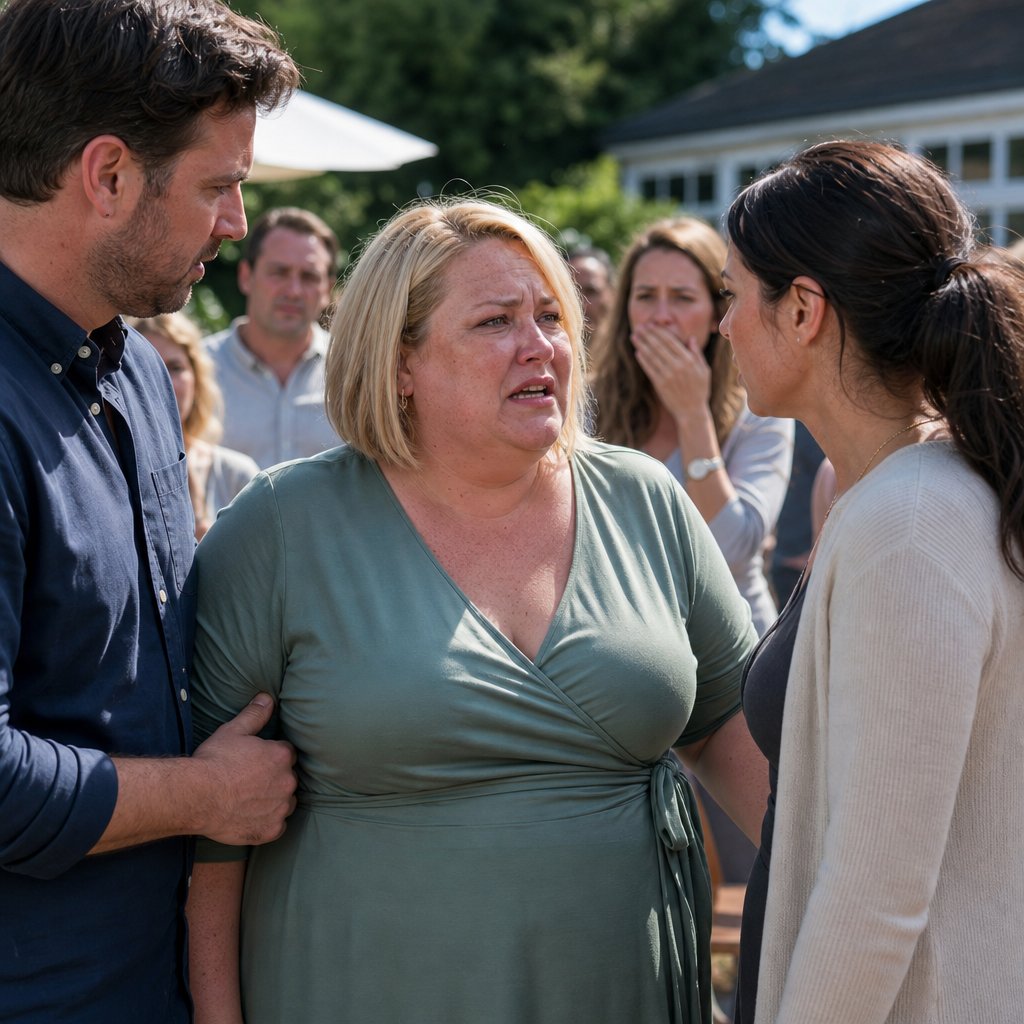
I thought I couldn’t feel smaller than I did in that moment, standing there with my party dress and my private joy and my husband’s hand pinning me in place. Then Maris looked straight at me.
Not at the crowd. Not at Caleb. At me—like she was choosing her target on purpose.
Her eyes were dark and wet, but her voice didn’t shake. “He told me you weren’t trying anymore,” she said.
I blinked, once, like I could clear the sentence away. It didn’t move.
Behind me, someone whispered, “Oh my God,” like it was a prayer and a curse at the same time. The grill popped in the distance, a little burst of heat and smoke, and it made me want to gag.
“He said you were… done,” Maris continued, words precise and cruel in their calm. “That you’d both agreed.” She gestured vaguely between Caleb and me, as if our marriage was a story she’d been told in bullet points.
My face burned so hot I thought my freckles might melt. I heard myself laugh—a thin, humiliating sound. “We’ve been trying for three years,” I said, and my voice cracked on the number. “I did the appointments. The shots. The stupid vitamins that made me smell like pennies.”
Caleb’s grip tightened, and he leaned toward my ear like he could still manage this. “Nina, please,” he whispered.
Maris didn’t look away from me. “He said you wanted the public image more than a baby,” she added, and that one sliced deep because it was tailored. It wasn’t random. It was something Caleb knew would hurt.
I turned my head slowly toward him. His eyes were glossy, not with remorse—with calculation, like he was already building the next lie.
And in that split second, I realized he hadn’t just cheated.
He’d been rewriting me to someone else.
Our Anniversary Was The Key
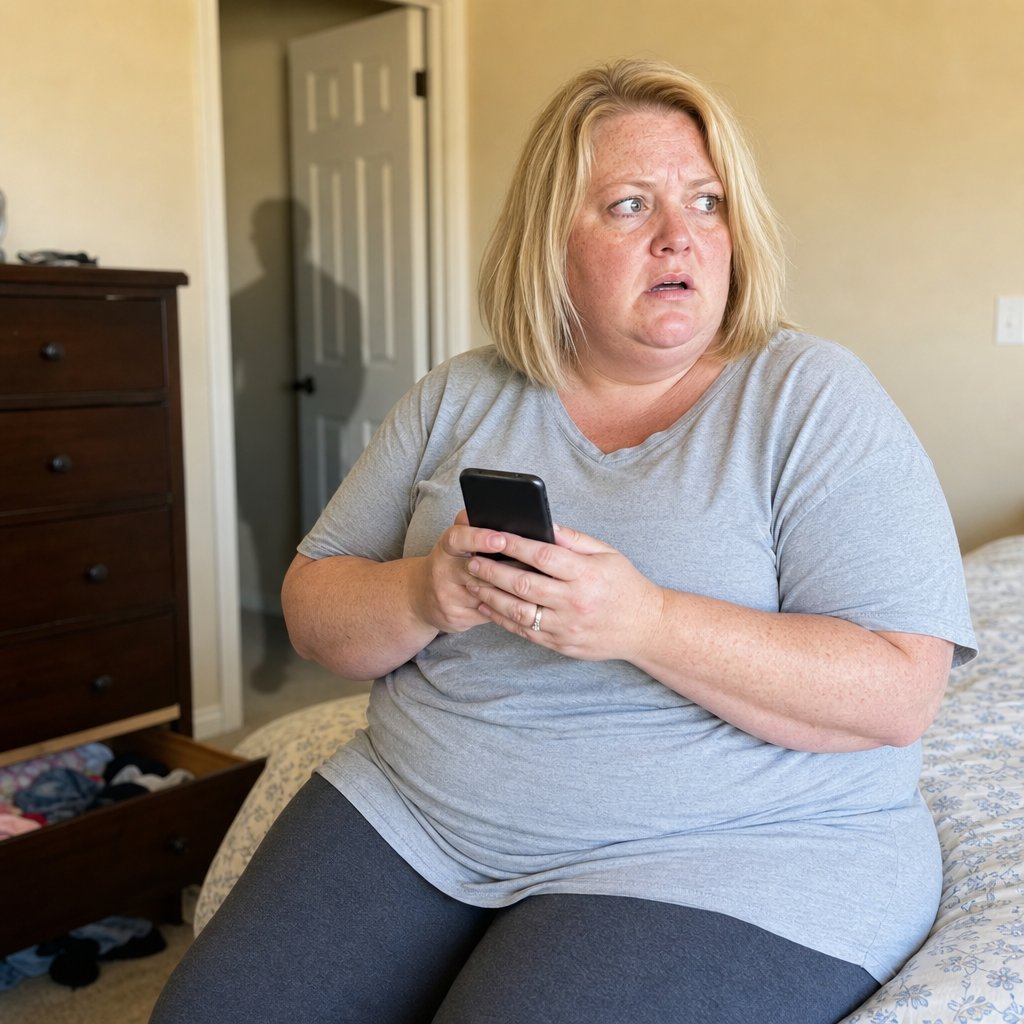
I don’t remember walking back inside. I remember the sound of my own breathing—too loud, too fast—and the way my hands felt numb, like they didn’t belong to me anymore.
Upstairs, the bedroom was dim and too tidy, like a showroom version of a marriage. Caleb’s dresser sat against the wall, the top arranged with the kind of careful minimalism he loved: a watch stand, a cologne bottle, nothing personal enough to be used against him.
I yanked open the top drawer so hard it rattled. Socks. Undershirts. A tie he never wore. I dug like I was searching for a pulse.
Second drawer—gym shorts, a neat stack of T-shirts. My fingers snagged on something slick and unfamiliar tucked beneath the fabric, shoved all the way to the back like a shameful thought.
I pulled it out.
The second phone.
My heart pounded so hard it made my vision swim. I held it in both hands, feeling the cold weight of it, and for a second I just stared at the blank face of it like it might blink first.
When it prompted for a passcode, my hands moved on instinct, almost on muscle memory. Not his birthday. Not a random number. I typed in our anniversary—month, day, year—the date etched inside my ring.
The phone unlocked immediately.
I made a sound that was half sob, half laugh, because of course it did. Of course he’d used our marriage as the lock on his lies.
Then I heard footsteps on the stairs—slow, deliberate—like someone who knew exactly what they were about to walk in on.
The Calendar Was A Script
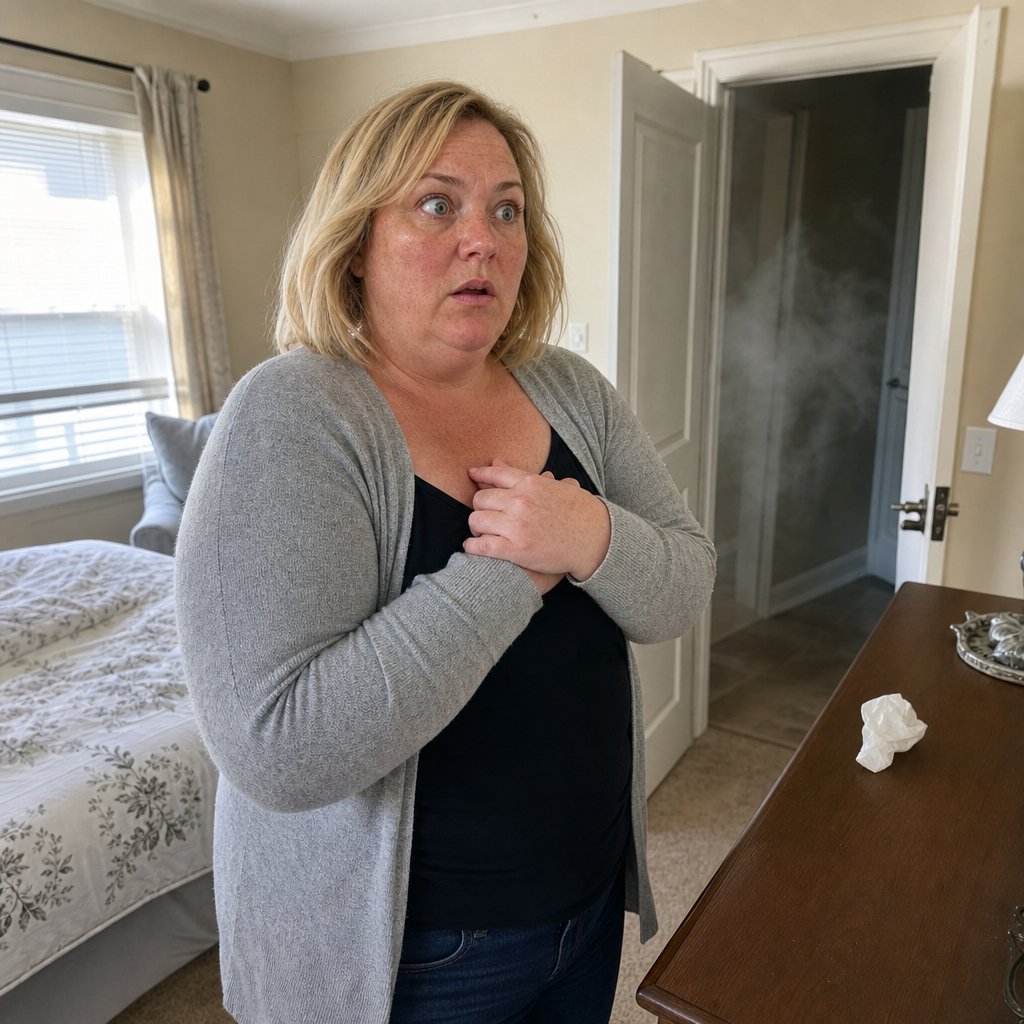
Footsteps hit the landing as I stood in the guest room with the second phone sweating in my palm, unlocked like it wanted to betray him. I froze, breath trapped behind my teeth, and listened for the doorknob—then the steps turned toward the bathroom. The shower clicked on. Steam hissed through the vent like a warning.
I moved fast, silent, thumb flicking through apps like I’d done it a thousand times. There it was: a calendar that wasn’t ours. Not dentist appointments and charity luncheons—logistics. Color-coded blocks with names that weren’t mine. “Maris—lunch (tell her board meeting ran late).” “Dani—drop-off (say Nina needed the car).” “Nina—party (be visible).” Visible. Like I was a prop he wheeled out when the lighting mattered.
My stomach pitched as I opened a message thread and saw the line that felt like someone pressing a thumb into a bruise: “Don’t worry, she thinks the baby is her idea.”
I stared at it until the words blurred, until my freckles felt hot, until my own heartbeat sounded like knocking. The shower kept running, steady and casual, while my entire marriage rewrote itself in my hands.
Then another notification slid down—no name, just an initial—and I watched the typing dots appear, like whoever it was already knew I was looking.
Someone was about to message back.
I Was In His Coverage
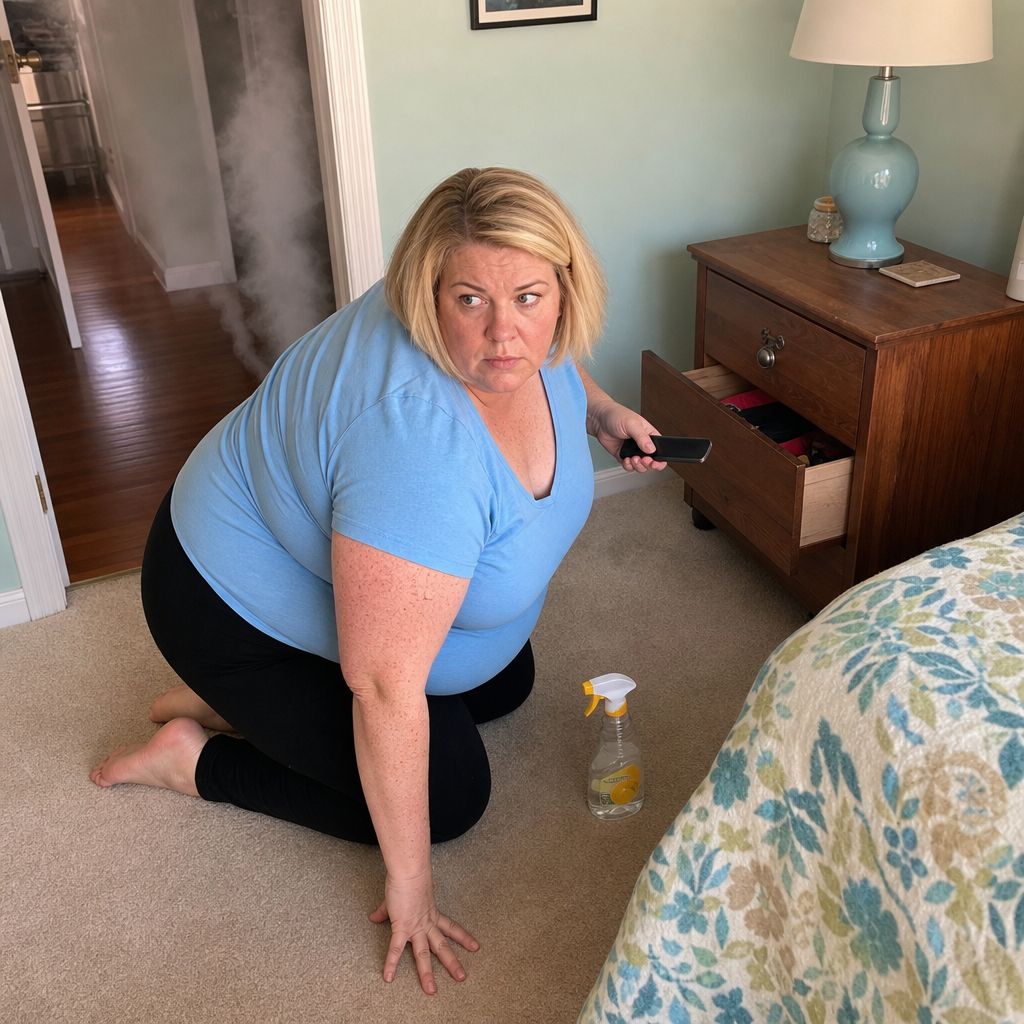
I clicked before I could talk myself out of it, like ripping off a bandage you know is going to take skin with it. Notes app. A folder named “Coverage.” My mouth actually went dry, the way it does right before you throw up.
Inside was a spreadsheet—clean, smug, organized. Columns labeled “Date,” “Excuse,” “Spend,” “Follow-Up.” And then the one that made my vision tunnel: “Nina’s story.” Like I was a headline he wrote and rewrote depending on who he needed to charm.
Rows of petty, surgical lies: “Feb 3 — ‘Emergency donor dinner’ — $312 — send Nina flowers” “Mar 18 — ‘Board retreat’ — $1,140 — tell Nina it’s for the mission” “Apr 9 — ‘Airport pickup’ — $68 — Nina’s story: ‘I insisted you go’”
I could smell the lemon cleaner on the guest room carpet and suddenly it was the scent of every time I’d apologized for him. Every time I’d smoothed his reputation with my own hands like I was polishing silver.
There were names in the margins—initials, shorthand—like a team. Like this wasn’t an affair. It was operations.
The shower cut off upstairs. Water stopped. Silence dropped like a guillotine. And right as I started to back out of the file, I saw a new tab at the bottom.
“Contingencies.”
The Photo He Forwarded
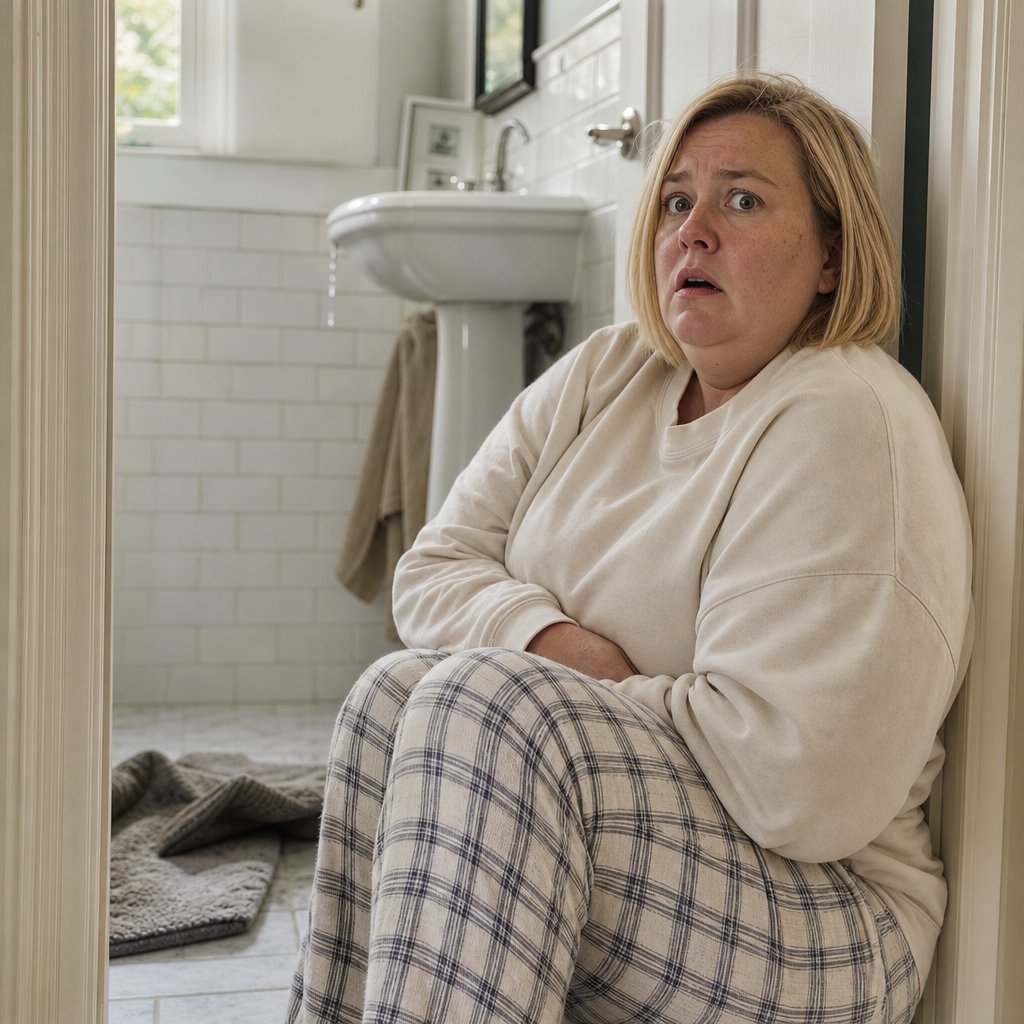
I hit “Contingencies” and the world narrowed to a single thread. A photo thumbnail loaded—my bathroom counter. My hand. My ring. And the pregnancy test I’d taken in secret before I’d even let myself hope.
I remembered that morning so clearly it hurt: me in an oversized sweatshirt, sitting on cold tile, staring at plastic like it could tell me whether my life was about to become real. I had taken the picture for myself. Not for him. Not for anyone.
Caleb had it anyway.
He’d forwarded it to someone saved as “M.” with a message that turned my insides to ice: “She’s late. This complicates everything.”
Not she might be pregnant. Not we need to talk. Late. Like I was a shipment. A deadline. A variable in a plan he’d already written.
My fingers shook so hard I almost dropped the phone. The air tasted metallic, like I’d bitten my tongue. I scrolled up—more messages, more check-ins, more little adjustments to my body and my choices, like he’d been monitoring me from inside the walls.
And then I saw it: a reply from M, time-stamped the day of our party.
“If she announces tonight, we’re done. Handle it.”
The floor felt like it tilted. Upstairs, a drawer slid open. Footsteps moved toward the stairs again—faster this time.
The Text I Shouldn’t Send
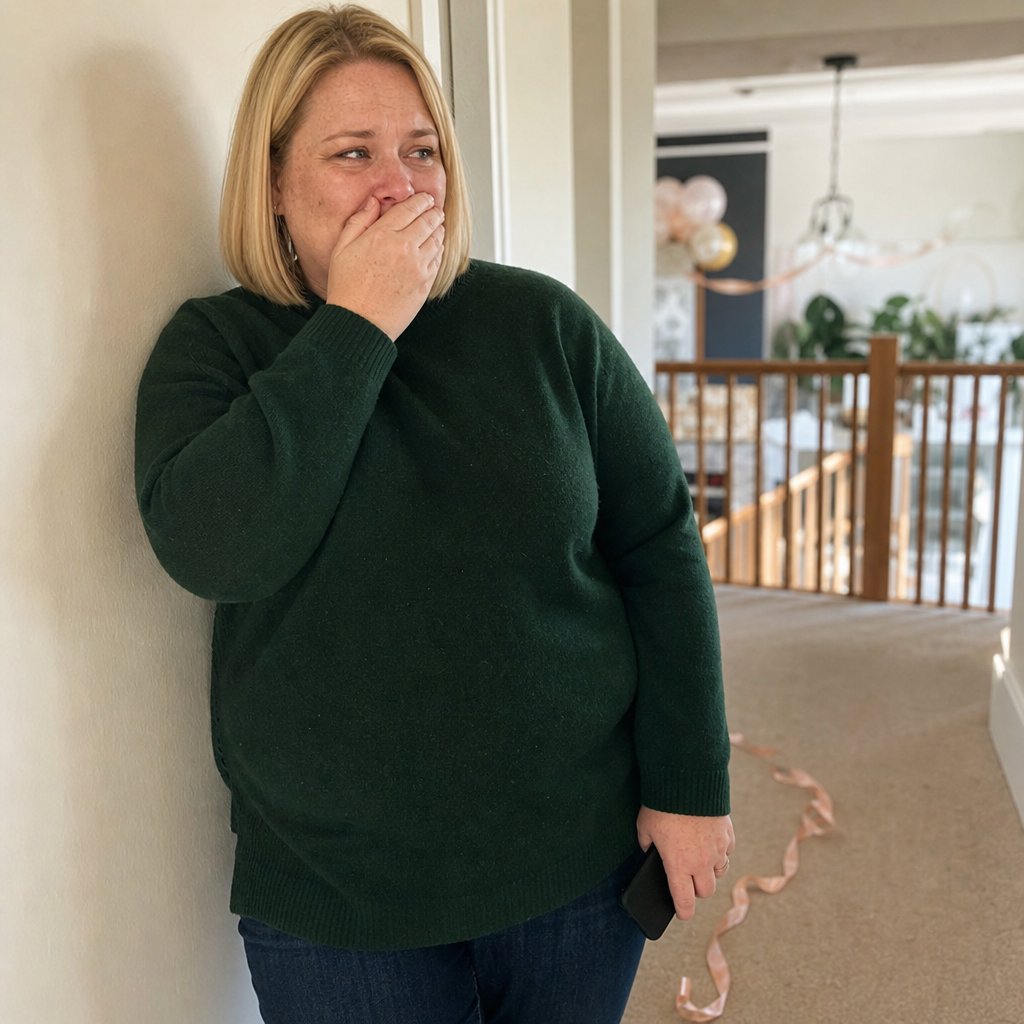
I didn’t even remember standing up. One second I was on the floor, the next I was in the hallway with my heart trying to escape my ribs. I needed air. I needed a witness. I needed someone to tell me I wasn’t insane.
Maris. Her name had been everywhere in his secret calendar like a stain he didn’t bother to scrub. I found her number from the thread and my thumbs moved on their own, furious and stupid-brave.
“How long have you known he was married?”
I hit send and immediately hated myself for giving her the power to answer. The house smelled like someone’s vanilla candle and it made me want to scream—sweetness trying to cover rot.
My phone buzzed so fast it felt like she’d been waiting with it in her hand.
“He said you were his ex,” she wrote. “And he pays your rent.”
I stared at that sentence until it stopped making language and became just cruelty. Ex. Rent. Like I was a leftover obligation he handled with checks and pity. Like the life I’d built—our mortgage, our photos, the stupid matching towels—was a story he told other women to make them feel safe.
My throat tightened around something ugly and hot. I typed back, then deleted it, then typed again. In the living room below, I heard laughter—my friends, my family—oblivious, clinking glasses.
And then Maris sent one more message.
“Are you at the party right now?”
The Third Phone Revelation
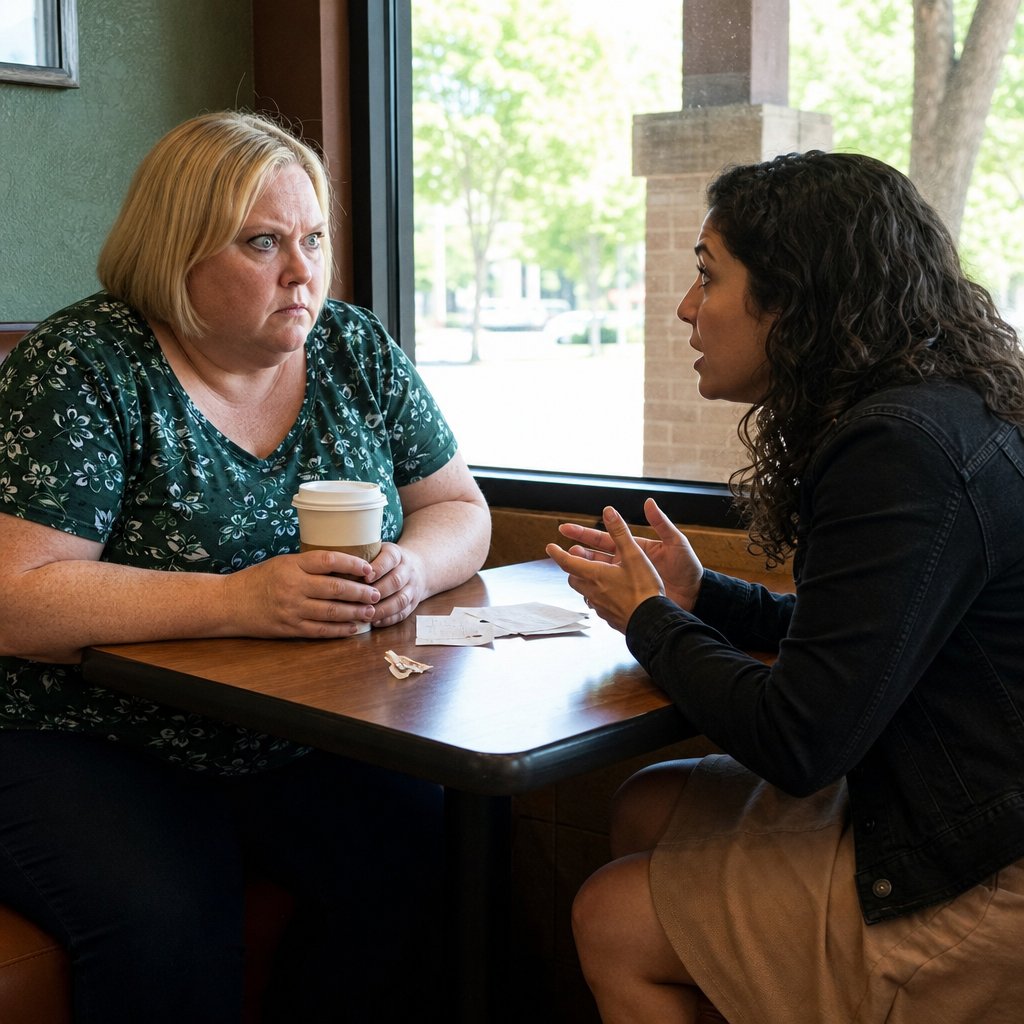
I met Maris the next morning like it was a drug deal and not two women comparing notes on the same man. A coffee shop off the highway, neutral territory, the kind with wobbly tables and a sticky sugar station. I wore a mustard-yellow blouse I’d bought for “good news” and suddenly it felt like a costume.
Maris walked in and my stomach dropped all over again. She was in her early 30s, olive-skinned with long dark curls and a sharp jaw that looked like it had learned to hold its ground. She didn’t smile. She didn’t pretend. She slid into the booth across from me like she’d been rehearsing this.
“He has a third phone,” she said, low and flat, like she was reading the weather. “Not the one you found. Another.”
My hands went cold around the paper cup. The coffee smelled burnt and bitter, fitting.
She pulled out printouts—actual paper, like she’d learned the hard way not to trust anything digital around him. Receipts I didn’t know to look for. Dates that matched his “board retreats.” A pattern that wasn’t an affair—it was a schedule.
Then she leaned in and said, “And there’s a group chat. His donors. Board members. They joke about ‘keeping the wives happy.’ Like it’s a budget line item.”
I felt my face heat with humiliation so sharp it turned into rage. “Who’s in it?” I asked.
Maris hesitated, eyes flicking to the window like she was checking for him.
“Someone you know,” she said.
The Storage Unit With Proof
It took three days of acting normal—smiling at Caleb, nodding through his fake concern, swallowing my own bile—to get what I needed. Bank statements. Transfers. Payments with no explanation. A monthly charge that didn’t belong to our life: a storage unit across town.
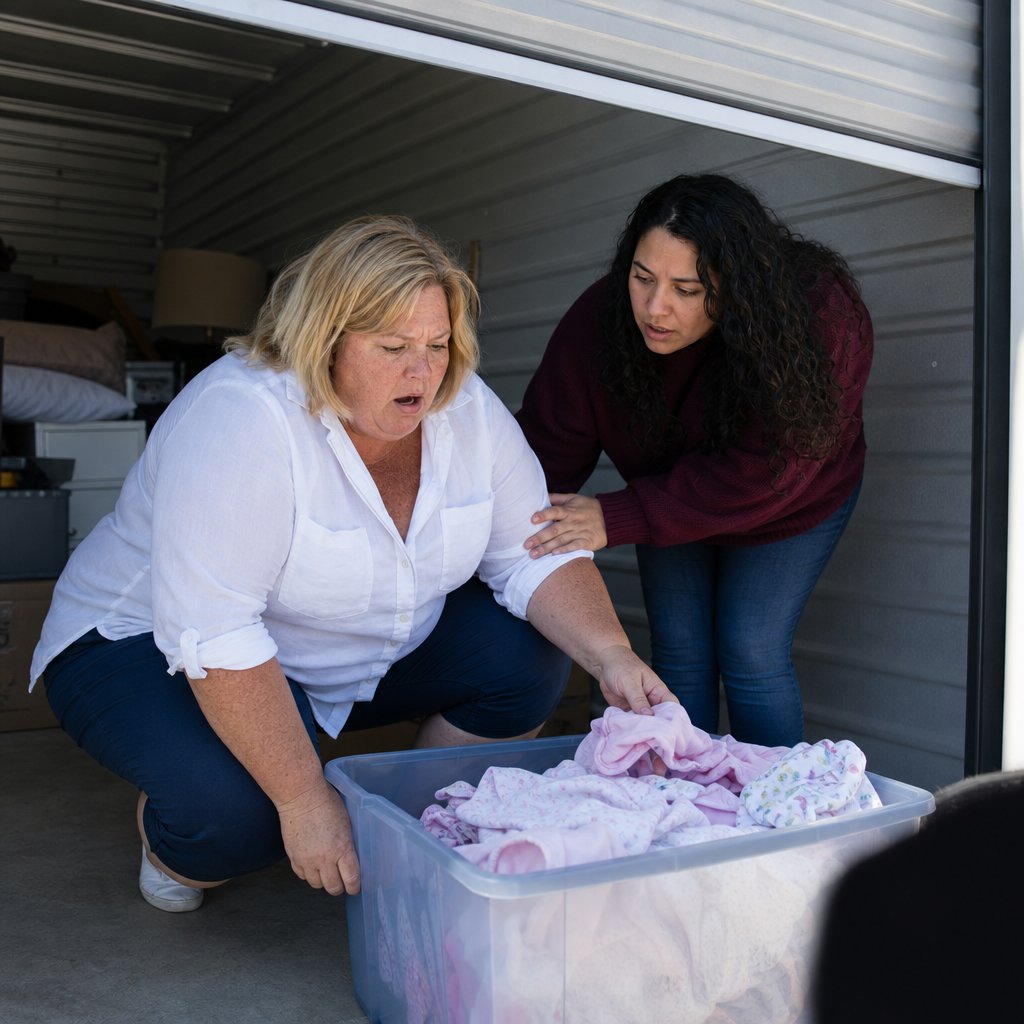
Maris came with me, because I couldn’t trust myself not to drive straight into a tree. The storage facility smelled like hot asphalt and dust. The manager didn’t look up when we signed in. Like secrets were the most common thing stored there.
The roll-up door screeched and my skin prickled. Inside: two sets of everything. Two folding chairs. Two mismatched mugs in a box. A men’s toiletry bag identical to Caleb’s—except newer. Like he’d built a duplicate life in bulk.
Then I saw a plastic tote with thick black marker on it. One word.
“Baby.”
My knees actually went weak. Maris steadied me by the elbow, her grip firm. I popped the lid and the smell of fabric softener puffed out—tiny onesies folded too neatly, pastel socks, a soft knit cap. Not ours. Not from our registry. Not from any conversation Caleb and I had ever had.
At the bottom was a note card in handwriting I didn’t recognize—loopier, younger.
“For when you finally choose us.”
Behind the tote, something shifted—like someone had just bumped the outer door.
She Thought I Was Family
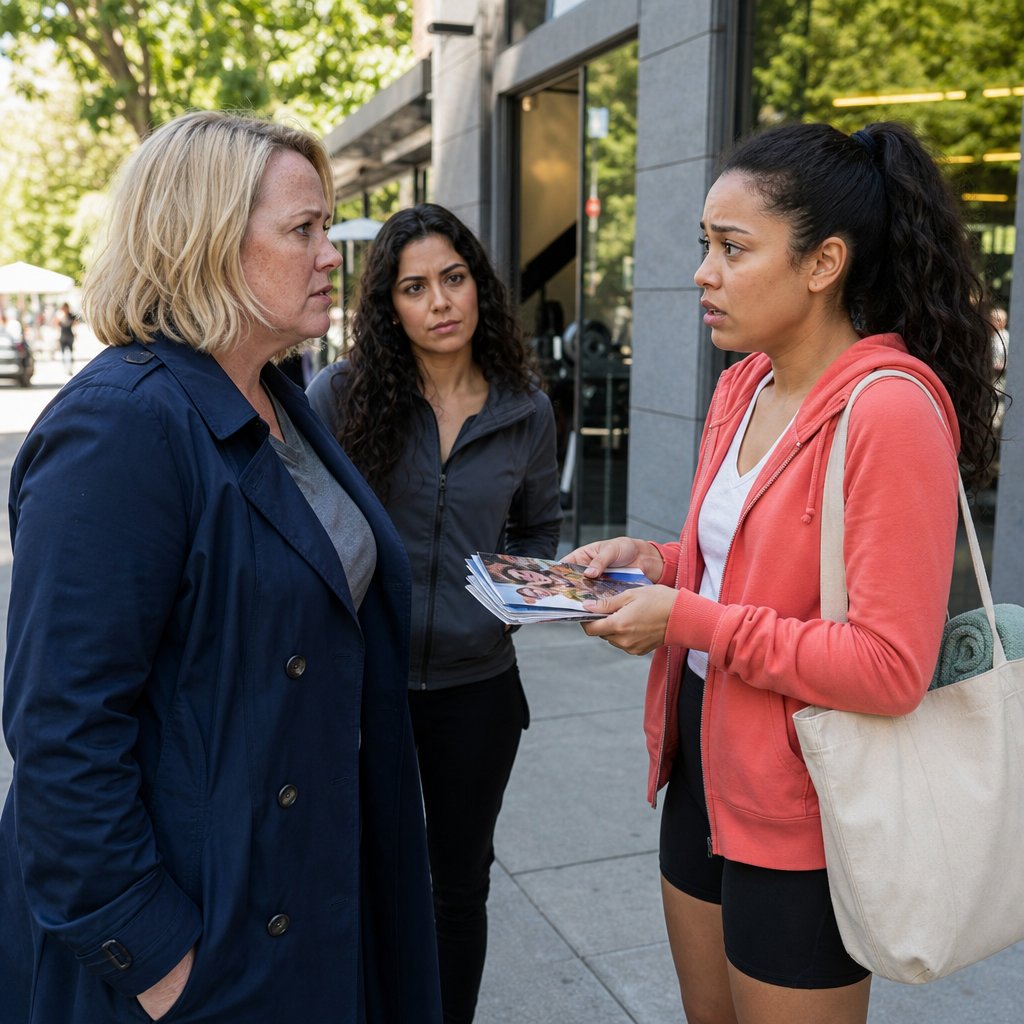
We found Dani because Maris knew the gym she posted from—one of those boutique places with eucalyptus towels and mirrors that make you look like you’re doing better than you are. I sat in my car outside, hands gripping the steering wheel until my knuckles went pale, watching women come and go like normal life wasn’t a cruel joke.
Dani walked out wearing a coral hoodie and black bike shorts, hair in a high ponytail, cheeks flushed from class. Mid-20s, light-brown skin, big brown eyes that went wary the second she saw us approach. She looked like someone who still believed people when they said “trust me.”
“Dani?” Maris said gently. “We need to talk about Caleb.”
Dani’s face tightened. “I’m not doing this,” she snapped, then glanced at me and faltered. “Wait… you’re Nina?”
My name in her mouth sounded wrong. Like she’d heard it in a different context. I nodded.
She swallowed, eyes darting between us. “He told me you were his sister,” she said, voice cracking on the last word. “He said you were… sick. That he helped you out.”
I felt something inside me go cold and clean. Sister. Sick. Helped out. He’d made me into a sympathy story for a girl half my age.
Dani dug into her tote bag with shaking hands and pulled out glossy photos—him in a different apartment, his arm slung around her shoulders like he belonged there. On the table in one shot, a baby book already open.
She pointed with a trembling finger. “He started it. For ‘Baby C.’”
My breath hitched as she reached for one last photo and said, “And there’s something else you need to see—”
Cheating Turned Into Fraud
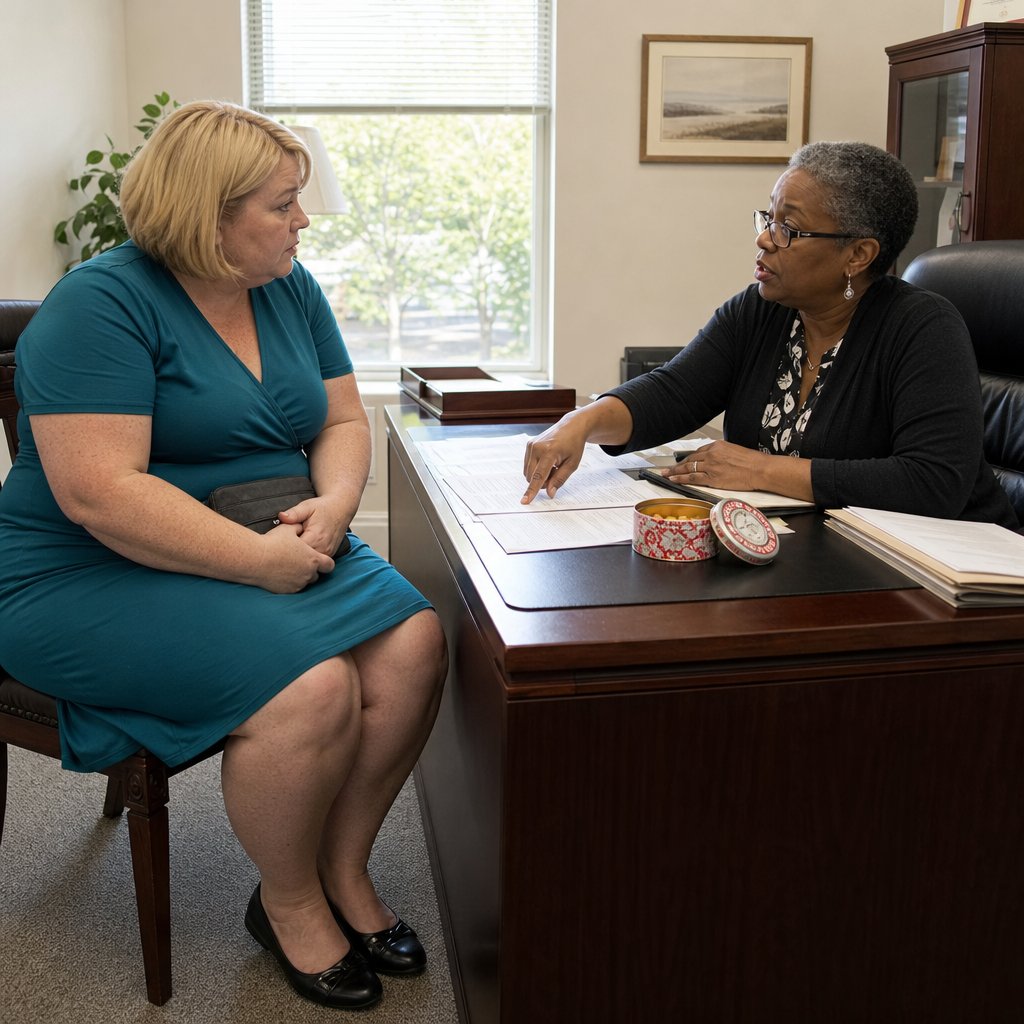
My attorney’s office smelled like old paper and peppermint tea, the kind of calm people pay for when their lives are on fire. I sat across from her—Janice, late 50s, Black woman with close-cropped gray hair and glasses that made her look like she could see straight through lies—and I slid the stack of evidence onto her desk like it weighed a hundred pounds.
Hotel charges. Dates. “Board retreat” weekends that weren’t retreats. Storage unit payments. Receipts Maris had collected like breadcrumbs.
Janice didn’t gasp. She didn’t flinch. She just started making connections out loud, her voice getting colder with every sentence. “These hotel stays line up with nonprofit invoices,” she said, tapping with a pen. “See this? ‘Donor lodging.’ The amounts match. The dates match. The locations match.”
I felt my blood roar in my ears. “He billed his cheating to the charity?” I asked, and my voice sounded like someone else’s.
Janice looked up, eyes sharp. “It’s more than that. If he submitted false expense reports, if board members approved them, if donors were misled—this isn’t just marital misconduct. This is fraud.”
The word landed like a brick through glass. Fraud meant subpoenas. Fraud meant headlines. Fraud meant every smug handshake he’d ever given at a gala turning into a screenshot people passed around.
Janice leaned forward. “You need to decide what you want,” she said. “Quiet divorce, or accountability.”
My phone vibrated in my purse like it was possessed. I pulled it out and saw Caleb’s name lighting up the caller ID. Of course. Like he could sense the air shifting.
Janice held my gaze. “Do not answer,” she mouthed.
But the call went to voicemail—and immediately my phone buzzed again with a second incoming call from a number I didn’t recognize.
The Applause That Died
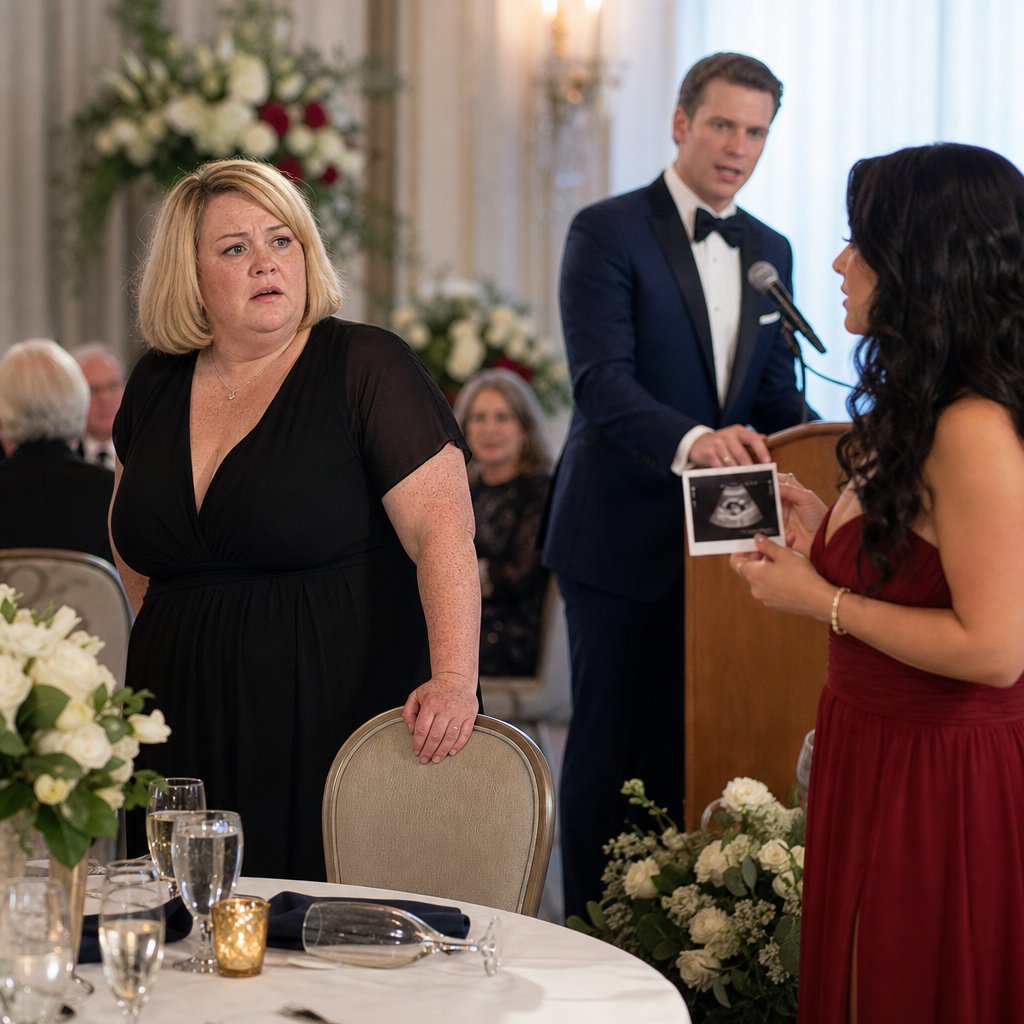
The gala was all crystal and forced smiles, the kind of night where people hugged you with their fingertips and called it warmth. I wore a black dress that pinched under my arms and lipstick that made me look steadier than I felt. My hair was curled, my freckles powdered over, my face arranged into something presentable for the cameras that would never show what was rotting underneath.
Caleb stood at the podium like he’d been carved for it—tall, clean-cut, navy tux, that familiar philanthropic shine in his eyes. He thanked donors. He thanked the board. He told a story about “community” that used to make me proud and now made me nauseous.
Then he looked right at me, smile widening as if he were about to crown me in front of everyone.
“And of course,” he said, voice booming, “my beautiful wife, Nina, who’s expecting—”
The applause hit like a wave. People turned toward me with delighted faces, hands clapping, mouths forming congratulations I couldn’t hear over the blood pounding in my ears. I stood because my body remembered the role even when my soul refused it.
For one split second, I thought maybe he was going to steal my announcement and twist it into his redemption. Maybe he was going to use my pregnancy like a shield.
And then the clapping faltered, just slightly, as a chair scraped behind me.
In the thin silence right after the applause, Maris stood up. She was in a deep red dress, shoulders squared, face pale but determined. In her hand, she held an ultrasound photo—raised high enough for the nearest tables to see.
Caleb’s smile froze mid-breath. My stomach dropped through the floor as Maris opened her mouth to speak.
Should Maris have revealed the pregnancy at the party?