



The Lockbox Behind Winter Coats
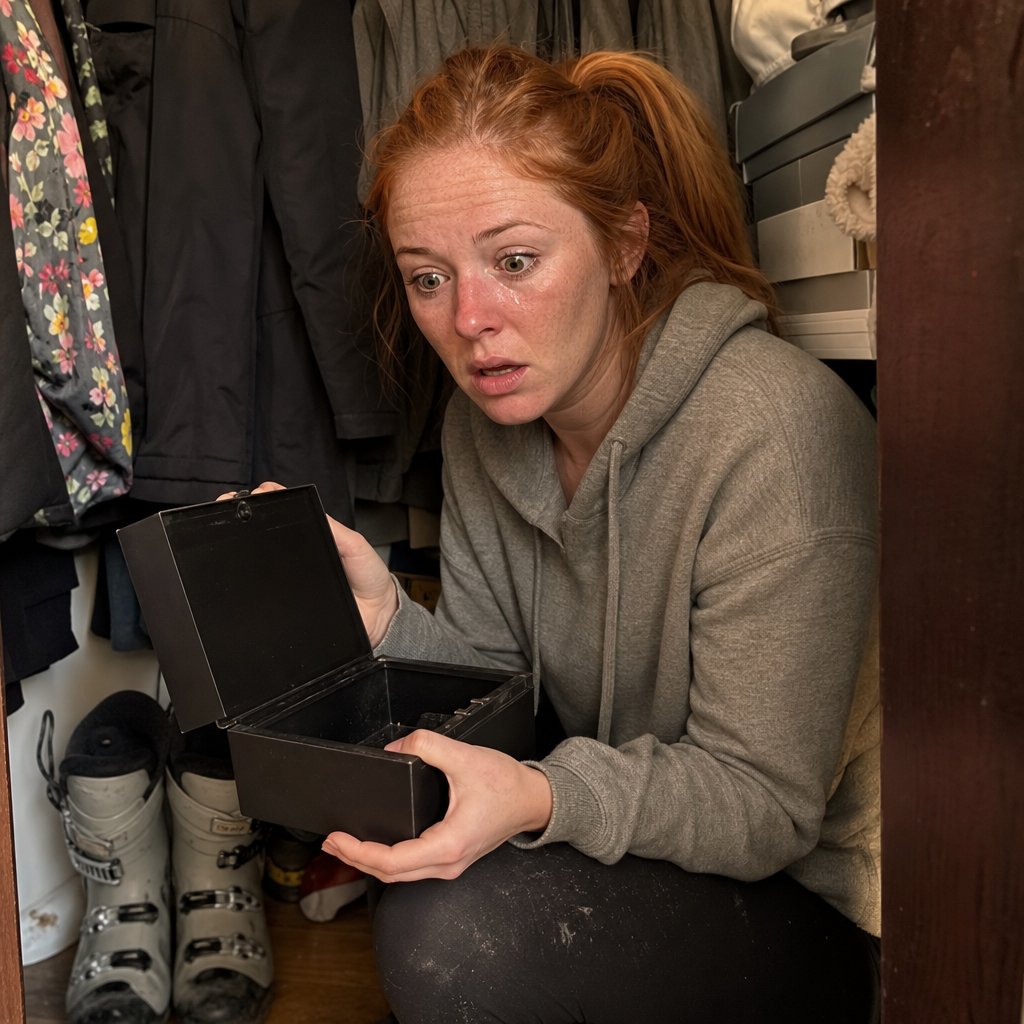
I was on my knees in the back closet with dust in my throat and a sweater sleeve stuck to my palm when my fingers hit something hard behind the shoeboxes. Not plastic. Not cardboard. Metal.
I dragged it out like it might bite me. A small lockbox—matte black, scuffed at the corners—wedged behind Mark’s old ski boots like it belonged there. Like it had always belonged there. My stomach did that slow drop, the one that starts behind your ribs and ends somewhere cold.
The latch wasn’t even locked. That was the part that felt personal, like whoever hid it didn’t think I’d ever look. I flipped it open and the smell hit me first—paper and that faint chemical tang of toner.
Inside were copies of my signature. My signature. On forms I had never seen in my life. Clean lines, perfect loops, on crisp pages that looked official in a way that made my skin prickle. And on top, a single sheet of notebook paper with a title written in heavy pen: “Talking Points.”
I read the first bullet and my face went hot, because it wasn’t about finances or paperwork—it was about me, like I was a problem to be managed. The closet suddenly felt too small, the coats pressing in, and I heard Mark’s footsteps in the hallway slow like he’d stopped to listen—
The Screenshot She Shouldn’t Send
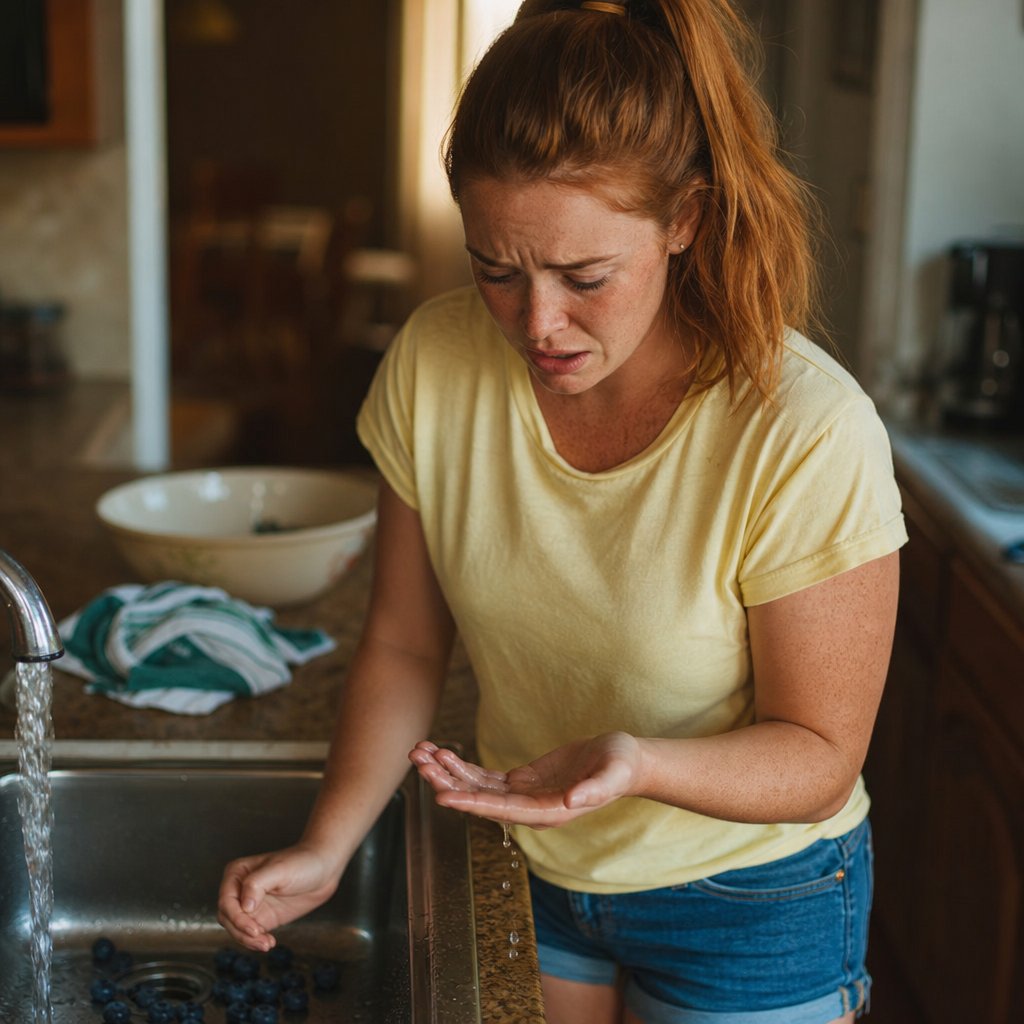
Hours earlier, my phone buzzed while I was rinsing blueberries in the sink, cold water numbing my fingertips. Jenna’s name popped up, and I smiled automatically—because that’s what you do when you still think people like you.
Then the image loaded, and the smile slid right off my face.
It was a screenshot from a group chat. Not our usual family thread with birthday reminders and dog photos. This one had a name stamped across the top that felt like a slap: “Real Family Only.”
And there I was—except I wasn’t in it. I was the entertainment.
Jenna had circled something in neon markup like she was being cute, like she was sharing a harmless joke. Mark’s mom, Diane—blonde bob, pearls even on a Tuesday—had written something about “handling her moods” with a little laughing emoji. Mark’s brother, Nate (tall, shaved head, always smirking like he knew better than you), replied with a line about keeping me “distracted” so I wouldn’t “spiral.”
My name wasn’t typed, but it didn’t need to be. The wording was too specific—my habits, my reactions, the way I like the towels folded. Tiny details only people inside my house would know.
My hands shook so hard I dropped a blueberry into the drain. I stared at the screenshot until my eyes burned, and then another message from Jenna came through—three little bubbles, like she was typing fast, like she’d realized what she’d done—
Sunday Dinner Felt Rehearsed
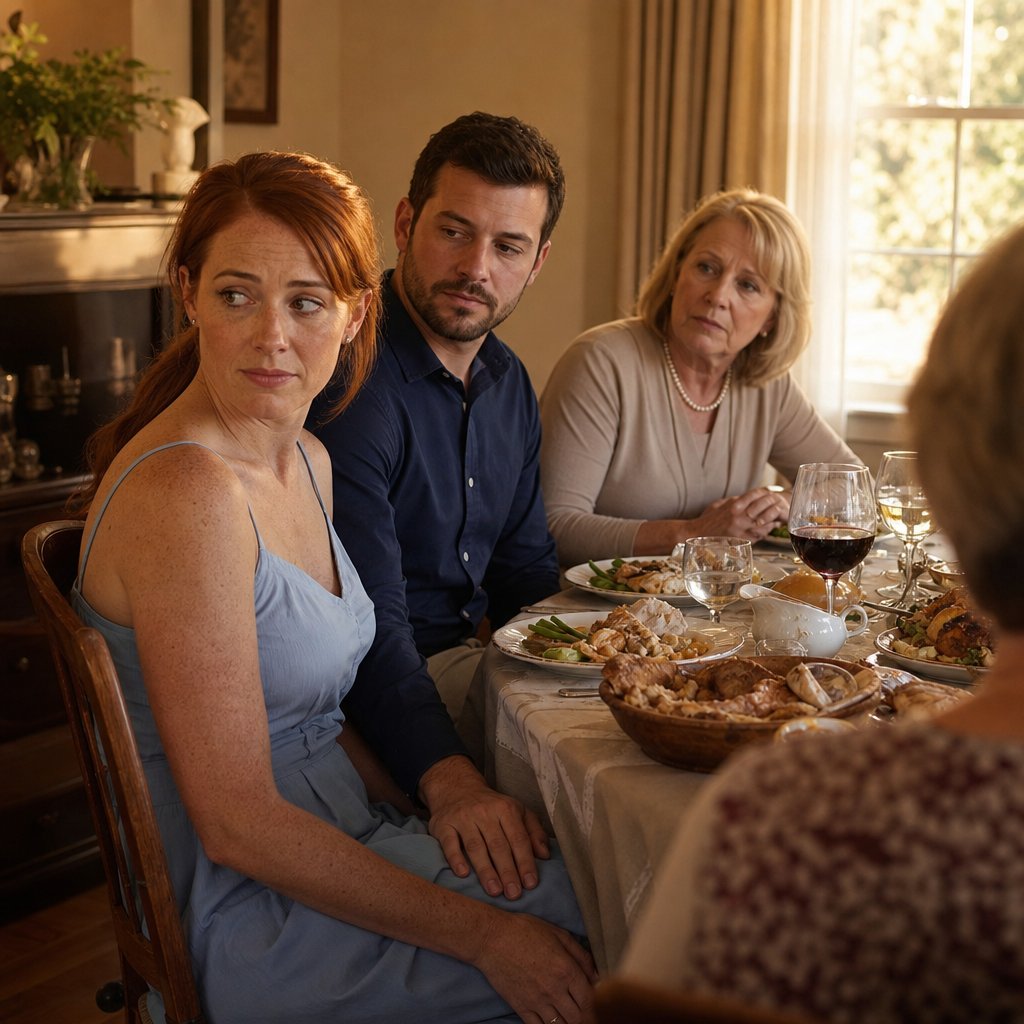
By Sunday dinner, they were all acting like they’d attended a seminar on How To Be Nice To Her Without Meaning It.
Diane greeted me with this bright, overdone smile and a hand on my forearm that lingered a second too long, like she was checking my temperature. Nate offered to take my coat—Nate, who usually couldn’t be bothered to stand up. Jenna complimented my hair like she’d never seen it before. Even Mark’s dad, Ron (gray mustache, heavy hands, quiet), laughed at my joke a beat too late, like he’d been cued.
Mark sat beside me with his phone face-down on the table, unnaturally still. No buzzing. No checking. No “sorry, work.” Just his palm hovering near it like a guard dog.
I watched their eyes, the tiny glances that flicked to Mark before they answered me, like they were following a script. When I mentioned we might refinance next year, Diane’s fork paused mid-air. Jenna’s wine glass stopped halfway to her mouth. Then they recovered—too smooth, too synchronized.
“Whatever you think is best,” Diane said, sugary-sweet. “We just want you to feel… supported.”
Supported. The word landed heavy, like a blanket thrown over a cage.
The roast smelled like rosemary and something burnt at the edges, and I could suddenly taste how controlled everything was. Mark squeezed my knee under the table—harder than affectionate—and leaned close enough that his breath warmed my ear.
“Let’s not get into money talk tonight,” he murmured, smiling at everyone like nothing was wrong, while his fingers dug in like a warning—
The Receipt In His Jeans
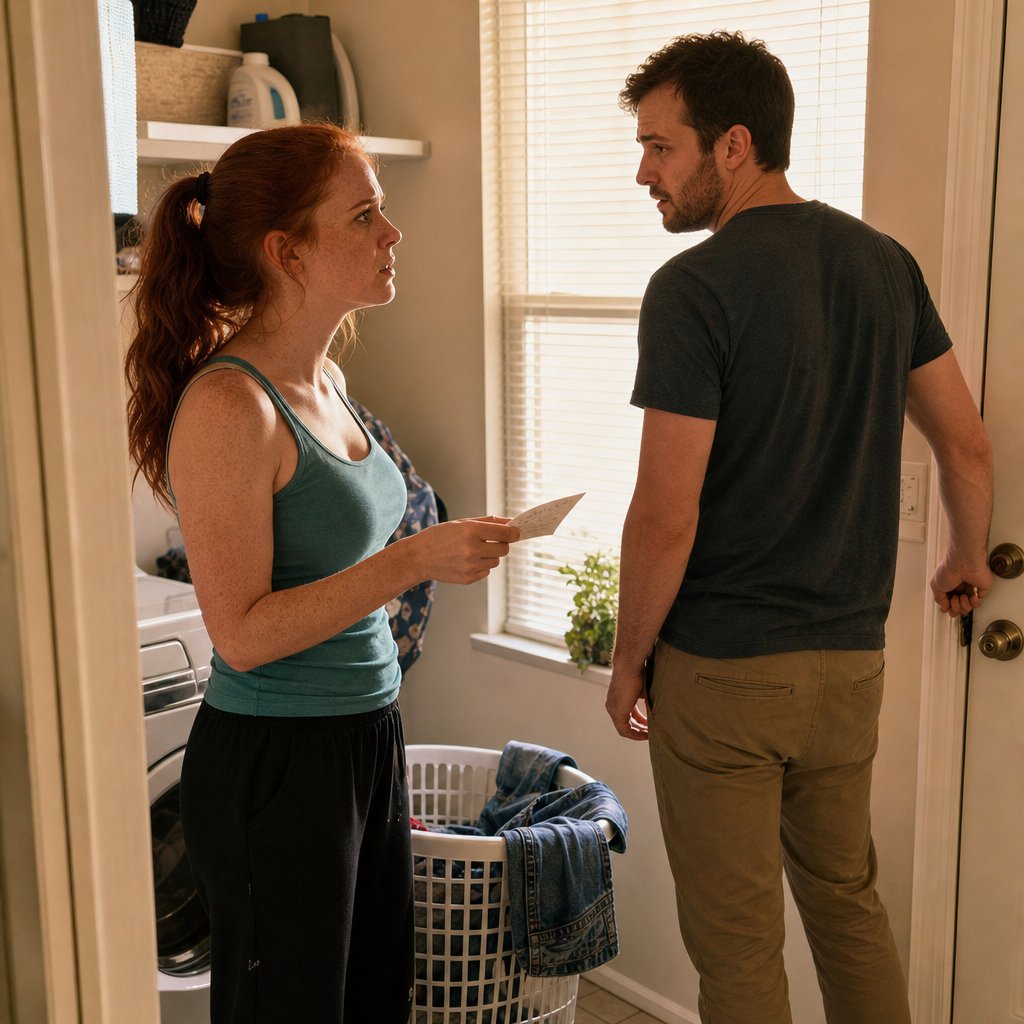
I found it the way you find the worst things—by doing something boring and loving, like laundry.
Mark’s jeans were inside-out, heavy with that stale cologne-and-gym smell, and when I shook them before tossing them in the washer, a folded slip of paper fluttered onto the tile. It didn’t float like a grocery receipt. It dropped like it had weight.
I picked it up and my fingers went cold. Storage unit. Monthly payment. Paid in cash. The kind of place you rent when you want something out of your home and out of sight.
My heart thudded so loud I swear it filled the laundry room. We didn’t need storage. We’d argued about clutter for years—Mark always insisting we “keep it minimal.” And yet here it was, proof of an entire secret space he hadn’t mentioned once.
When he walked in, I didn’t even try to be casual. I held the receipt between two fingers like it was contaminated.
“What is this?” My voice sounded steadier than I felt.
Mark’s eyes flicked down, then up, then he smiled—too fast, too practiced. “Oh. That. It’s for work.”
“For work,” I repeated, because sometimes repeating a lie out loud makes it crack.
He crossed the room and plucked it from my hand like he had every right. “Don’t worry about it,” he said, already turning away, already shutting me out. Then, like an afterthought, he added, “Why are you going through my pockets anyway?”
That petty little accusation—like I was the one being shady—hit me harder than the receipt. I watched him tuck the paper into his wallet with careful fingers, like it mattered not to lose it, and he headed for the door.
“Mark,” I called, because my chest felt too tight for anything else, “where is it?”
He paused with his hand on the doorknob and didn’t turn around—
The New Key On His Ring
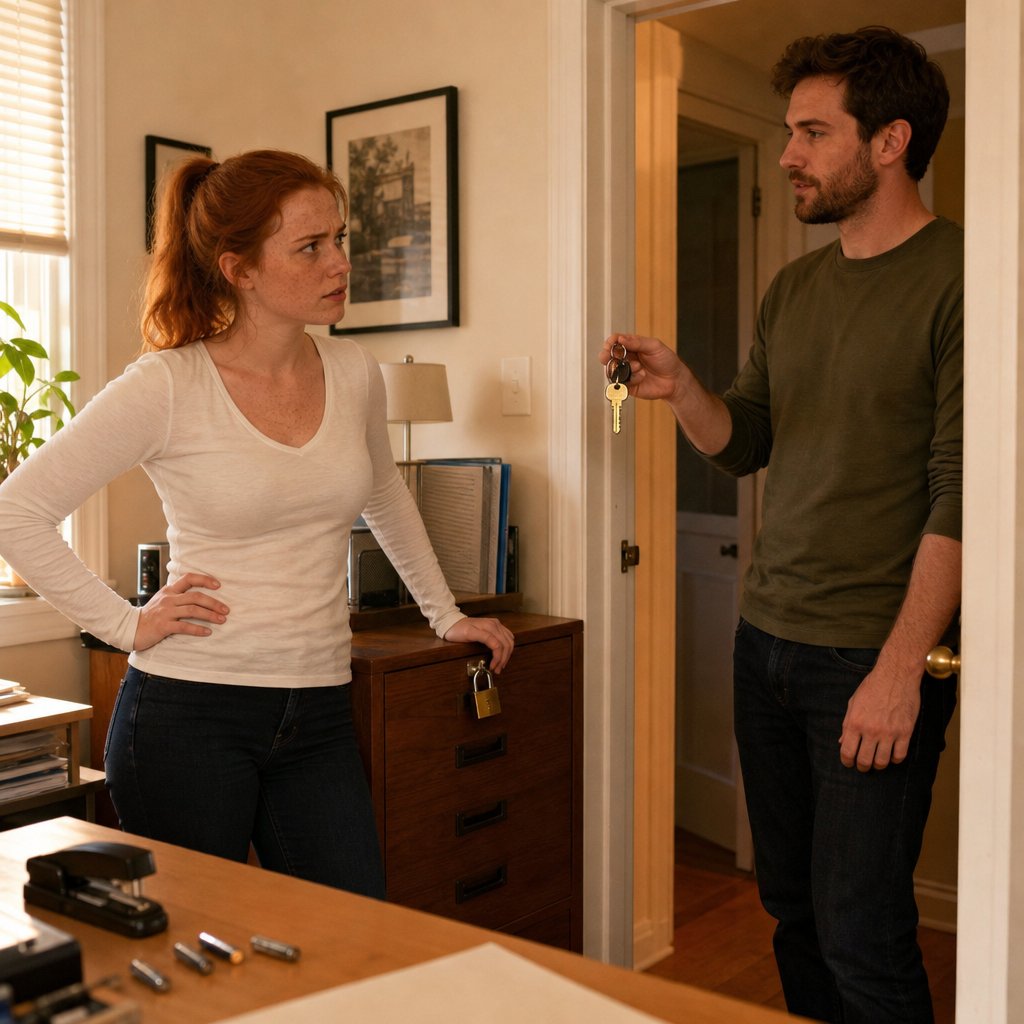
The office drawer had never been a thing. It was where we shoved old manuals, random batteries, a stapler that jammed every time. The kind of drawer you forget exists until you need tape.
So when I heard the soft metallic jingle of keys and saw Mark slide one into that drawer like it was Fort Knox, my stomach tightened.
I waited until he stepped away, then walked in like I belonged there—because I did. I reached for the drawer and pulled.
It didn’t budge.
I tugged again, harder, and the wood creaked in protest. Locked. Since when was it locked?
Mark appeared in the doorway with that too-calm face he used when he wanted to end a conversation before it started. “What are you doing?”
“Since when is this locked?” I asked, and I hated how my voice rose on the last word like it was begging.
He held up his key ring and there it was—an unfamiliar little brass key, shiny like it was new. “I just organized some stuff,” he said. “Important stuff. It’s easier if it’s… secure.”
Secure. Like I was a threat.
I walked to the ceramic dish by the entryway where we kept the spare keys—our whole life in a little pile of metal—and the office key that always lived there was gone. Not misplaced. Gone-gone. The empty spot felt like a missing tooth.
“Where’s the spare?” I asked.
Mark shrugged without shrugging, shoulders barely moving. “You probably moved it.”
The casualness of it made my ears ring. Evidence being moved, keys being swapped, and somehow it was already my fault. I stared at the locked drawer and imagined papers sliding into place, signatures copied, stories rehearsed.
Then Mark stepped closer, lowering his voice like he was being kind. “Babe,” he said, “don’t make this into a thing.”
And behind him, in the hallway mirror, I caught my own reflection—freckles stark, mouth parted—and realized I didn’t recognize the life I was standing in—
The Spare Key Vanished—Then Returned
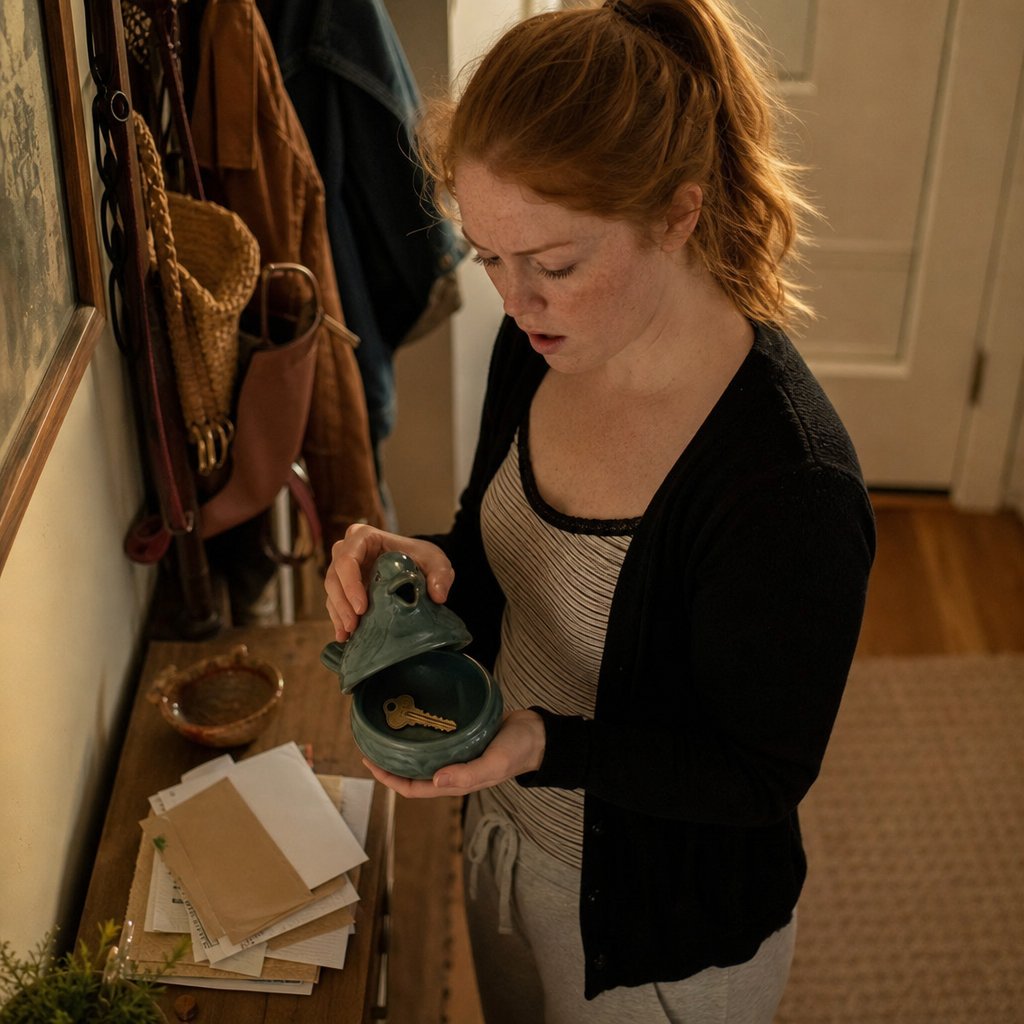
The ceramic bird on our entryway table was stupidly cute. A little teal thing with a hollow back where we tossed the spare key, the “in case of emergencies” key we’d joked was really for when one of us forgot our wallet.
Monday morning, I lifted the bird’s lid and my fingers hit air.
No key.
I stared into that empty hollow like it was going to explain itself. I checked the table. Under the mail. Under the bird. In the junk drawer. In my purse. I even looked in the freezer, because panic makes you do weird things. The emptiness sat in my chest like a stone.
When Mark came downstairs, tying his shoes like he had all the time in the world, I said, “Did you move the spare key?”
He didn’t even look up. “No.”
“It’s not in the bird.”
He sighed—like I was asking him to solve world hunger. “Maybe you used it and forgot. You’ve been stressed.”
Stressed. There it was again: the little label they could slap on me whenever reality got inconvenient.
All day, every time I walked past that bird, I felt my pulse spike. I took a picture of the empty space in my head, like I needed proof for myself. I told myself I wasn’t crazy. I told myself keys don’t grow legs.
That night, after Mark showered, I walked by the entryway and the bird’s lid was slightly askew, like someone had touched it.
I opened it.
The spare key sat inside, perfectly placed, gleaming like it had never left.
I didn’t feel relief. I felt hunted. Like someone was testing how easily they could rewrite my memory.
Upstairs, the shower shut off. Footsteps started down the hall. I stood there with the bird in my hands, my mouth dry, and I realized I had to decide: confront him, or start keeping my own secrets—
The Phrase That Gave Them Away
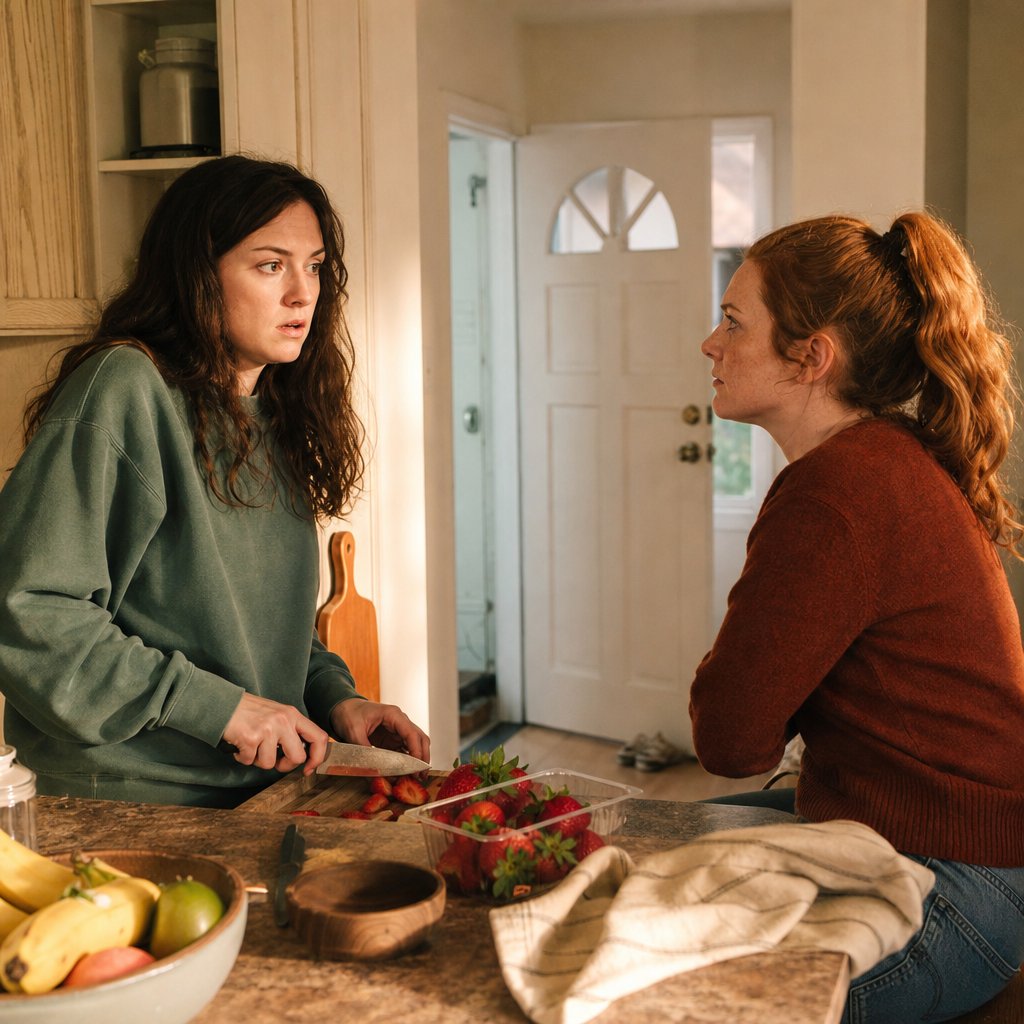
Jenna said it like it was nothing—like she was commenting on the weather.
We were in her kitchen, and she was chopping strawberries too aggressively, the knife thudding against the cutting board in a steady, annoyed rhythm. I was perched on a stool, pretending I wasn’t cataloging every word she’d said to me for the last week.
“I just think,” she began, tilting her head with that fake-concern face, “with your… spending habits, it might be good if Mark takes the lead for a while.”
Spending habits.
The exact phrase from the screenshot. Not “you’ve been buying a lot lately.” Not “maybe cut back.” The same neat little label, like it had been handed to her on an index card. My skin went prickly, and the room felt suddenly too bright.
I set my glass down carefully because my hand was shaking. “That’s an interesting way to put it,” I said, forcing my voice to stay calm. “Where’d you hear that phrase?”
Jenna’s knife paused mid-slice. For half a second, her eyes darted—not to me, but toward the hallway, like she expected someone to swoop in and save her.
“What phrase?” she asked, too quick.
I smiled, and it felt like showing teeth. “Spending habits. You said it exactly like Diane did. Exactly like the chat did.”
The color drained from Jenna’s face so fast it was almost satisfying. She swallowed, her throat bobbing, and she gave a little laugh that sounded like a cough.
“You saw that?” she whispered.
There it was. Not denial. Not outrage. Confirmation.
I leaned forward. “How long have you all been talking about me like I’m a case study?”
Jenna’s eyes got glossy, and she shook her head like she was trying to clear it. “It’s not—” she started, and then her front door opened with a sharp click, and footsteps came in like they owned the place—
His ‘Help’ With Autopay
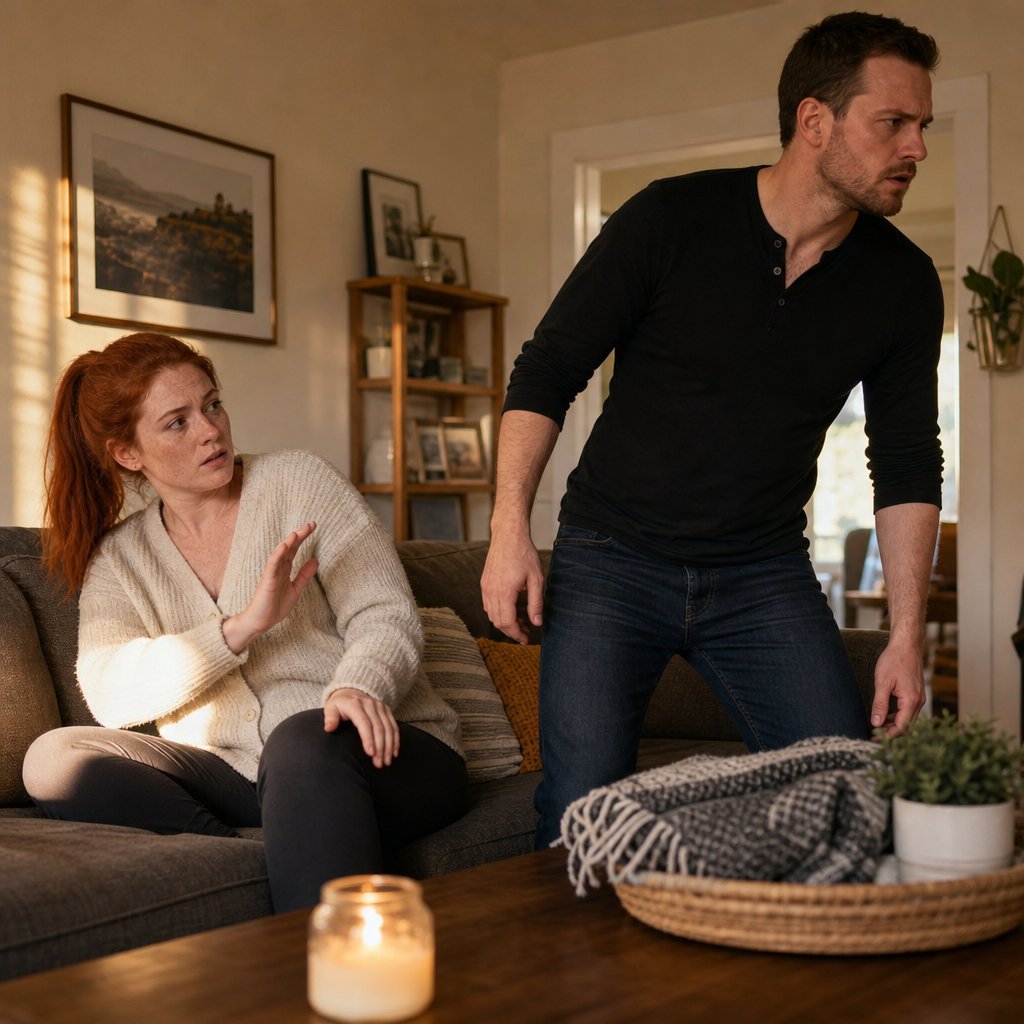
Mark brought it up like he was offering to carry my groceries.
We were in the living room, and he’d lit a candle that smelled like cedar and false peace. He sat close—too close—his knee touching mine, his voice soft in that careful way he used when he wanted me to feel unreasonable before I even spoke.
“I’ve been thinking,” he said, “we should simplify. I can handle the mortgage autopay. Just take it off your plate.”
I stared at him. “Off my plate,” I repeated, because he’d said it like my responsibilities were dishes he could wash. Like our house wasn’t also my name, my credit, my future.
He nodded, eyes warm, hands open. “You’ve had a lot going on. And it’ll stop you from stressing about numbers.”
There it was again: stress. My new personality trait, according to them.
I tried to keep my voice even. “Why now? We’ve been doing it this way for two years.”
Mark’s jaw tightened for a split second before he smoothed it out. “Because I want us to be a team.” He reached for my hand, squeezing like he could press me into agreement. “And honestly? It might look better if one person’s in charge. Cleaner. For the bank.”
Cleaner for the bank. Cleaner for who else?
I thought about the storage unit paid in cash. The locked drawer. The spare key games. The “Talking Points” I hadn’t even found yet but somehow already felt in my bones.
I pulled my hand back. “So you want to control the mortgage,” I said, quiet.
Mark’s smile flickered. “Control?” he echoed, like I’d said a dirty word.
He leaned in, voice dropping. “Don’t do that,” he warned softly. “Don’t make me the bad guy when I’m trying to help you.”
Help me. Like I was a charity case in my own home.
He stood up suddenly, candlelight throwing shadows across his face, and I watched him walk toward the hallway—toward the office—like he’d remembered something he needed to move right now—
What I Heard Outside
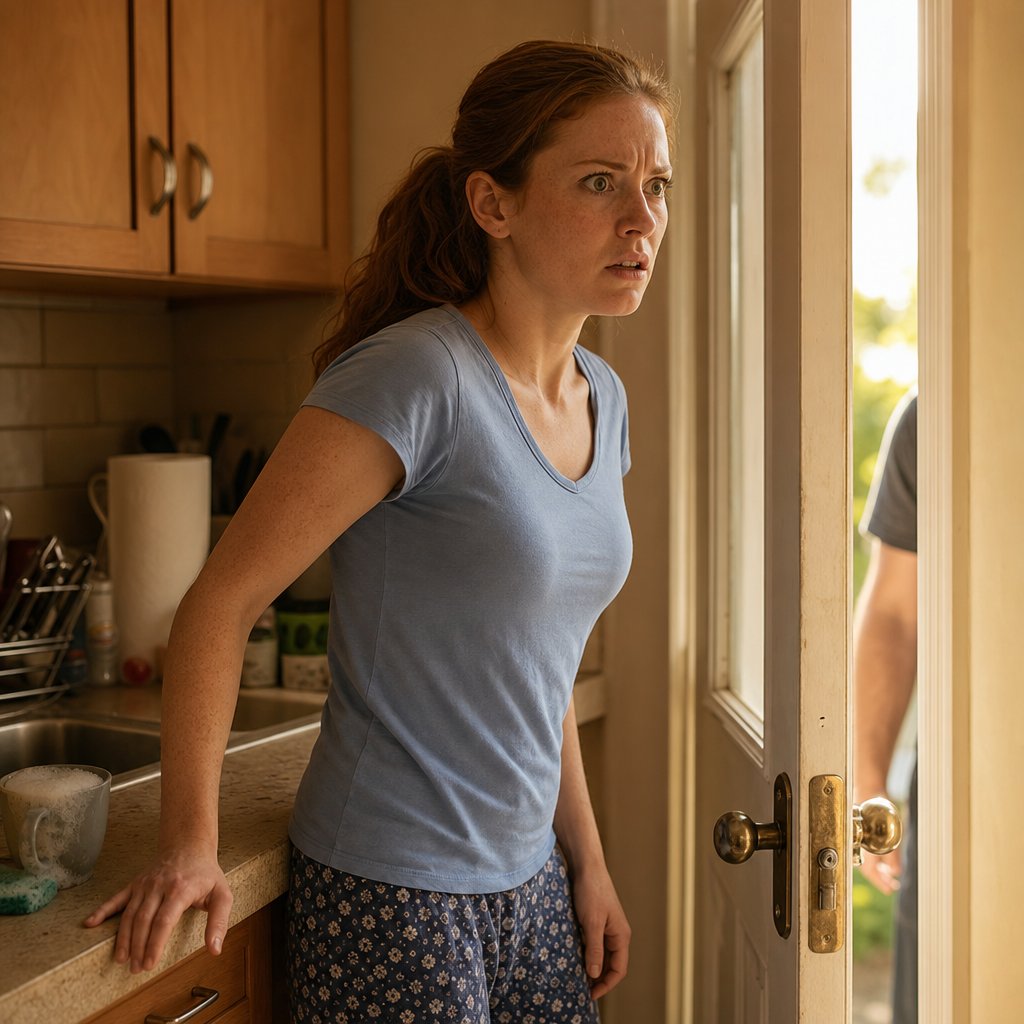
I wasn’t trying to spy. That’s the thing I kept telling myself, like it mattered.
I was in the kitchen, rinsing a mug, when I heard Mark’s voice outside—low, casual, the way you talk when you think you’re safe. The back door was cracked just enough to let in the smell of cut grass and the sound of him laughing like nothing in our life was on fire.
“She doesn’t know about the chat,” he said.
I froze with the mug in my hands. The ceramic was slick with soap, and my fingers clenched so hard it squeaked against my grip.
There was another voice out there, closer than I expected. Nate’s, I realized—dry and amused. “You sure? She’s not dumb.”
Mark snorted. “She’s emotional. That’s not the same thing.”
Emotional. Like I was a defective appliance that made too much noise.
Nate said something I couldn’t catch, and Mark answered, “Just keep Mom on script. If she starts freestyling, it gets messy.”
On script.
My knees went weak, and I set the mug down too hard on the counter. It clinked, a sharp little sound that felt like it echoed into the yard.
Outside, the voices stopped.
Silence rushed in, thick and sudden. Then I heard footsteps shift on the patio, slow and deliberate, like someone had turned their head toward the door.
I backed up, heart hammering, and the back door handle twitched—just once—testing.
I stood there, holding my breath, realizing they weren’t just talking about me. They were coordinating. They were rehearsing me like I was a role they could rewrite.
The handle turned again, this time farther, and I had one second to decide whether to step forward and catch him in the act—or disappear down the hallway before he saw my face—
The Folder I Couldn’t Open
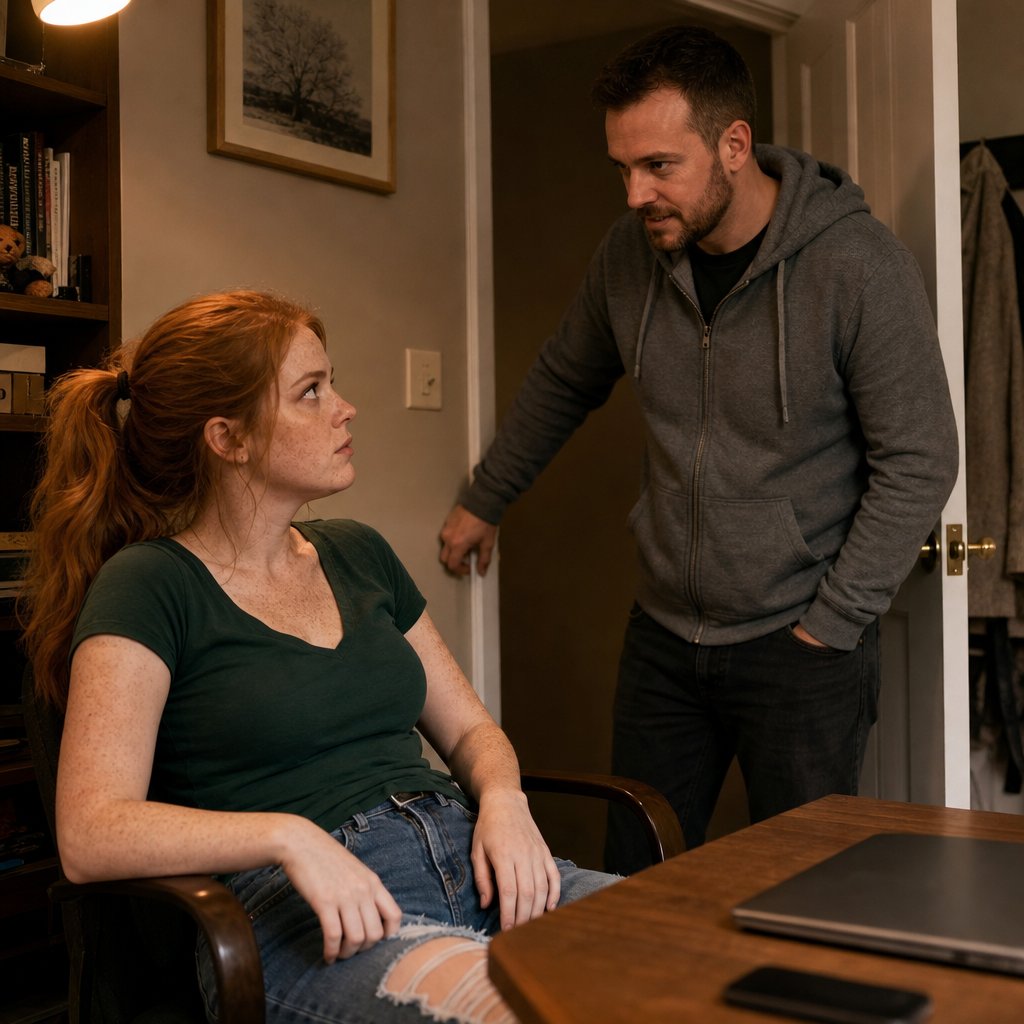
I told myself I needed facts. Not feelings. Facts didn’t get called “emotional.” Facts didn’t get managed with “talking points.”
So I went digging—not in drawers this time, but in the place where people hide things because it feels clean: shared storage, shared accounts, shared life. The kind of “ours” that turns into “mine” the second someone decides you’re a problem.
I found it almost immediately, like it had been created with confidence. A new folder labeled “House Docs.” Neat. Innocent. The kind of thing you’d make if you were being responsible.
Except when I tried to open it, I couldn’t. Access denied. Blocked. Like I was a stranger trying to break into my own future.
I sat very still, the blood roaring in my ears. The air smelled faintly like the cedar candle Mark loved, and suddenly that scent made me want to gag. Somewhere in the house, a floorboard creaked—his footsteps, moving with purpose.
My mind raced: refinance paperwork, mortgage statements, insurance, titles. The forms with my signature in that lockbox I hadn’t found yet but now felt inevitable. The “simplify finances” pitch. The family chat “script.”
They weren’t just gossiping about me. They were building a paper trail. A narrative. A cage.
I forced myself to breathe quietly, because if Mark heard me moving too fast, he’d know I’d caught the scent. I slid my chair back without a sound and listened as his steps got closer, closer—toward the room I was in.
Then the doorknob turned, and Mark’s voice floated through the opening like honey over a blade.
“Hey,” he said, too casual. “What are you up to?”
I looked up at him, and all I could think was: if I tell him what I just found, he’ll know how much I know. And if I lie, I’ll be playing their game.
He stepped inside, eyes flicking past me like he was checking what I could see, and his smile tightened at the corners—
The Script They Memorized
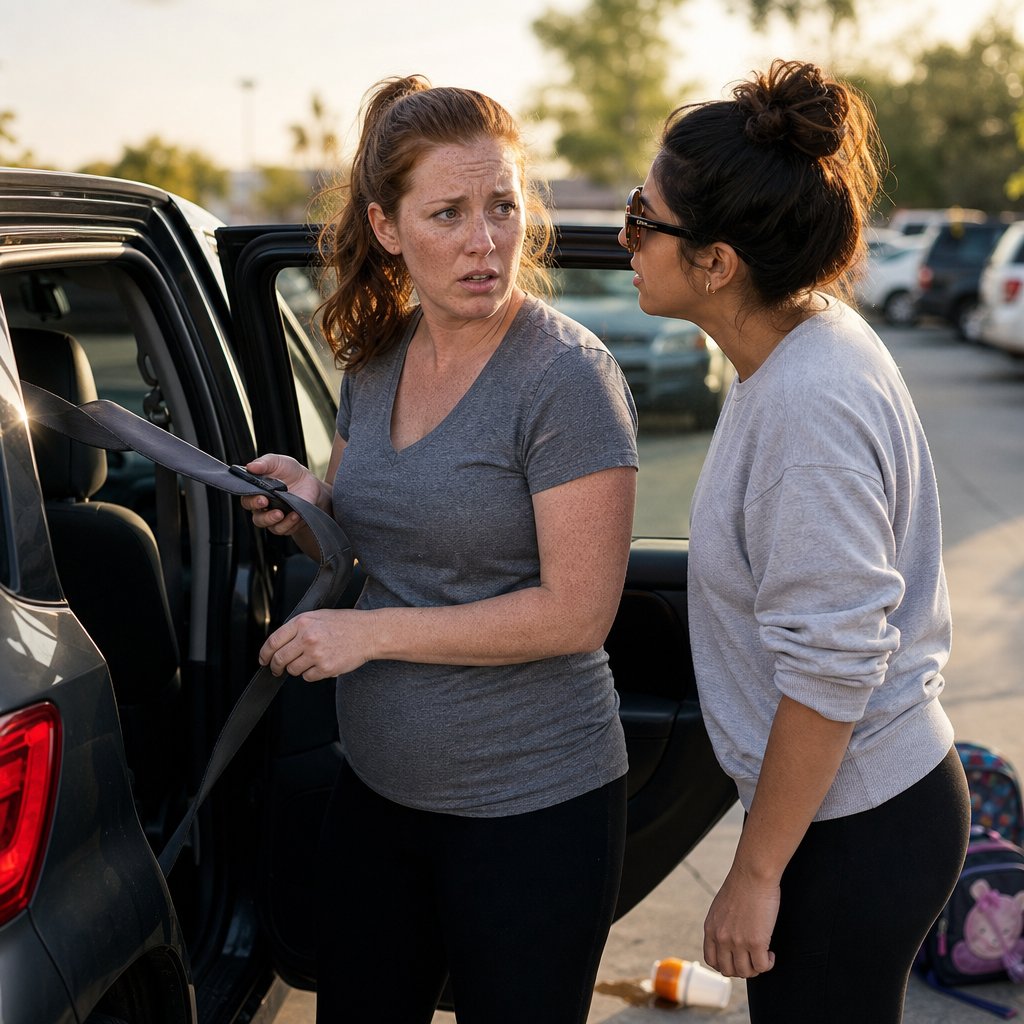
Mark’s eyes flicked past me, checking what I had access to, and I swear my skin went cold like I’d stepped into a freezer aisle.
At school pickup the next day, I was halfway buckling my kid into the car when Talia—messy bun, oversized sunglasses, always nice—leaned in like she was sharing a coupon tip. “Hey,” she said softly, “Jenna mentioned you’ve had… a lot. Like you don’t handle stress well.”
I froze with the seatbelt twisted in my fingers. The parking lot smelled like warm asphalt and spilled apple juice, and my ears started ringing. “Jenna said that?” I kept my voice light on purpose, like I was asking about the weather.
Talia’s smile slipped. “She was just worried. Said she’s trying to support Mark, because you’ve been… you know.” She made a vague circling motion by her temple, then immediately looked guilty.
My phone buzzed in my pocket before I even closed the car door. When I answered, Linda—my mother-in-law—didn’t even say hi. “Sweetheart,” she said, syrupy, “I just wanted to check in. Are you taking your anxiety meds the way you’re supposed to?”
I stared at the steering wheel, knuckles whitening. I’d never been prescribed anxiety meds. Not once. Linda kept talking anyway, like she was reading a list, and when I asked her why she thought that, she paused—too long—then said, “Oh… Mark mentioned you’d been struggling.”
My throat tightened so hard it hurt. Because it wasn’t concern. It was confirmation. Like they were checking if I’d follow the script they’d already handed out…
The Key That Didn’t Belong
I waited until Mark was in the shower that night. Not because I was sneaky by nature—because I’d learned the hard way that asking questions just gave him time to rearrange the truth.
His gym bag sat by the laundry basket, half-zipped, reeking of stale deodorant and rubber. I slid my fingers inside like I was reaching into a mouth that might bite. Towel. Shaker bottle. A crumpled receipt I didn’t recognize. And then my fingertips hit metal.
A keyring.
Not ours. Not the chunky black house key Mark and I both had. This was a second set—clean, barely scratched, like it didn’t live on a key hook. Two plain silver keys and one tiny brass key that looked old, almost delicate, like it belonged to a lock you weren’t supposed to notice.
My stomach rolled. I held the brass key up to the bathroom light and it gleamed a dull honey color against my palm. Mark was humming behind the shower curtain, relaxed, domestic, like he wasn’t quietly building a world I wasn’t allowed into.
I walked through my own house like a stranger. Hall closet. Guest room. The little cabinet under the stairs. I tried the brass key on everything that even looked like it might have a lock, my hands shaking harder each time it didn’t fit. It wasn’t for convenience. It was for something hidden.
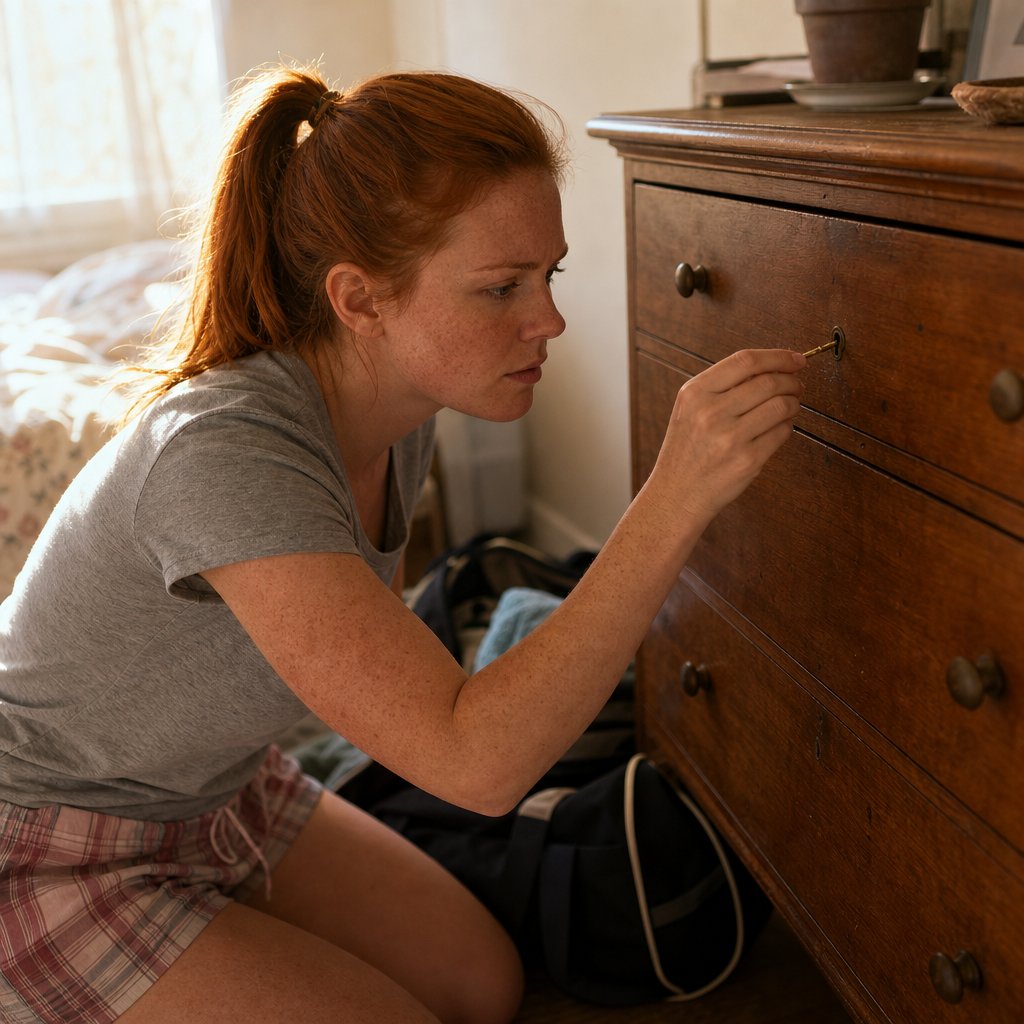
Then I remembered the locked drawer Mark suddenly cared about—the one he’d started pushing shut with his hip like it was sacred. I crouched by the dresser, the wood cool under my knees, and slid the brass key toward the tiny keyhole…
What They Filed Away
The key turned with a soft little click that felt way too loud in the quiet house.
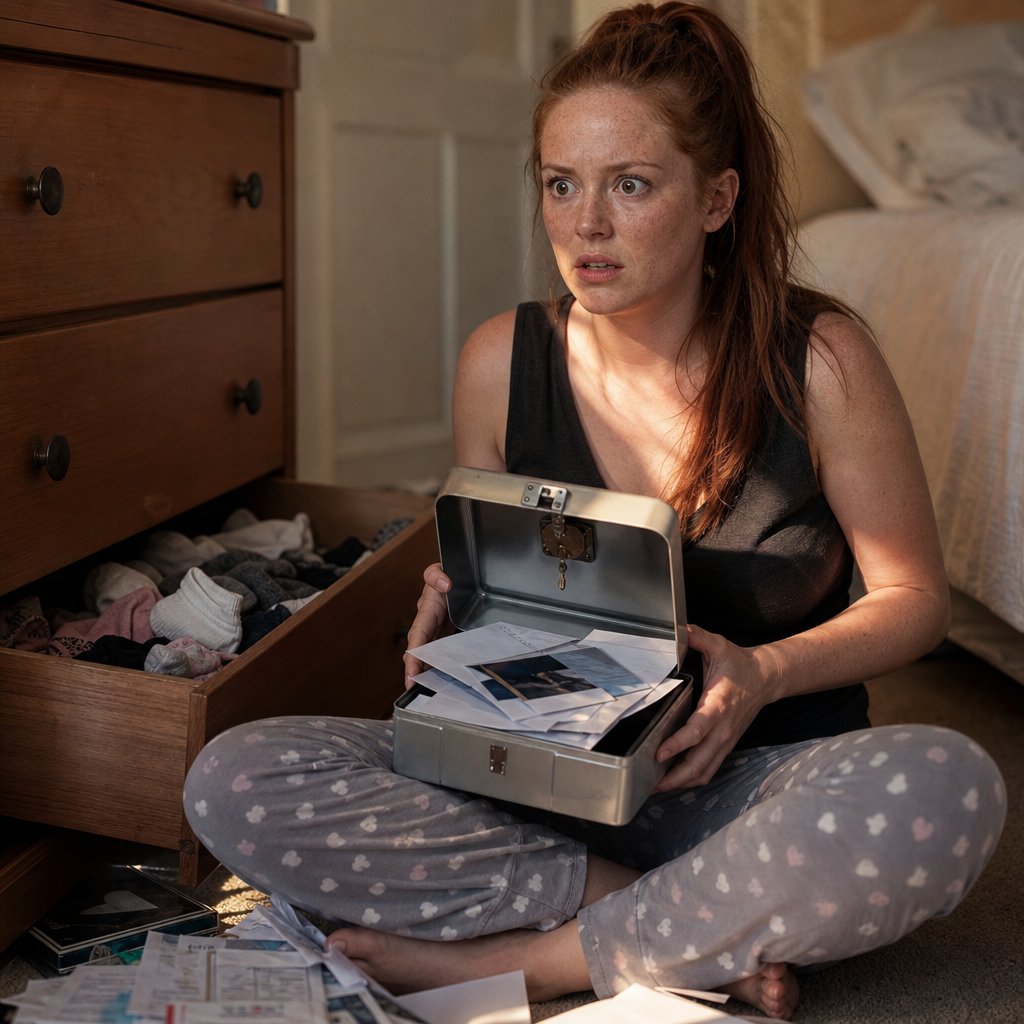
I pulled the drawer open and my breath caught. Not lingerie. Not a surprise gift. A hidden lockbox sat inside, wedged beneath folded socks like it was just another harmless secret. The metal was cold and heavy when I lifted it out, and for a second I actually laughed—this sharp, humorless sound—because of course it was a lock inside a lock.
The brass key fit again.
Inside were printed pages, stacked with the neatness of someone who thought they were doing something righteous. Screenshots of my texts—my real ones—selected like a highlight reel of my worst moments. Me asking Mark where he was. Me saying I felt alone. Me crying in words at 1:12 a.m. Every message cropped so my context was gone, so I looked frantic and irrational instead of… human.
Under that: forms. Official-looking, with boxes and lines and that cheap paper smell. My name typed in. My address. And my signature—except it wasn’t mine. It was close enough to pass if you didn’t know me, but the slant was wrong, the loop on the “M” too tight. My fingers went numb as I traced it.
Then I found the page that made my vision blur: a sheet titled “Talking Points,” bullet after bullet like a rehearsal. “Emotional volatility.” “Financial anxiety.” “History of overreacting.” “Concern for safety.” Phrases you’d use if you were building a case. If you were laying groundwork to take decisions away from me.
I sat on the carpet with the lockbox open in my lap, feeling like my own home was tilting. Mark’s shower shut off down the hall, water pipes ticking as they cooled, and I scrambled to shove everything back—because I suddenly understood this wasn’t gossip.
This was evidence.
And I could hear his footsteps heading toward the bedroom…
Everyone Stick To The Plan

I barely got the drawer shut before Mark walked in, towel around his waist, steam still clinging to his shoulders. He kissed the top of my head like we were a normal couple and asked what I wanted to watch. I smiled so hard my cheeks hurt.
That was the worst part: how easy it was for him to be gentle while he was sharpening knives behind my back.
The next afternoon, Jenna cornered me at the grocery store like it was a coincidence. She was in yoga pants and a beige cardigan, hair in that smooth blowout she always wore when she wanted to look “concerned.” She grabbed my arm by the apples and said, “How are you really doing?” with her eyebrows pinched like she was practicing empathy.
I told her I was fine. I told her Mark and I were good. I watched her eyes flick over my face like she was checking for cracks.
My phone buzzed later while I was unloading groceries, hands smelling like onion skins and dish soap. A message came through from a number I didn’t recognize—just an image attachment from someone who clearly meant to send it somewhere else. My stomach dropped before I even opened it, because I’d learned what an “oops” looked like.
It was a screenshot of the family group chat I wasn’t in.
Jenna’s name sat right there above her message, plain as day: “She’s getting suspicious. Everyone stick to the plan.”
Below it were little reactions—hearts, thumbs-up, the casual approval of people who thought they were managing a problem child. And one reply that made my scalp prickle: Mark, answering her with, “I’ll handle it tonight.”
I stood in my kitchen holding my phone face-down against the counter, like it could burn through the laminate. My groceries sat half-put-away, milk sweating on the countertop. I wasn’t imagining it. I wasn’t sensitive. I wasn’t overreacting.
They had a plan.
And apparently, tonight was scheduled.
The Money That Kept Vanishing
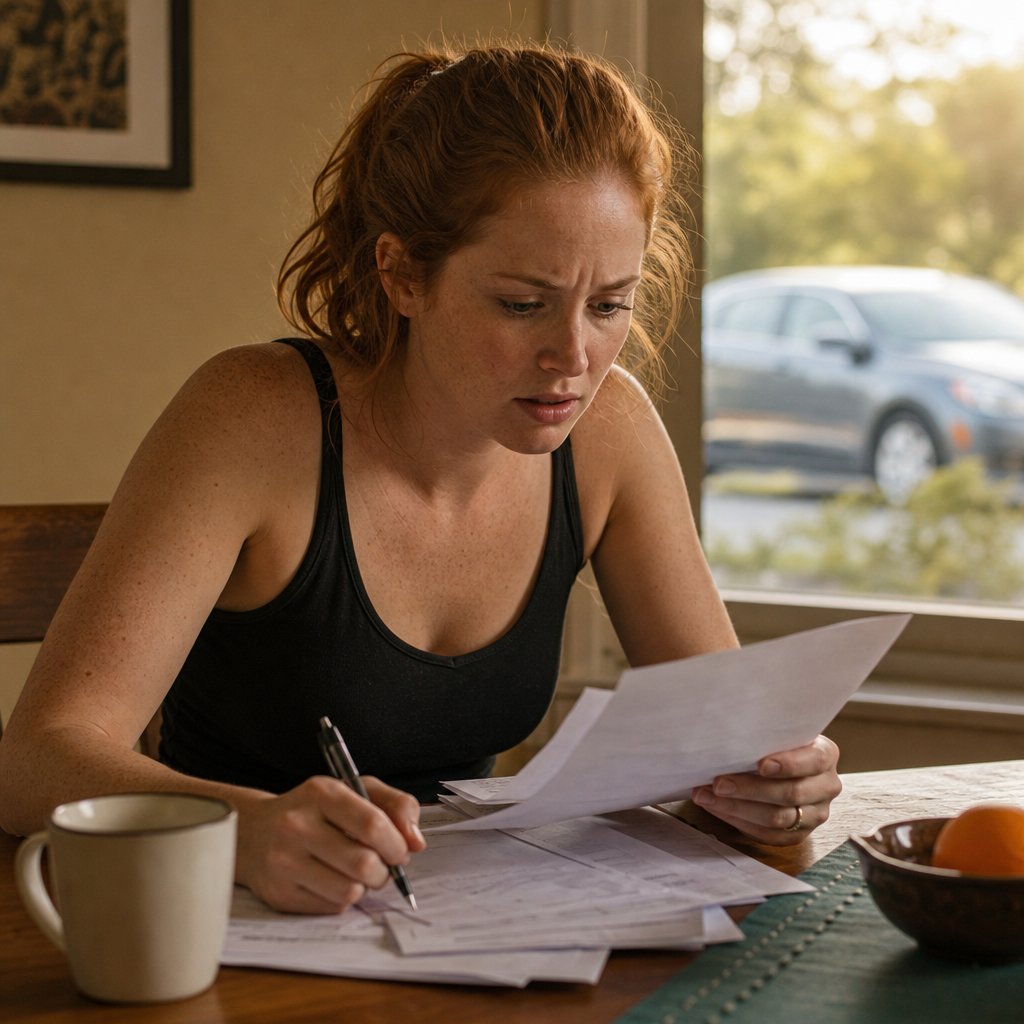
That night, Mark was extra sweet. He offered to do bedtime. He rubbed my shoulders. He asked if I wanted tea. It was like watching someone decorate a room right before they set it on fire.
When he finally fell asleep, I didn’t. I lay there staring at the ceiling, replaying “I’ll handle it tonight” until my jaw hurt from clenching.
The next morning, I pulled our bank statements—printed ones I’d shoved into a folder months ago, back when I still believed we were a team. I sat at the dining table with a pen and a mug of coffee that went cold, and I started circling the tiny withdrawals I’d ignored because life was busy and Mark always said he had it under control.
$180. $220. $199. Always just under the amount that would trigger a “big purchase” conversation. Always spaced out like someone thought they were being clever. And always followed by Mark saying we were “tight” when I wanted to replace the broken vacuum or sign our kid up for swim lessons.
I flipped through the pages faster, heart thumping. The pattern was so obvious once I saw it: little bites taken out of our account like termites, the kind of stealing that counts on you being too tired to add it up.
And while he was telling me no to everything, Mark was coming home with new “toys”—a fancy watch he claimed was a work bonus, upgraded golf clubs that “a buddy was selling cheap,” new running shoes that still smelled like fresh rubber.
I wrote the totals in the margin until my hand cramped. It wasn’t a couple hundred. It wasn’t even a couple thousand.
It was enough to change the shape of our life.
And right when I hit a withdrawal labeled only with a location code I didn’t recognize, I heard Mark’s car in the driveway—earlier than usual—like he’d come home to make sure I wasn’t counting.
Bins With My Name
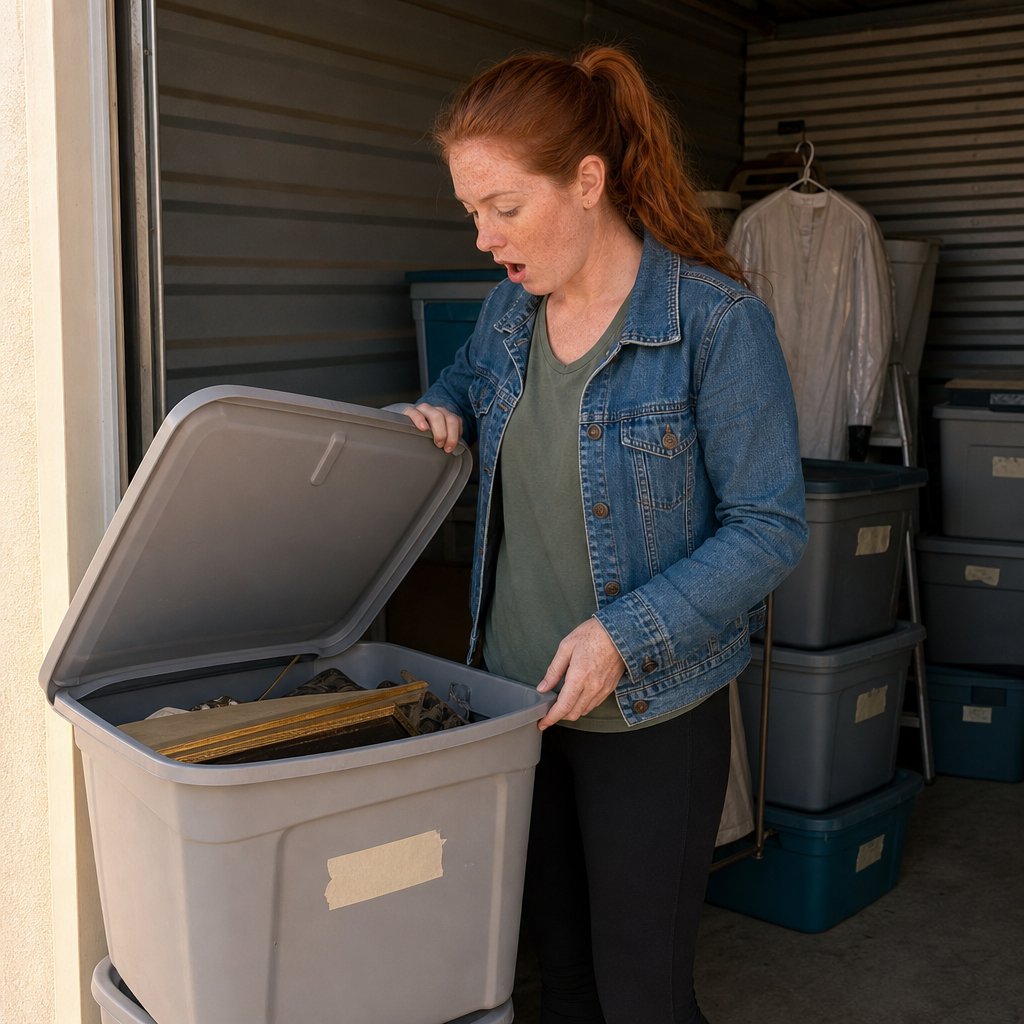
I told Mark I was running errands. I said it casually, like I wasn’t vibrating with adrenaline. He barely looked up from his coffee, just nodded like he’d already decided what I was allowed to do.
The location code from the statement sent me to a storage facility on the edge of town. The air out there smelled like dust and hot metal, and the rows of roll-up doors looked like mouths lined up to swallow secrets.
Inside the office, the manager slid paperwork across the counter. I kept my voice steady. “I’m trying to confirm a unit number for my family,” I said, smiling like an idiot. My pulse was pounding in my throat.
He typed, squinted at the screen, then said, “It’s under Jenna Parker.”
I felt my face go numb. “That’s… my sister-in-law,” I managed, like the words were stuck in glue.
The manager didn’t care about my life imploding. He just checked my ID and walked me down the corridor. When he unlocked the unit, the door screeched up with a metallic groan that made my teeth ache.
Inside were plastic bins stacked neatly like someone had been organizing a museum exhibit. And there—on masking tape strips stuck to the lids—were labels in thick black marker.
My name.
Not “holiday decor.” Not “old clothes.” My actual name, like I was a category of stuff to store away.
I stepped closer, hands shaking, and popped the first lid. The smell of old paper and cedar hit me. On top were photo albums I’d cried over when I thought they were lost—pictures of me as a kid, my dad’s handwriting on the back of snapshots, my college graduation tassel, the quilt my grandmother made me.
They hadn’t been misplaced.
They’d been removed.
And at the back of the unit, behind the bins, I saw a garment bag hanging like a shadow—something long and white inside it that I recognized instantly…
The Advisor Already Knew

Mark called it a reset. A “romantic, grown-up step.” He booked us an appointment with a financial advisor and acted like it was a date—like spreadsheets could fix betrayal if you wore the right smile.
I showed up in a soft blue blouse and lipstick I hadn’t worn in months, because if they wanted to paint me unstable, I was going to look like a brochure. Mark wore his nice button-down and that calm, reasonable face he saved for other people—his “see, she’s lucky I’m so patient” face.
The advisor’s office smelled like lemon cleaner and expensive carpet. The advisor himself—Graham, mid-40s, salt-and-pepper hair, crisp suit—shook my hand a little too firmly, like he was testing me. We sat, and Mark immediately slid a folder forward like he’d been waiting all week to present his case.
Graham glanced between us and said, “Before we start, I just want to make sure you’re comfortable with Mark remaining the sole account holder, given… everything.”
Everything.
I blinked. “Given what, exactly?” I asked, keeping my voice smooth even as my stomach twisted.
Mark’s hand landed on my knee under the table, a warning squeeze disguised as affection. “Babe,” he said gently, loud enough for Graham to hear the patience in it, “we talked about this. Just for now. Until things settle.”
Graham nodded like that made perfect sense. Like he’d already been briefed. Like someone had already told him I was a risk to my own money.
I looked at Mark’s face—so calm, so practiced—and I realized this meeting wasn’t for us to decide anything together. It was for me to be managed.
And then Graham opened the folder Mark had brought and said, “I have the refinance paperwork here as well—”
After She Signs What
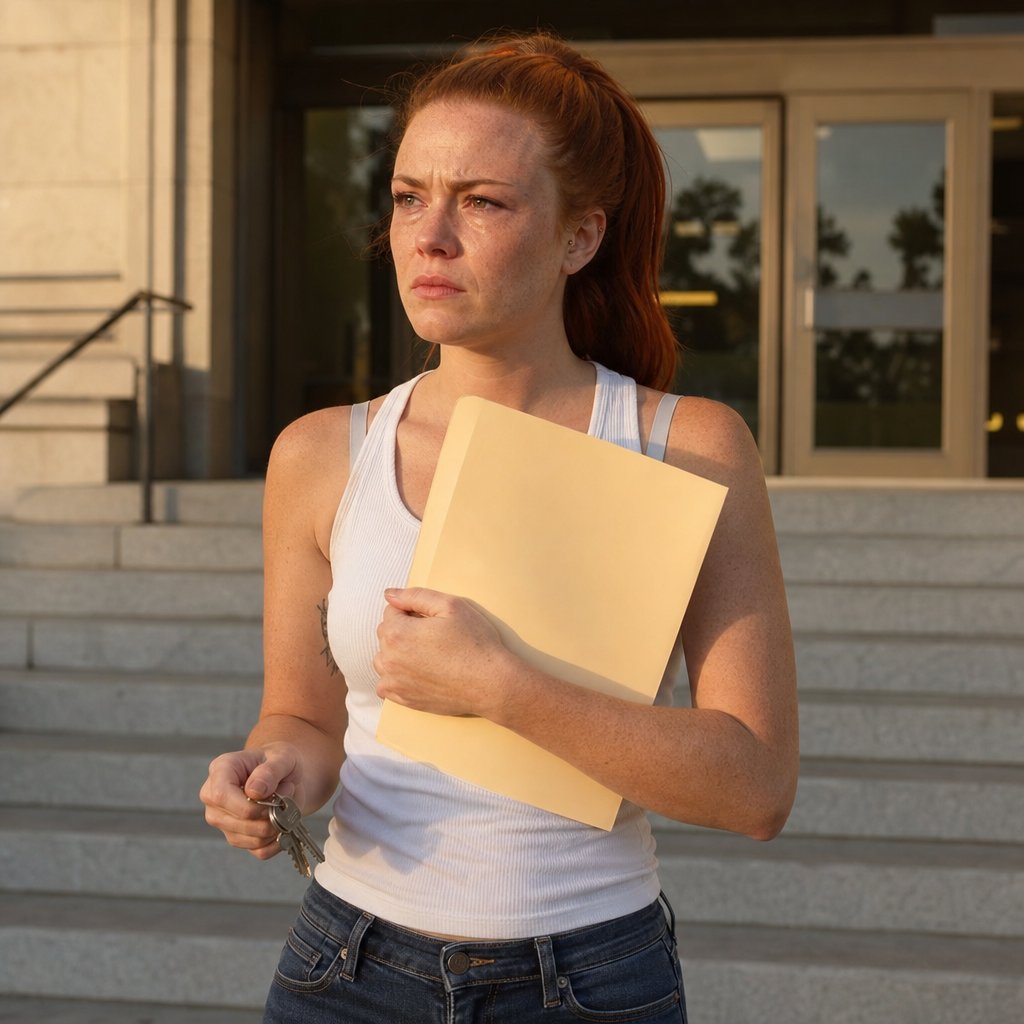
I didn’t cry in the advisor’s office. I didn’t even raise my voice. I nodded, I smiled, I played the part of the agreeable wife while my insides turned to ice.
Later, in my car, I sat with my hands on the steering wheel until my palms left damp prints. My phone buzzed again—another “oops,” another dropped grenade from the group chat I wasn’t supposed to see.
This one was worse because it wasn’t even pretending to be concerned.
A poll. Jenna had made a poll like we were picking a brunch spot.
“When do we tell her?”
Options: “After the refinance.” “After she signs.”
I stared at it until the words stopped looking real. After she signs. Signs what. My throat tightened so hard I gagged a little, the sour taste of panic rising up.
I drove straight to the county records office like I was possessed. The lobby was beige and tired, and the air smelled faintly like toner and old paper. I requested what I could request without sounding insane, hands steady only because I was running on pure rage.
When the clerk slid the document across the counter, my eyes went straight to the signature line.
My name was there.
It looked like mine at first glance—same letters, same rhythm—but the more I stared, the more wrong it became. The downstroke was too heavy. The “r” was shaped like someone copying from memory. Like a stranger practicing me.
I felt my vision narrow into a tunnel. They weren’t just talking about me. They were moving money and property around me, through me, using my name like a tool.
And if there was already an application started… that meant there were more documents somewhere waiting for “my” signature next.
I walked out of the building into the heat, my hands shaking so badly I could barely hold my keys, and I knew I had one chance to catch them mid-act.
Because they weren’t asking if they’d tell me.
They were voting on when.
Midnight In The Locked Drawer
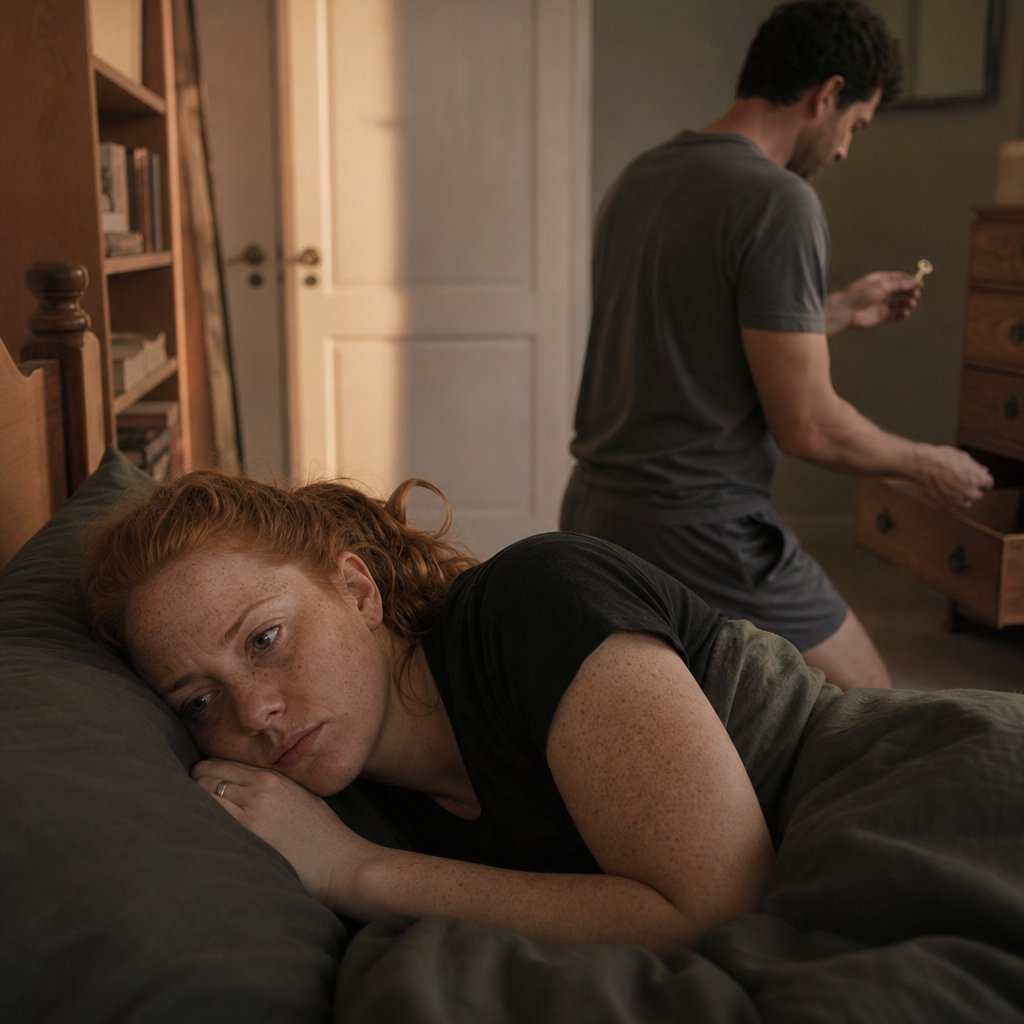
I didn’t confront Mark. Not yet. I did something colder.
I let him apologize first—vague, careful apologies that didn’t name what he’d done. “I just want us to be okay,” he said, rubbing my arm like he could soothe me back into compliance. I nodded. I leaned my head on his shoulder. I even told him, “I trust you,” and the lie tasted like pennies on my tongue.
Then I told him I’d “review” whatever paperwork he needed. I made my voice small. Cooperative. The version of me they’d been trying to manufacture: pliable, emotional, eager to be guided.
While he was at work, I prepared.
I printed my own copies of the documents I’d seen referenced—clean pages, nothing that would scream trap—and I added tiny, invisible-to-the-eye marks only I would recognize if they got scanned or copied. Not big, not dramatic. Just enough to prove a chain. Then I tucked them where Mark expected them, like I was playing along.
And in the corner of the bedroom, half-hidden behind a row of books on a shelf, I placed a small camera I’d bought with cash. No blinking lights. No obvious angle. Just a quiet witness aimed at the dresser with the locked drawer.
That night I went to bed early. I breathed slow. I let Mark think he’d won.
At 12:17 a.m., I heard the soft creak of the mattress as he slid out of bed. I kept my eyes shut, heart slamming against my ribs so hard it hurt. Through my lashes I watched him cross the room in socks, moving with the confidence of someone who’d done this before.
He knelt at the dresser. The drawer opened. The brass key flashed once in his fingers like a tiny blade.
He pulled something out, held it close, and then—without hesitation—picked up his phone from the nightstand and started typing fast, his thumb flying.
I lay perfectly still, my whole body buzzing, because I didn’t need to see the screen to know who he was reporting to…
I Walked In Smiling
By morning, I had it all.
The chat screenshots. The “Talking Points.” The forged signature. The pattern of withdrawals that suddenly looked like a pipeline. The storage unit in Jenna’s name filled with my life like I was already gone. And the footage—Mark at the dresser at midnight, opening the locked drawer like it was his real relationship and texting immediately after like he couldn’t wait to be praised for it.
I didn’t sleep. I didn’t eat. I moved through the day with a strange, bright calm that scared me more than panic ever had. I showered, put on a fitted charcoal blazer, and slicked a little concealer under my eyes. If they wanted “unstable,” they were going to choke on how composed I could be.
I re-booked the advisor meeting myself. Same office. Same time slot. I told Mark it was a follow-up to “get on the same page.” He looked relieved—actually relieved—like he could already picture me signing whatever he slid in front of me.
Then I called my lawyer. A woman named Diane with sharp cheekbones and a voice like a paper cutter. She didn’t gasp. She didn’t pity me. She said, “Bring everything,” and I almost cried from the relief of being believed.
On the day of the meeting, Mark drove us there like it was a victory lap. His hand rested on my thigh in the car, possessive and calm. I kept my smile in place and stared out the window at the passing trees, each one like a ticking second.
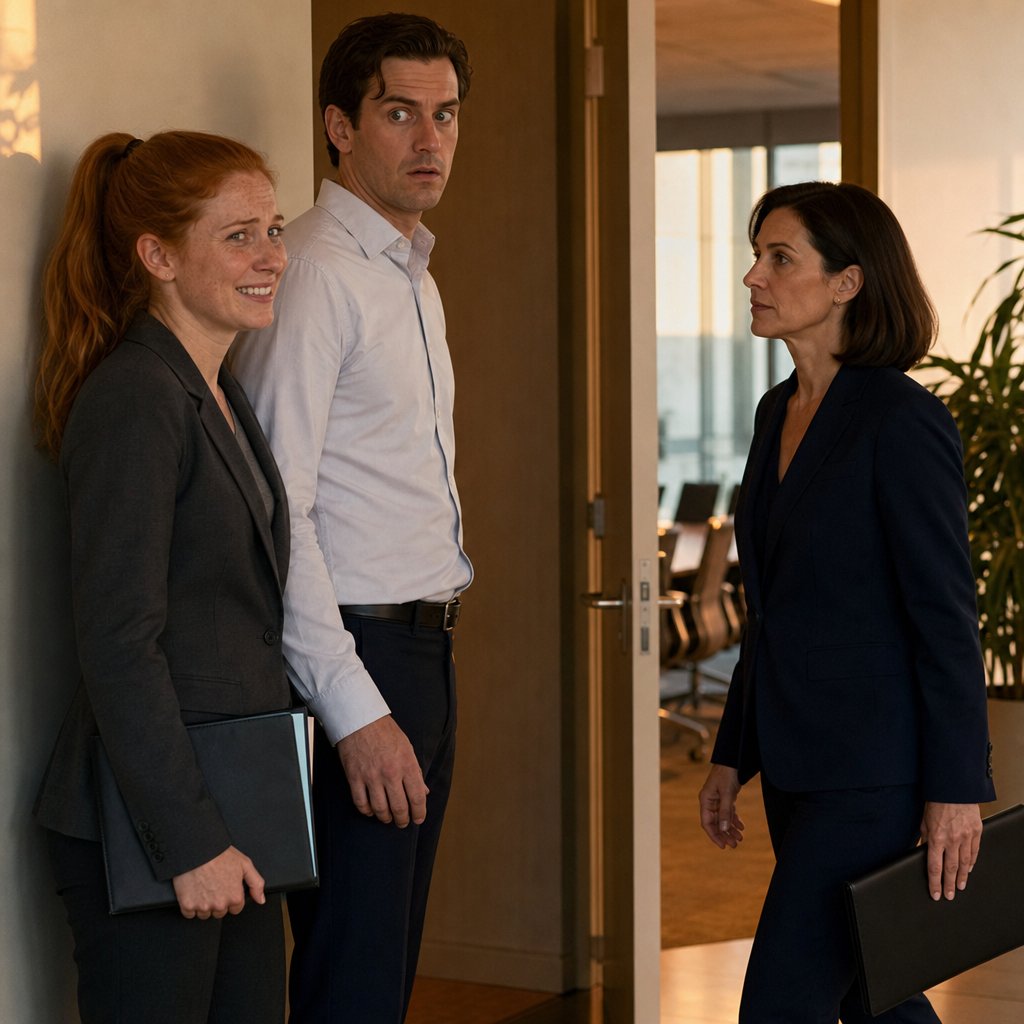
In the lobby, I told him I needed to use the restroom. Instead, I walked to the entrance and watched Diane step through the doors in a navy suit, carrying a slim briefcase like a weapon.
Mark turned, saw her, and his face did something I’d never seen before—his calm cracked, just for a second.
“Who’s that?” he asked, voice suddenly too high.
I turned back to him, still smiling, and pushed the conference room door open like it was business as usual…
The Photo I Promised Them
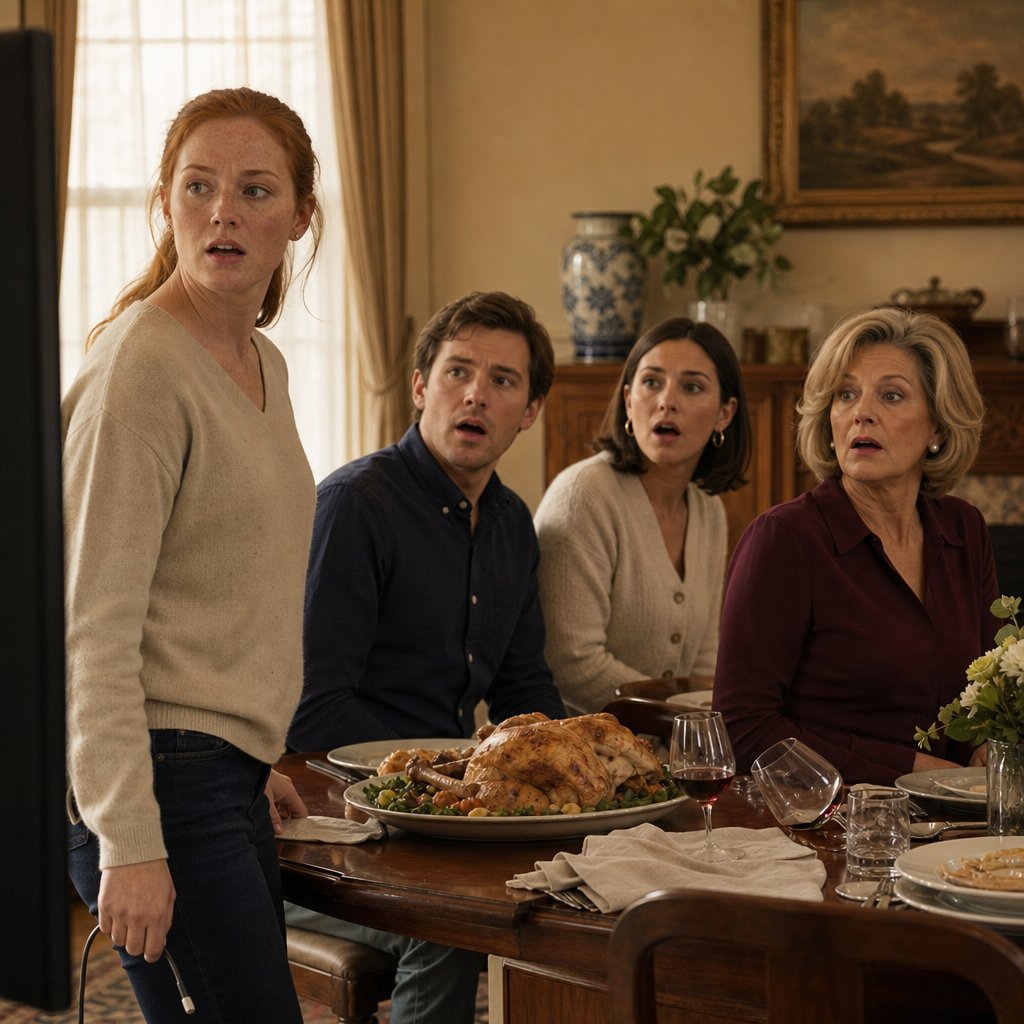
Mark’s calm cracked when he saw my lawyer walk in, and I opened the conference room door anyway. The room smelled like burnt coffee and lemon disinfectant, and for a second everyone forgot to breathe. Mark’s mother, Carol—perfect blowout, pearl studs, that tight smile like she’d practiced it in a mirror—actually recoiled when she clocked the legal pad in my lawyer’s hands.
“We can do this the easy way,” my lawyer said, voice flat, like she’d said it a thousand times. Mark started talking too fast, hands out like he could physically push the moment back into the hallway. Jenna was there as well—Mark’s sister with the glossy dark bob and the little gold hoops—acting like she’d just wandered into the wrong meeting, like she wasn’t the reason my stomach had been in a knot for weeks.
I didn’t argue. I didn’t cry. I just smiled and said, “Sunday dinner. Everyone. Like normal.”
And then I made it normal. Roast chicken, rosemary, Carol’s precious linen napkins that felt like sandpaper. I waited until the awkward pauses started stacking up, until Mark kept clearing his throat like he had a pill stuck, until Jenna’s eyes kept flicking to Carol for permission.
“Before we eat,” I said, sweet as sugar, “can we do a family photo? Like… all of us.”
Mark’s fork froze midair. Carol’s hand tightened on her wine glass so hard her knuckles went pale. I pulled out my phone and a little adapter—something I’d bought days ago and kept buried under tampons in my purse—and walked to their TV like I belonged there.
“Renee,” Mark hissed under his breath. “What are you doing?”
I connected it. The screen blinked once, then filled with a chat thread header so bold it felt like a slap: Real Family Only. Underneath it, another title in the same ugly confidence: Operation Renee.
No one moved. Jenna’s face went white in slow motion, like the blood just… evacuated.
I scrolled just enough for the newest line to land dead center, and I stopped with my thumb hovering in the air, right on Jenna’s message: “She’s not really family. She’s just… temporary.”
Mark made a sound I’d never heard from him before—half choke, half laugh—and Carol’s chair scraped back hard enough to jolt the table, but I didn’t look away from that line because I knew what came next if I kept scrolling…
Would you have confronted Mark about the secret page?