



A Key In My Palm
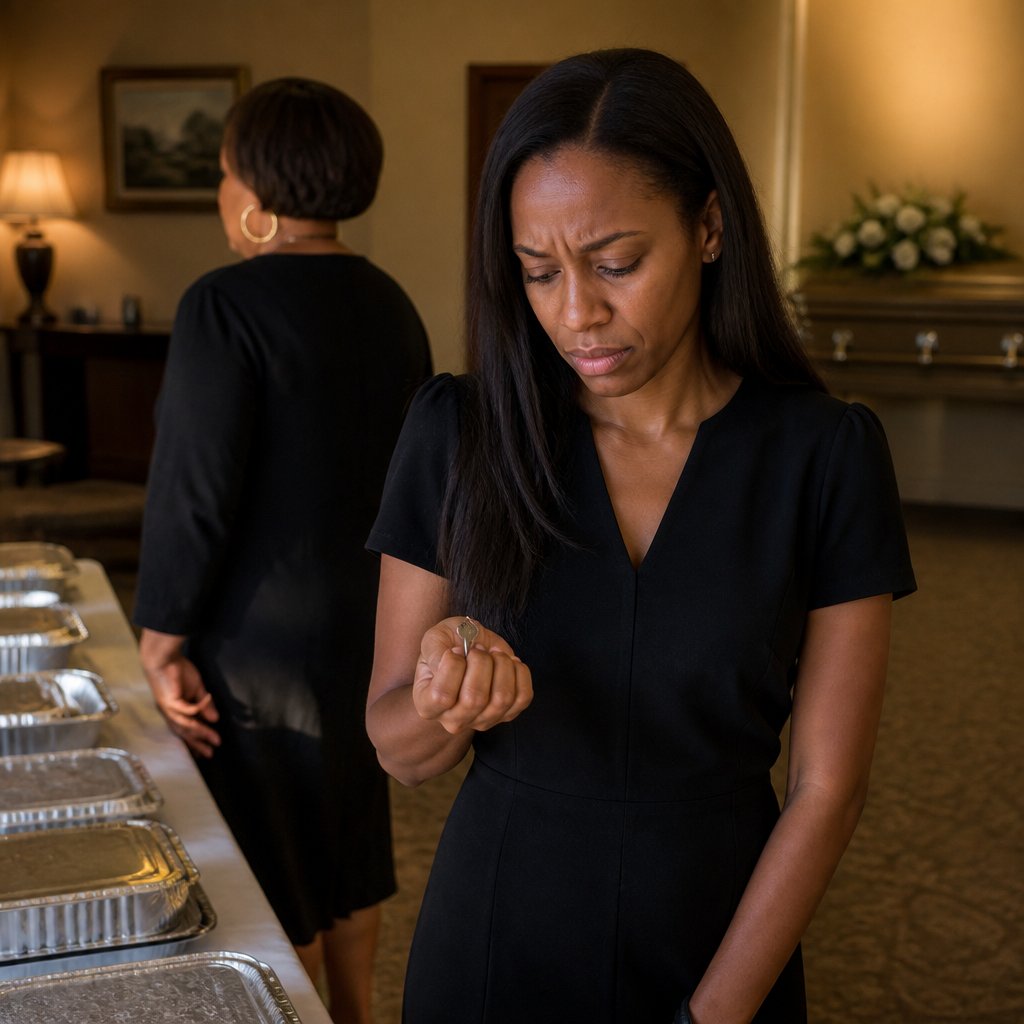
The funeral home smelled like lilies and coffee that had sat too long. I stood near the folding table where people kept dropping off casseroles in foil pans, trying to smile at cousins I hadn’t seen since I was a kid. My black dress itched at the collar, and my eyes felt raw from crying in the car before I came in.
Aunt Darlene waited until I was alone by the guest book. She was a light-skinned Black woman in her late 50s with a sharp bob haircut and gold hoop earrings, the kind that flashed when she turned her head. She took my hand like she was comforting me, then pressed something cold into my palm.
It was a small brass key on a bent metal ring, the ring warped like someone had stepped on it. Darlene curled my fingers closed over it and leaned in close enough that I smelled her powdery perfume.
“If you love your mother, you’ll wait,” she whispered, like the words hurt to say.
I pulled back and tried to ask what she meant, but her eyes went flat. She glanced toward my mother’s casket, then toward the doorway like she was checking who could hear us.
“Just… wait,” she said again, and she walked off before I could open my hand to look at the key.
When I finally did, the bent ring dug into my skin, and I realized I had no idea what I was holding or why Darlene looked scared of it.
The Box That Wasn't There
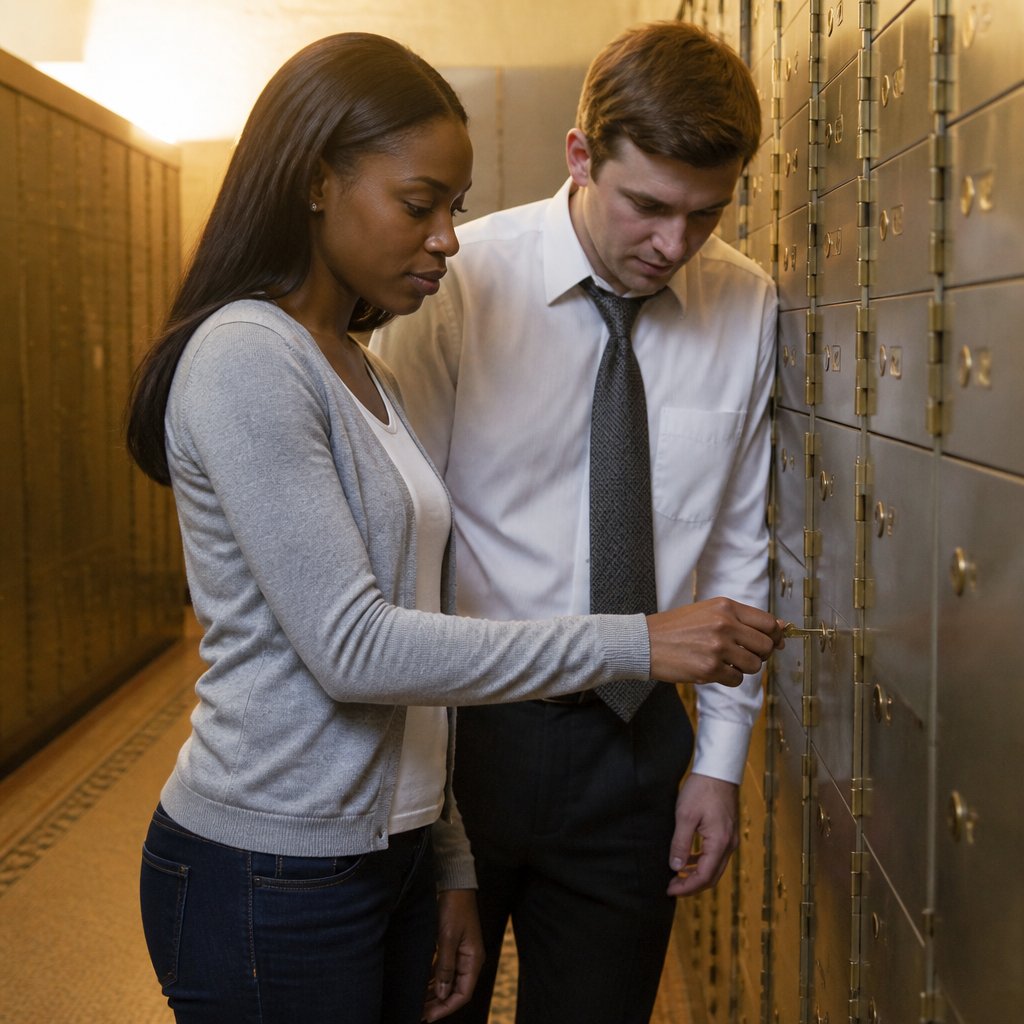
Two days later I stood inside the bank lobby with the key in my coat pocket, my stomach tight like I’d skipped meals. I wore a gray cardigan over a white top and dark jeans, trying to look like someone doing normal errands. The air smelled faintly like carpet cleaner and paper money.
The teller window glass made my voice feel small. The clerk was a young white man with sandy hair and a tie that looked too big for his neck. I slid the key across the counter on its bent ring without saying what it was for, like I could keep it casual.
He picked it up with two fingers and looked at it longer than I expected. “Safe-deposit?” he asked.
I nodded. “I’m trying to find the box number.”
He called someone over, then led me to a side door with a keypad. Past it was a narrow hallway and a heavy vault door that made everything feel suddenly serious. My shoes squeaked on the tile.
Inside, he pulled a long drawer of small metal boxes. He tried the key in one lock, then another, then paused at a box labeled 1147. When he turned the key, it fit like it belonged there. The tiny click sounded loud in the quiet room.
Back at his station, he frowned at his terminal and shook his head. “There’s no record,” he said. “Nothing in the system for Box 1147.”
He looked up at me like I’d brought him a problem he didn’t want, and I felt my pulse jump because the key had worked anyway.
The Manager's Tight Smile
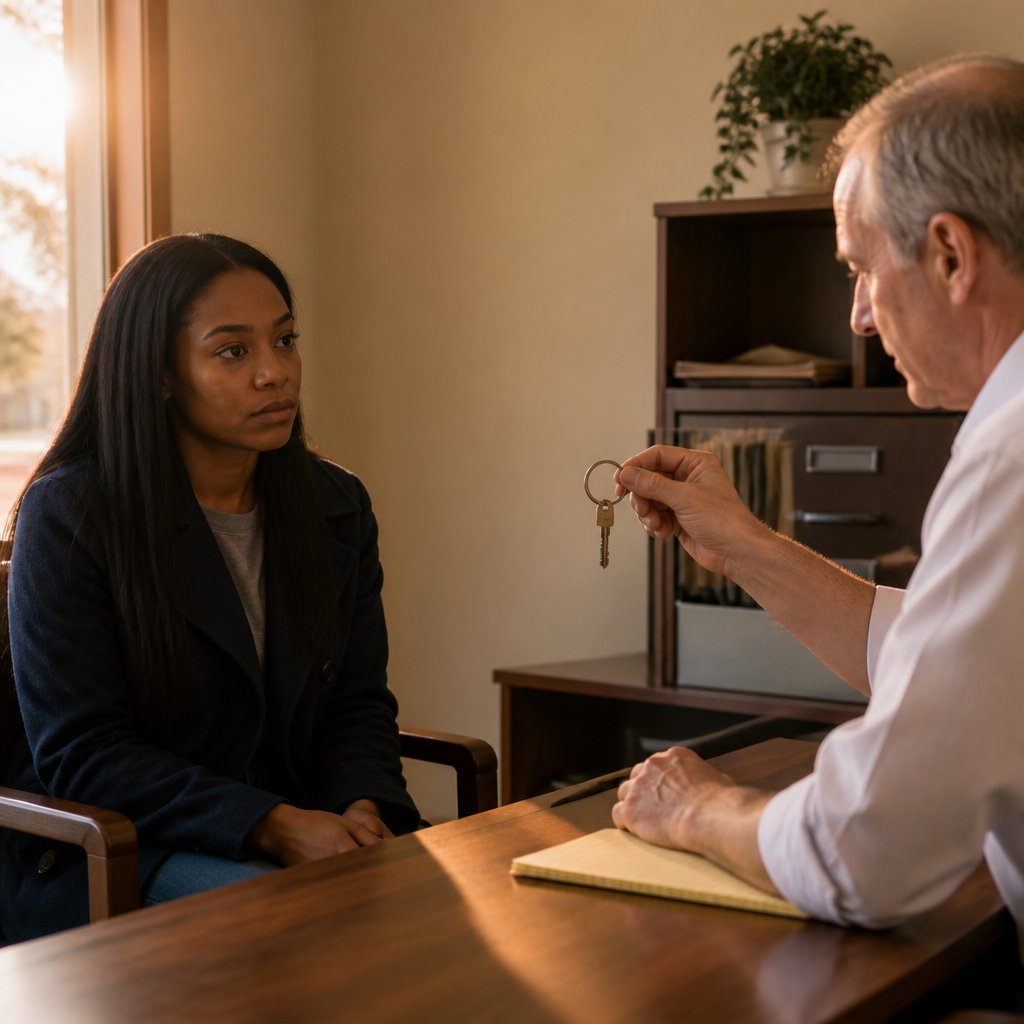
They made me sit in a little office off the lobby with a fake plant in the corner and a bowl of mints that tasted like dust. I kept the key in my fist under the desk, feeling the bent ring press into my skin. I could hear the low hum of the air conditioner and the muffled ding of the front door opening and closing.
The manager came in without introducing himself. He was a white man in his 50s with thinning gray hair and a pink face, his dress shirt sleeves rolled to the forearms like he’d been interrupted in the middle of something. He held the key up between thumb and forefinger, like it might leave a mark.
“This is older inventory,” he said. “We haven’t issued these in a long time.”
I told him it belonged to my mother, and that she’d just died. Saying it out loud in a bank office made it feel blunt and strange. He didn’t offer condolences. He asked for her full name, then wrote it down on a yellow pad without looking at me.
He opened a drawer and pulled out a thick binder, flipping pages fast. His jaw worked as he scanned. He checked again, slower, then sat back.
“There is no record under your mother’s name,” he said, too carefully. “No box, no rental, nothing.”
I watched his fingers tap the binder’s edge like he was trying to stop himself from doing something else. His eyes slid to the door, then back to the key. “Where did you get this?” he asked.
I didn’t tell him about Darlene. I just said, “It was in my mother’s things,” and his tight smile didn’t reach his eyes.
The Will Didn't Comfort Me
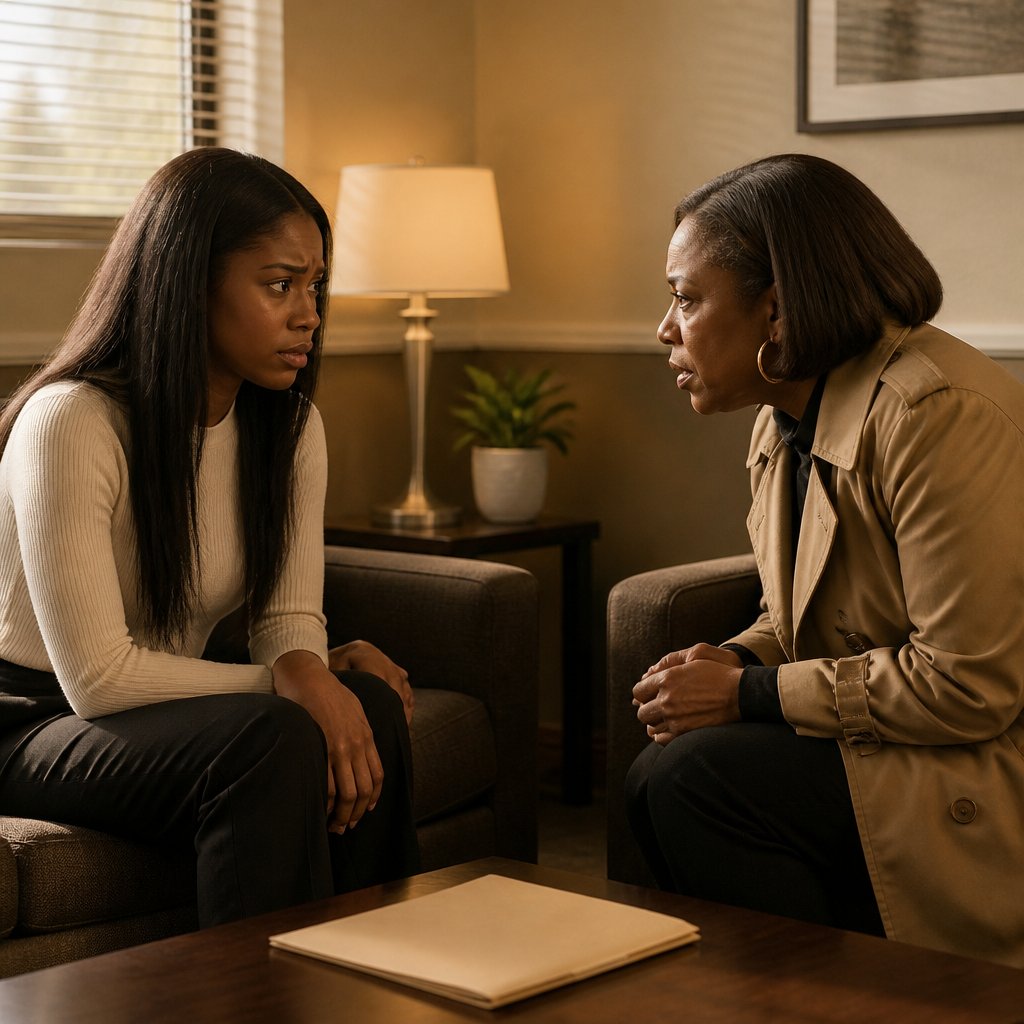
The attorney’s office smelled like copier toner and lemon cleaner. I sat on a stiff couch with my hands folded in my lap, wearing a plain cream sweater and black slacks because I didn’t know what you wore to hear your mother’s will. My throat felt tight the whole time, like I was holding back words that didn’t have a place to go.
Mr. Feldman, my mother’s attorney, was a short older man with a bald head and wire-rim glasses. He spoke in a calm, practiced voice as he read. The will was simple. My mother left the house to me. The small savings account to me. Her personal things to be divided, but I was named executor.
For a second, I felt something like relief. Not about money—about clarity. About my mother having chosen something on purpose.
Then Aunt Darlene cleared her throat. She sat across from me in a tan trench coat, her sharp bob neat as ever, her gold hoop earrings catching the light when she turned her head. Her lips pressed together like she’d been waiting.
“I’m challenging it,” she said. “My sister wasn’t competent. She wasn’t herself at the end.”
Mr. Feldman blinked, then set the papers down slowly. “Darlene,” he said, careful, “that’s a serious allegation.”
Darlene didn’t look at him. She looked straight at me, like the fight was personal. “You know she was confused,” she said. “You know she was vulnerable.”
My hands started to shake, and I tucked them under my thighs so she wouldn’t see. The room felt smaller, like the air had thickened. Mr. Feldman asked if she had evidence, and Darlene’s eyes narrowed like she did.
Proof Wasn't Enough
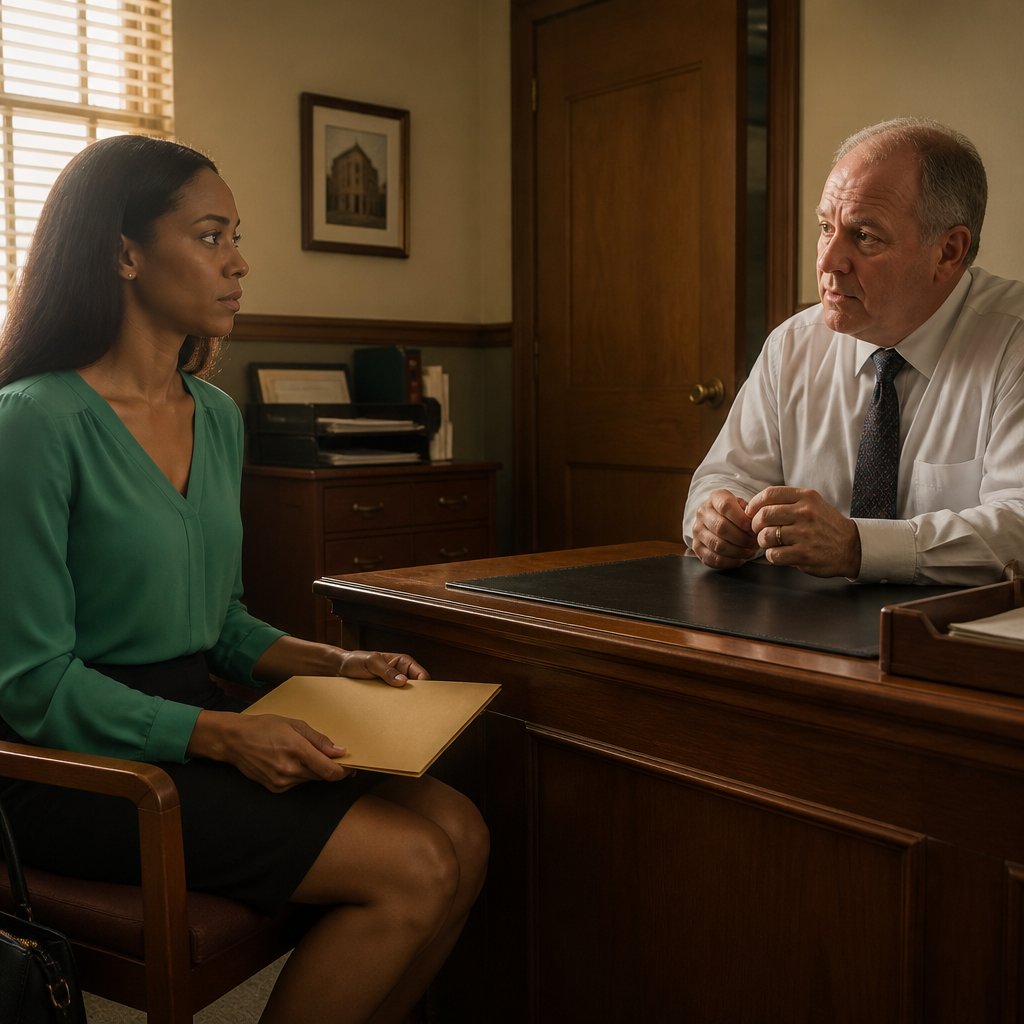
I went back to the bank with the death certificate in a manila envelope, like paperwork could make the weirdness disappear. I wore a green blouse and dark skirt, and I kept smoothing the envelope with my thumb until the edge started to bend. The lobby felt colder than last time, and the smell of hand sanitizer hit me as soon as I walked in.
The manager met me at the counter instead of making me wait. He didn’t smile. His eyes went straight to the envelope like it was a threat.
In the small office again, he opened the envelope and glanced at the document without reading it fully. He pushed it back toward me. “We’ll need formal authority,” he said. “Letters testamentary, or court appointment. Something showing you can act for the estate.”
I told him I understood, but I also told him the key worked. I said the number out loud—1147—and watched his face. His nostrils flared like he was fighting a reaction. He stood up and shut the office door even though it was already mostly closed.
“I can’t discuss vault inventory without proper authorization,” he said, voice low. “And I can’t allow access based on a loose key.”
“Then why does it exist?” I asked, and my voice cracked on the last word.
He stared at the desk, not at me. His fingers rubbed the edge of his wedding band, over and over, like he was trying to wear it down. “Ma’am,” he said, “you don’t understand what you’re asking.”
I leaned forward. “Then explain it,” I said, and he finally looked up with an expression that felt like warning, not refusal.
The Teller's Quiet Hint
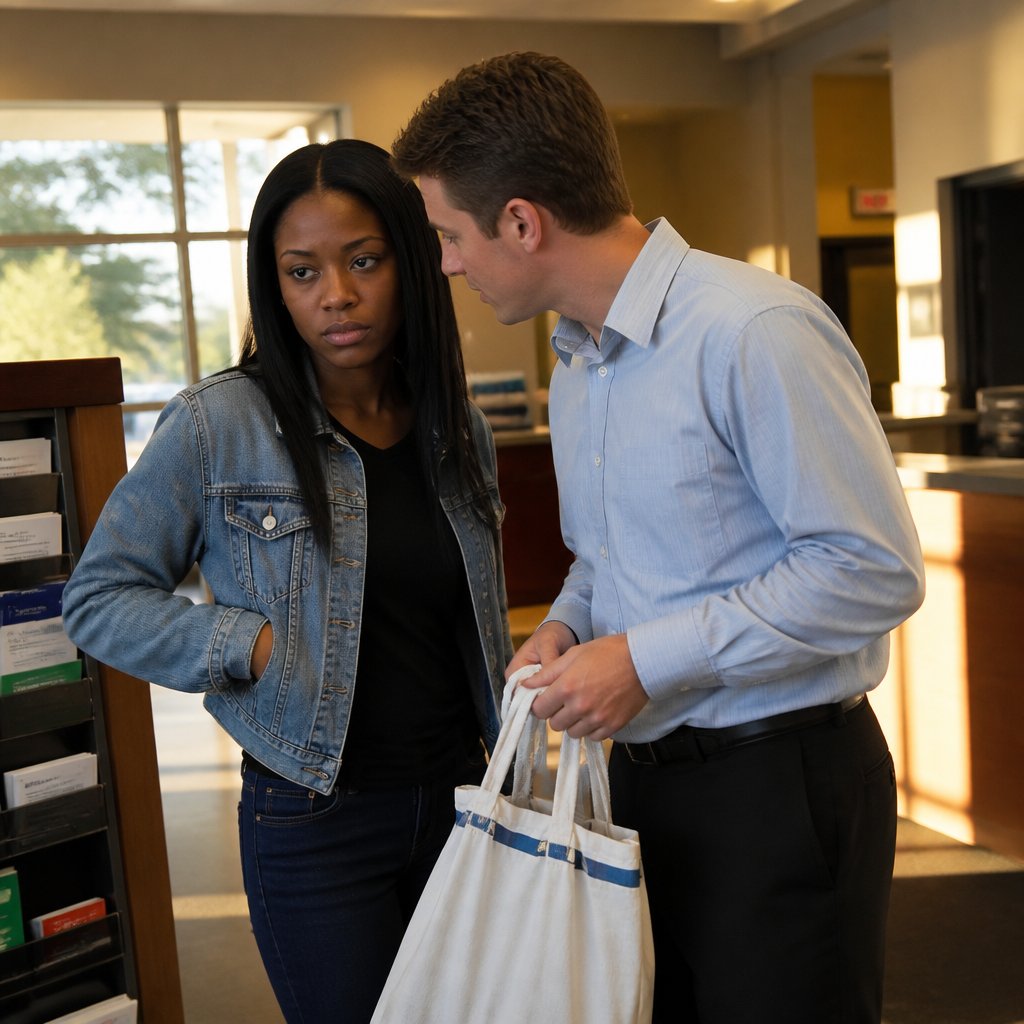
I lingered near the brochure rack after the manager left me, pretending to read pamphlets I didn’t care about. My face felt hot, and my hands were cold. I could hear the soft chatter of people in line and the click of pens on counters. I wore a denim jacket this time over a black T-shirt, like I’d dressed down on purpose to avoid attention.
The same teller from before passed by carrying a stack of deposit bags. He slowed when he saw me and glanced around, like he was checking who was watching. He didn’t stop at the window. He leaned close enough that his voice stayed under the lobby noise.
“I’m not supposed to talk about vault stuff,” he said, eyes fixed on the floor tiles. “But… some boxes don’t show up in the system. Older ones.”
I felt my heart thump hard. “Why?” I asked.
He swallowed and shifted the bags in his arms. “There’s… a legacy ledger,” he said, like the words tasted wrong. “Paper. Kept off-system. For certain accounts.”
“Who keeps it?” I asked.
His eyes flicked toward the manager’s office. “Not me,” he said quickly. “And if it’s tied to that, people can… move things around without it showing up where it should.”
I stared at him, trying to understand what he was really telling me. He straightened up, already retreating. “Just be careful,” he murmured, and walked away fast.
I watched him go, and the bent-ring key felt suddenly heavier in my pocket, like it had been made to pull me toward something I wasn’t ready to see.
Under The Desk Drawer
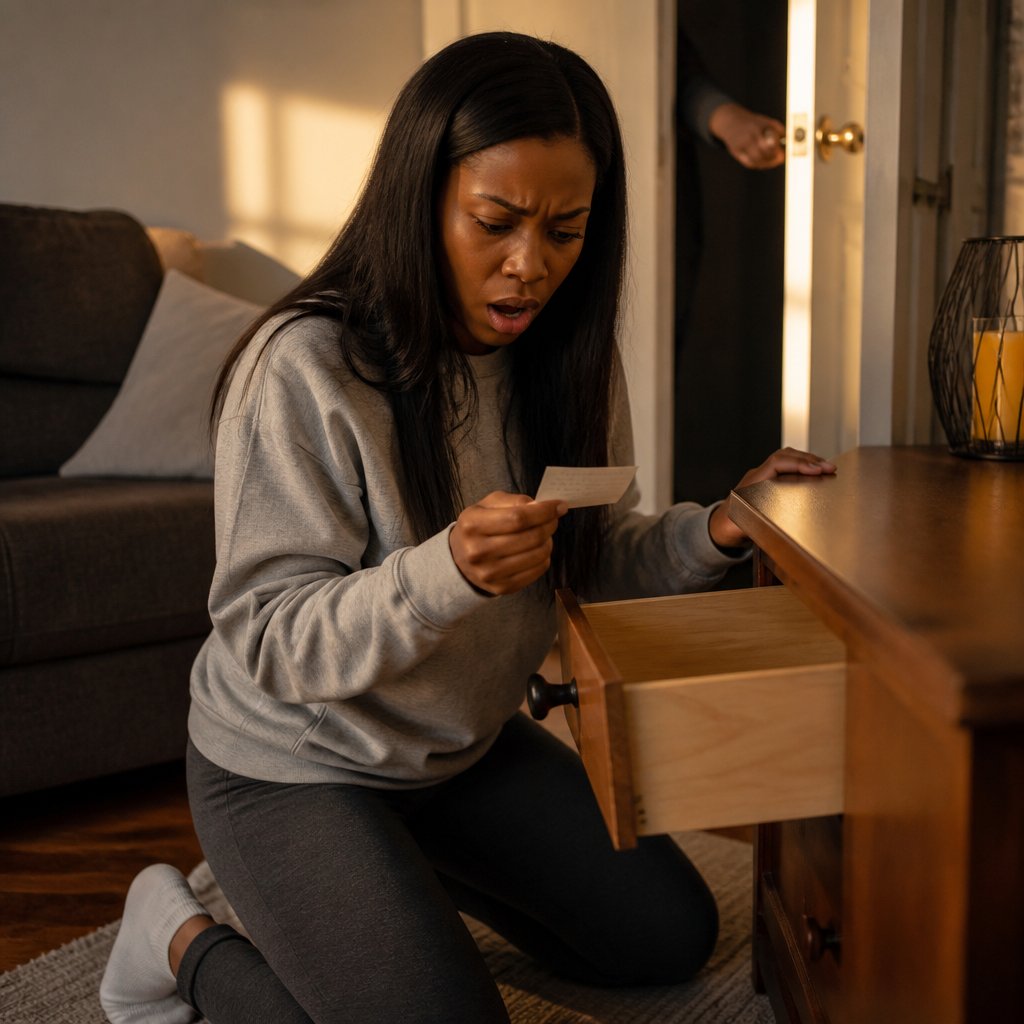
Back at my mother’s house, the quiet hit me the moment I stepped inside. It smelled like furniture polish and the faint sweetness of her lotion, the one she used every night. I wore a soft gray sweatshirt and leggings, because grief had turned me into someone who needed comfort more than style.
I went straight to her small desk in the corner of the living room, the one where she paid bills and wrote grocery lists on scrap paper. The chair creaked when I sat down. I opened the top drawer and saw the usual things: pens, a tape measure, a packet of seeds she never planted.
I remembered the way my mother used to tap the underside of the drawer when she was thinking. It was a habit I’d never asked about. I slid the drawer out as far as it would go and leaned down, my hair falling forward over my shoulder.
There, underneath, was a small square of paper taped flat to the wood. The tape had yellowed at the edges, like it had been there a long time. My fingers trembled as I peeled one corner back.
The note was in my mother’s handwriting. I knew it from birthday cards and the labels on leftovers in the fridge. It said: BOX 1147. Don’t let D. touch it.
I stared at the single letter—D.—and my stomach dropped. My mother had been specific. Not “don’t let anyone.” Not “be careful.” Just D.
I sat back hard in the chair, the paper shaking in my hand, and I heard the front door knob rattle like someone was trying it.
The Warning From My Lawyer
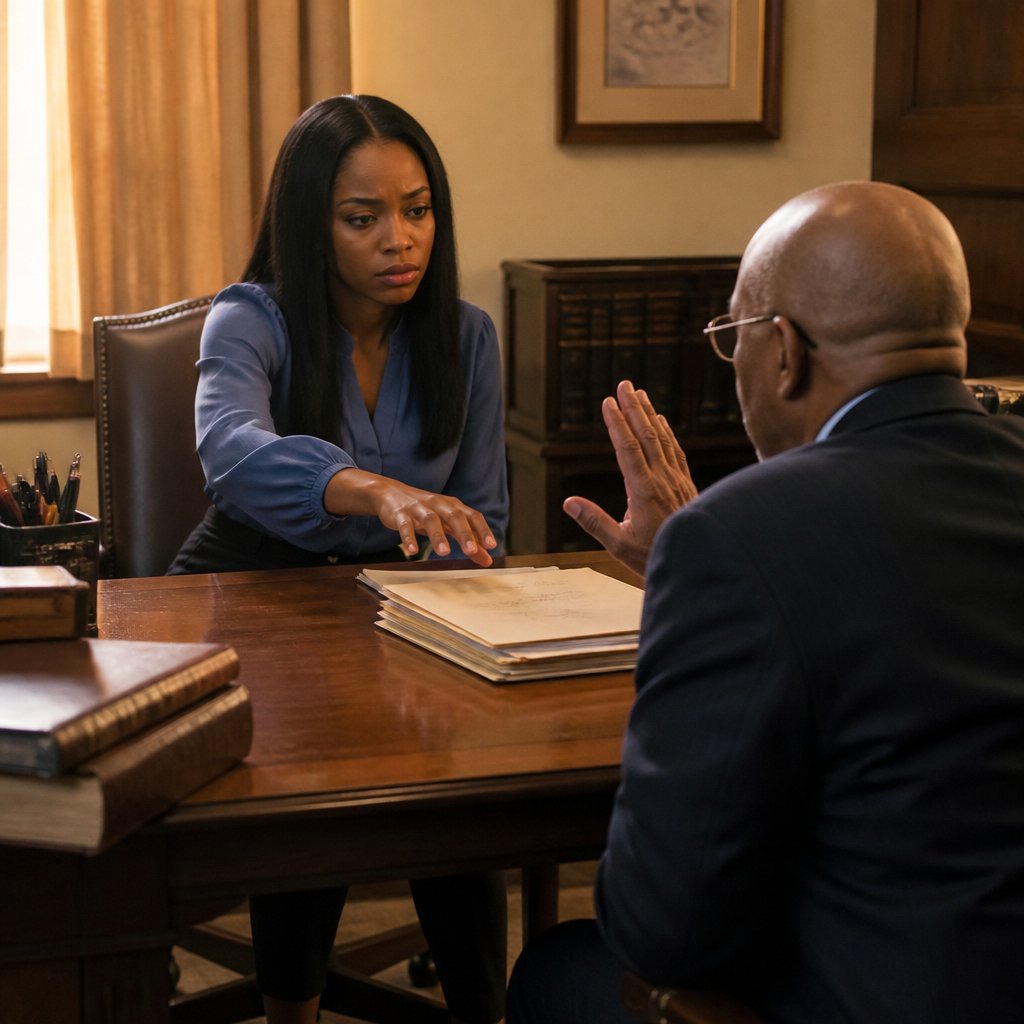
Mr. Feldman’s office felt less neutral the second time, like the walls had taken sides. I sat across from his desk in a simple blue blouse and black pants, my hair brushed straight and tucked behind one ear because I needed to feel put together. On the desk, his leather blotter had a faint scuff mark shaped like a crescent.
“The court granted you temporary appointment,” he said, sliding paperwork toward me. I didn’t read it closely. I just heard the words and felt the weight of them. Temporary personal representative. Like I was holding my mother’s life in my hands for a while.
“So I can access her accounts,” I said. “The bank wants authority.”
He nodded. “Yes. But listen to me,” he said, leaning forward. His wire-rim glasses caught a bit of glare when he moved. “If there are hidden assets, you have to report them. You can’t take something out and decide later what it is.”
I told him I wasn’t trying to steal anything. My voice came out sharper than I meant. “I’m trying to find out what my mother left.”
He held up one hand. “I’m not accusing you. I’m warning you. If that box contains cash, documents, anything tied to taxes or an old dispute, mishandling it can make you look like you were part of it.”
I thought of Darlene’s face at the will reading. I thought of the note under the drawer. “What if someone else is already part of it?” I asked.
Mr. Feldman’s expression tightened. “Then opening it could expose them,” he said, and he lowered his voice. “And it could expose you.”
I reached for the papers, and my hand paused halfway, because I realized the next step wasn’t just curiosity anymore.
A Sign-In Sheet That Changed
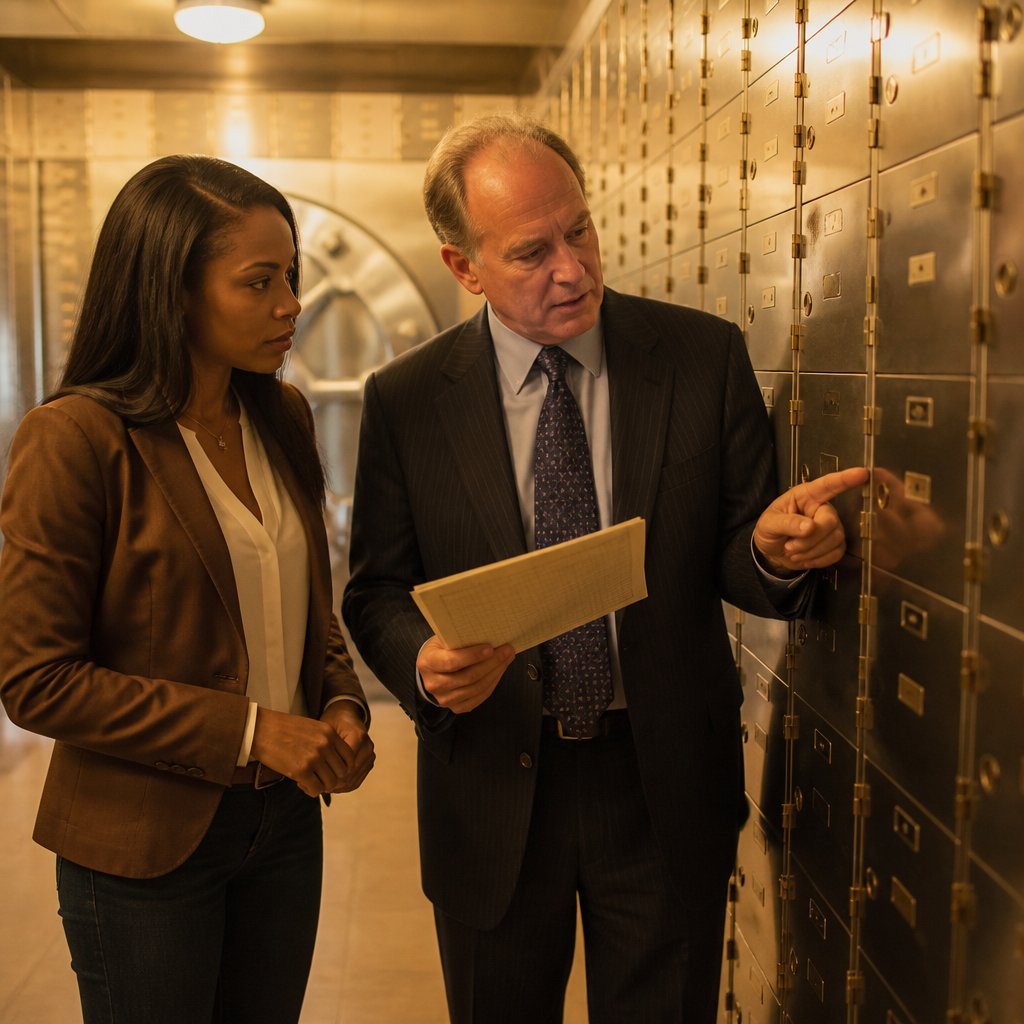
With my court papers in a folder, I went back to the bank and asked, calmly this time, to access my mother’s safe-deposit box. The manager’s smile returned, but it looked pasted on. I wore a brown blazer over a white blouse and dark jeans, trying to blend into the line of people doing ordinary business.
He escorted me to the vault. The heavy door swung open, and the air inside felt still, like a closet that had been shut for years. He brought out the logbook, and I signed where he pointed without looking for names. My pen dragged slightly on the thick paper.
Then he hesitated and opened a lower drawer in the cabinet beside the logbook. He pulled out a second sign-in sheet, thinner, more worn at the edges, like it had been handled recently. The paper had a faint smudge along the margin, a darker streak where someone’s thumb might have pressed.
“We also have to sign this,” he said, too quickly.
I watched his hands. He was careful not to let me see much of the page. He flipped it, then frowned as if something wasn’t where it should be. He reached for the wall of boxes and stopped at 1147.
Where I expected a small name card, there was nothing. Just a clean metal slot with a bit of adhesive residue, like a label had been peeled off.
“That’s odd,” I said, and my voice echoed slightly in the vault.
The manager didn’t answer. He stared at the empty slot, then at the second sign-in sheet, and his jaw tightened like he’d just found proof of something he couldn’t say out loud.
Darlene Showed Up Smiling
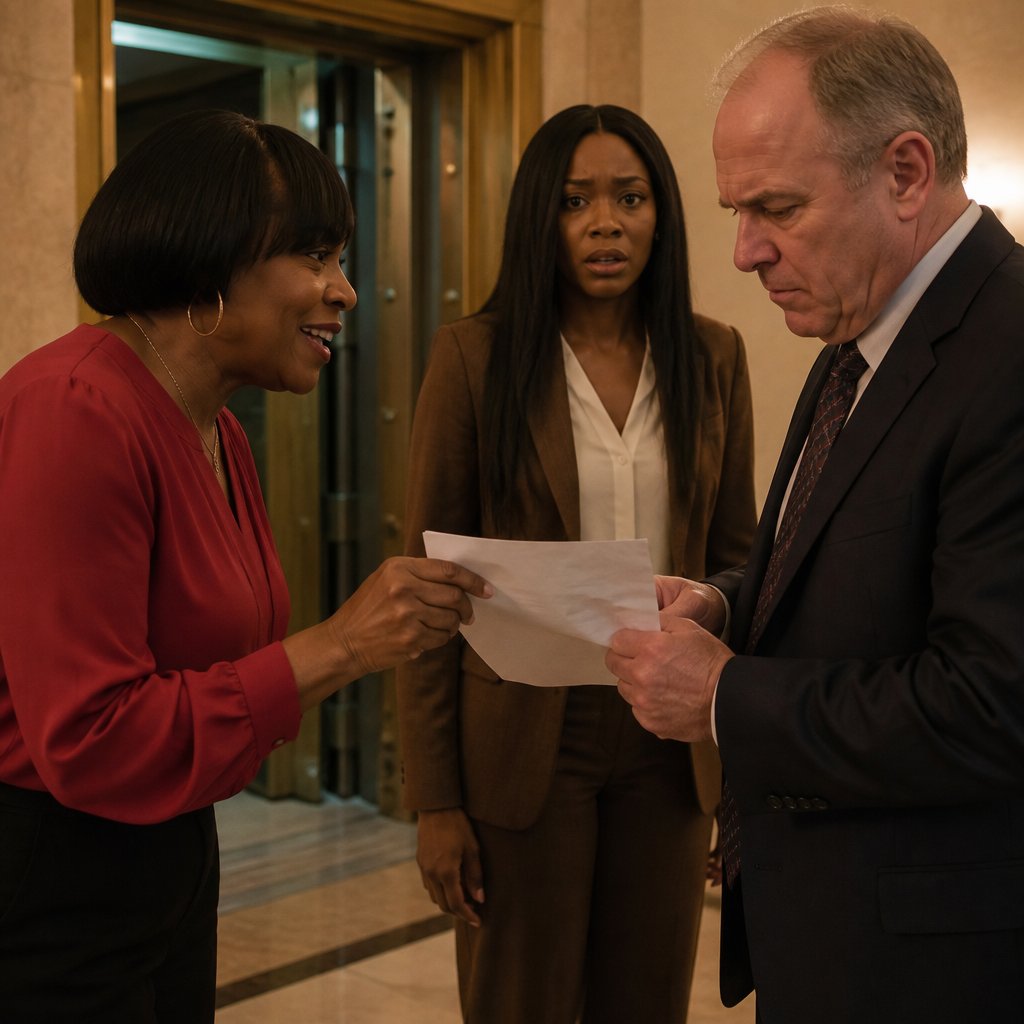
I was still in the vault corridor when I heard Darlene’s heels, sharp and fast, hitting the tile like she owned the place. The sound carried through the open door and made my shoulders tense. The manager stepped out first, like he could block her with his body.
Darlene appeared in the doorway in a red blouse and black slacks, her sharp bob perfect, her gold hoops swinging slightly with her movement. She held a single sheet of paper up in her hand, waving it with a bright, hard smile that didn’t match her eyes.
“You can stop all this,” she said, loud enough for the teller stations to hear. “I have power of attorney.”
My stomach flipped. I’d seen power of attorney forms before, when my friend helped her dad. They didn’t work after death. Everyone knew that. Even Darlene had to know it.
The manager took the paper and looked at it, his face going stiff. He glanced at me, then at her, like he was trying to decide which kind of trouble he was in. I could see a date near the top, but I didn’t need to read it clearly to understand what was wrong. It was dated after my mother died.
“This isn’t valid,” I said, and my voice sounded steadier than I felt.
Darlene’s smile widened like I’d said something funny. “It’s valid enough,” she said. “You’re emotional. Let adults handle it.”
Behind her, two tellers stared and then looked away fast. The manager’s hand tightened on the paper, and Darlene leaned closer to him, lowering her voice like she was offering a deal.
“Open 1147,” she said, soft but clear, “and we can all go home.”
The Bank Said Dispute
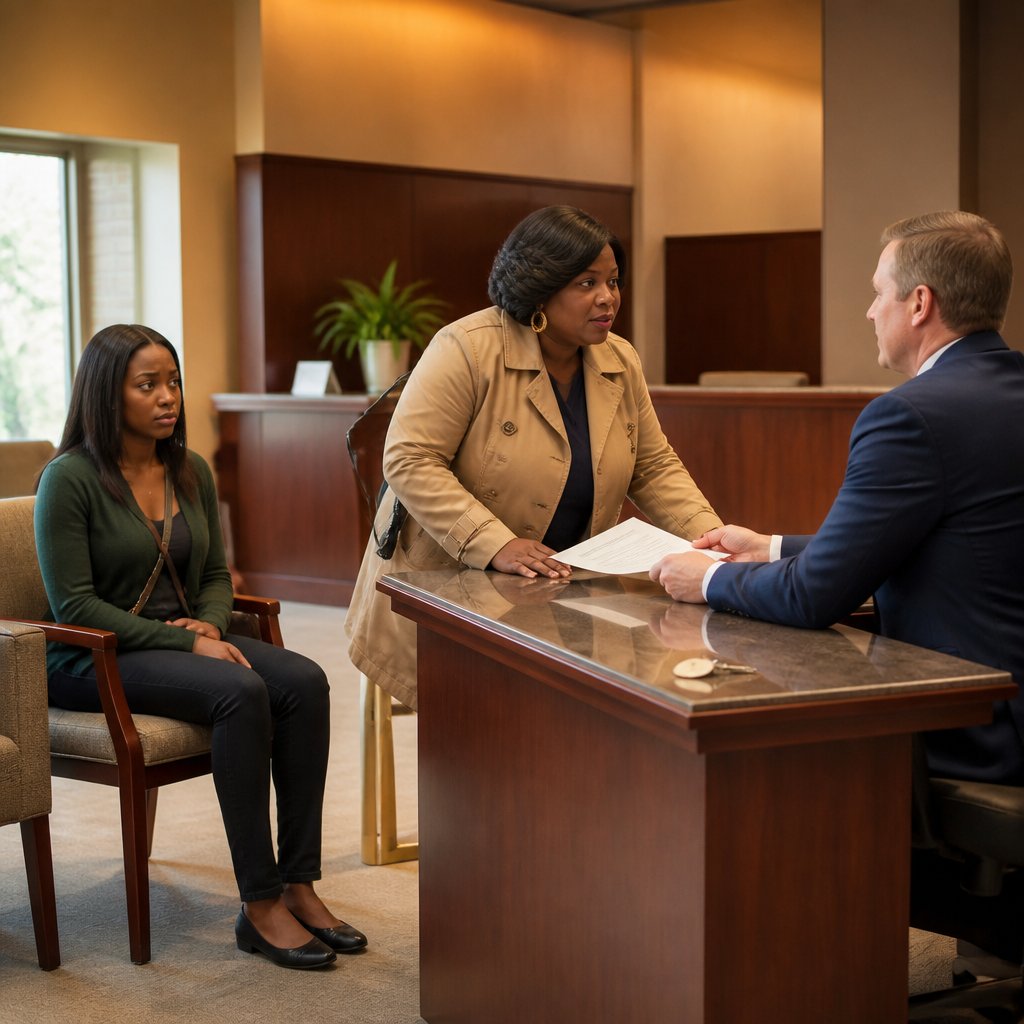
The bank manager didn’t even look at the fake power of attorney for long. He slid it back across the desk like it was dirty, then folded his hands and looked at both of us the same way. I sat stiff in the lobby chair, my knees pressed together, my purse strap cutting into my shoulder. Darlene stood beside me, too close, smelling like sharp perfume and mint gum.
“Because there’s a dispute,” he said, “we’re freezing access to the safe-deposit box until our legal team gives direction.” He didn’t say the box number out loud, but I heard it anyway in my head. Box 1147.
Darlene’s mouth tightened like she’d planned for this. She asked for the policy, for a supervisor, for the number to corporate. The manager kept his voice calm and pointed to a frosted glass door behind him. No papers, no signatures, no exceptions.
I tried to ask what counted as a dispute, but he was already printing something I wasn’t allowed to read from where I sat. The printer hummed, steady and indifferent.
Outside, Darlene paused at the curb and turned her head toward the parking lot like she was checking who might be watching, and I realized freezing access didn’t freeze her at all.
Fridays On The Calendar
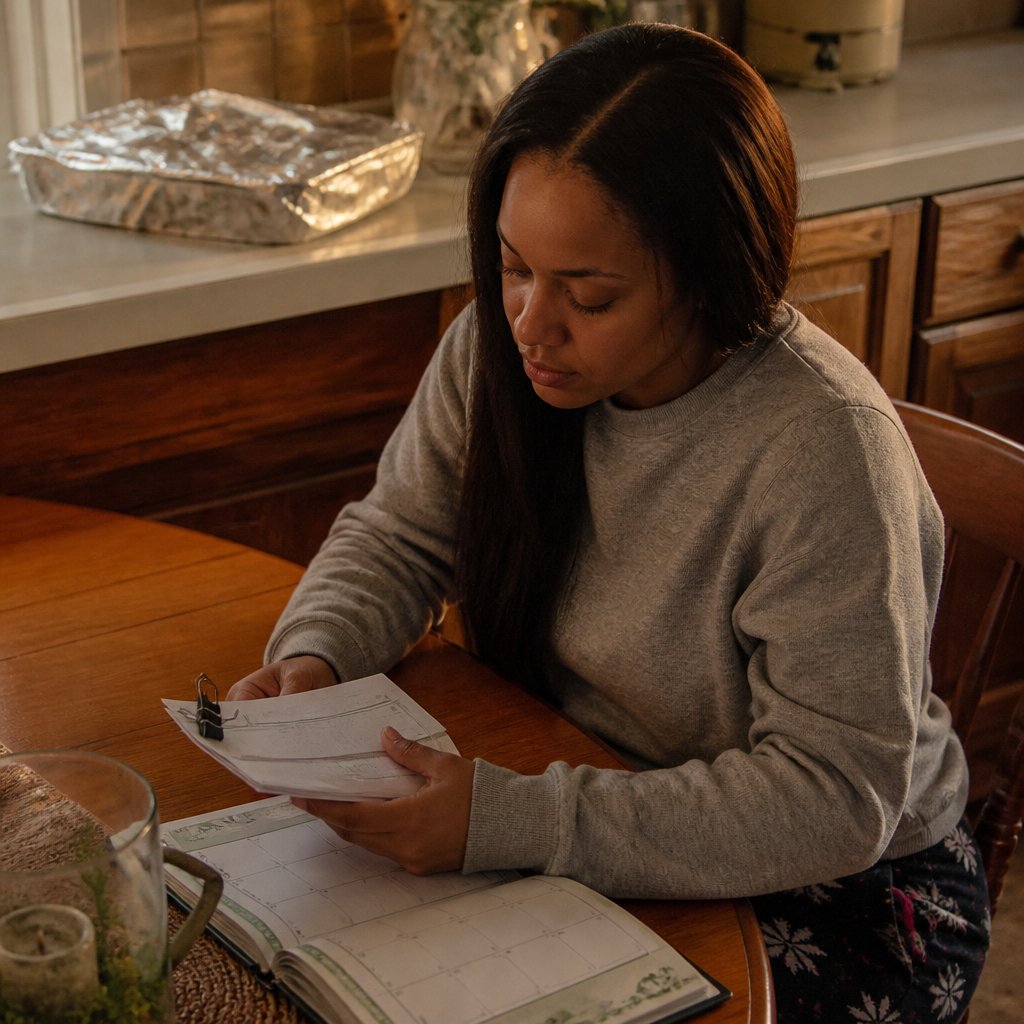
I drove to Mom’s house and let myself in with my key, the one on the worn brass ring she’d had forever. The living room still smelled faintly like the casseroles people dropped off after the funeral—cheesy, sweet, and tired. I went straight to the kitchen drawer where she kept stamps and scissors, then pulled out her old calendar book from the junk mail stack.
Every Friday had a small circle on it. Not every week, but enough to make a pattern. Some days had a little “B” next to the circle, like she was reminding herself where she was going without writing it out. I sat at the table and ran my finger along the months, feeling the raised ridge of pen indentations in the paper.
In the back of the calendar, clipped inside with a bent paperclip, were copies of cashier’s checks. No readable details from where I sat, but the memo line was marked the same way on each one: “SDB.” They went back years. Then they stopped.
Three years ago, the last one was clipped in like the rest, then nothing. No circles after a certain date, either. Like something got handled, or something got cut off.
I held the stack in both hands and listened to the house settle around me, and my mind kept landing on the same question: what changed three years ago that made Mom stop paying for a box she never talked about?
Vince Changed His Tone
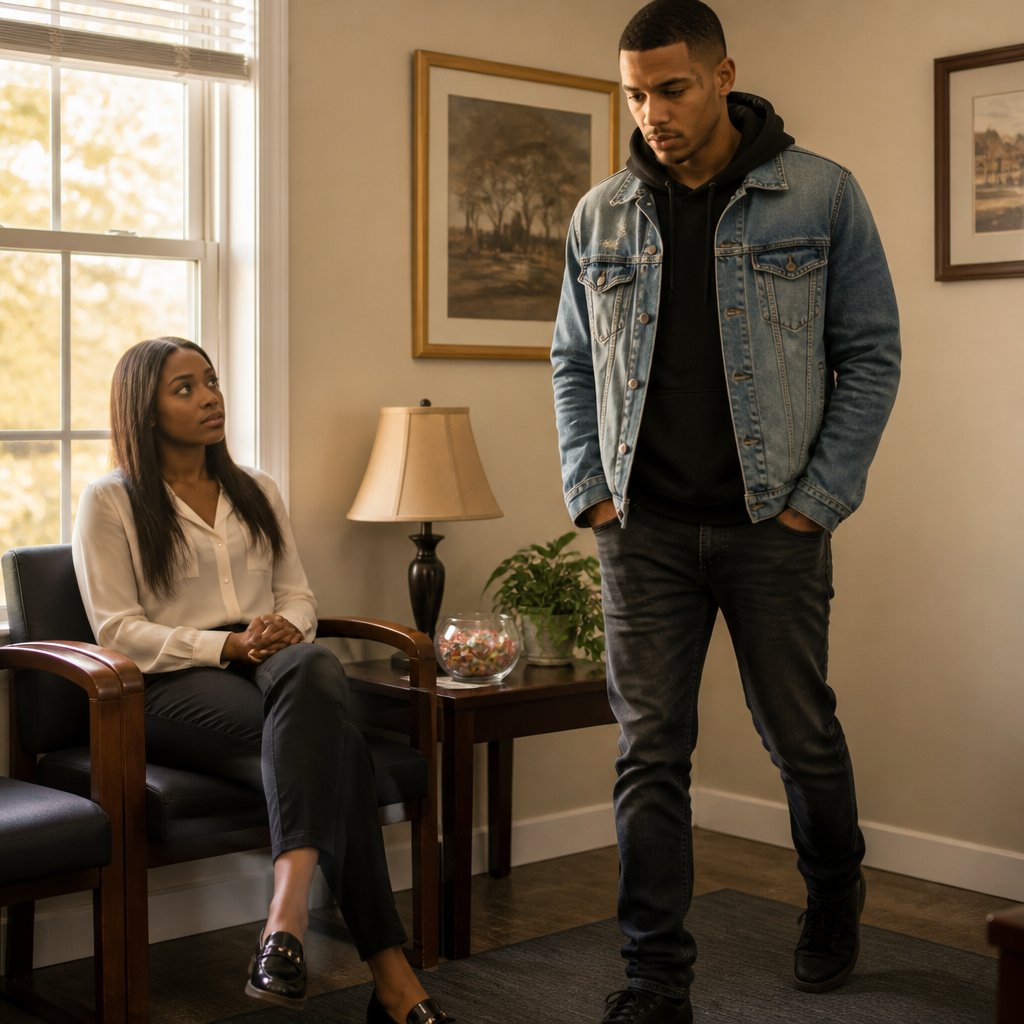
I met Vince at a small law office downtown because he said he needed “a quick talk” before he went back to work. The waiting room had old magazines and a bowl of hard candy that looked like it had been there since forever. Vince paced near the window, hands in his jacket pockets, his jaw working like he was chewing something he couldn’t swallow.
Vince was in his late 20s, light-brown skin, close-cropped hair, lean build, with a faint scar through one eyebrow that always made him look skeptical. Today he wouldn’t meet my eyes. He wore a black hoodie under a denim jacket, and his foot kept tapping against the carpet.
“Darlene’s offering to cover the legal costs,” he said finally. “All of it. Retainer, filings, whatever.”
I stared at him. “For what?”
He shrugged too fast. “For us to stop wasting time fighting the bank. For us to handle it the right way.”
The right way meant her way. I could hear it in how he said it, like he’d practiced the line. I asked him if she’d promised anything else. His eyes flicked to the hallway where the attorney’s door was half open, and he lowered his voice.
“She said we’re family,” he muttered, like that settled something. “She said she’ll make sure I’m not left out.”
It hit me then: she wasn’t just stalling. She was buying time and buying people, one at a time, and Vince was already halfway across the line.
The Night Before Access
The court order came through for supervised access, and for the first time in days I felt like I could breathe. It wasn’t full control, but it was a door cracking open. I put the folder with the funeral papers back in my car because I didn’t want to forget anything in the morning. The key was inside, taped to the inside pocket the way I’d been keeping it.
That night I parked outside my apartment and sat for a minute with my hands on the steering wheel, listening to the engine tick down. The street was quiet, just a porch light and the sound of someone’s sprinkler in the distance. I grabbed my bag and stepped out.
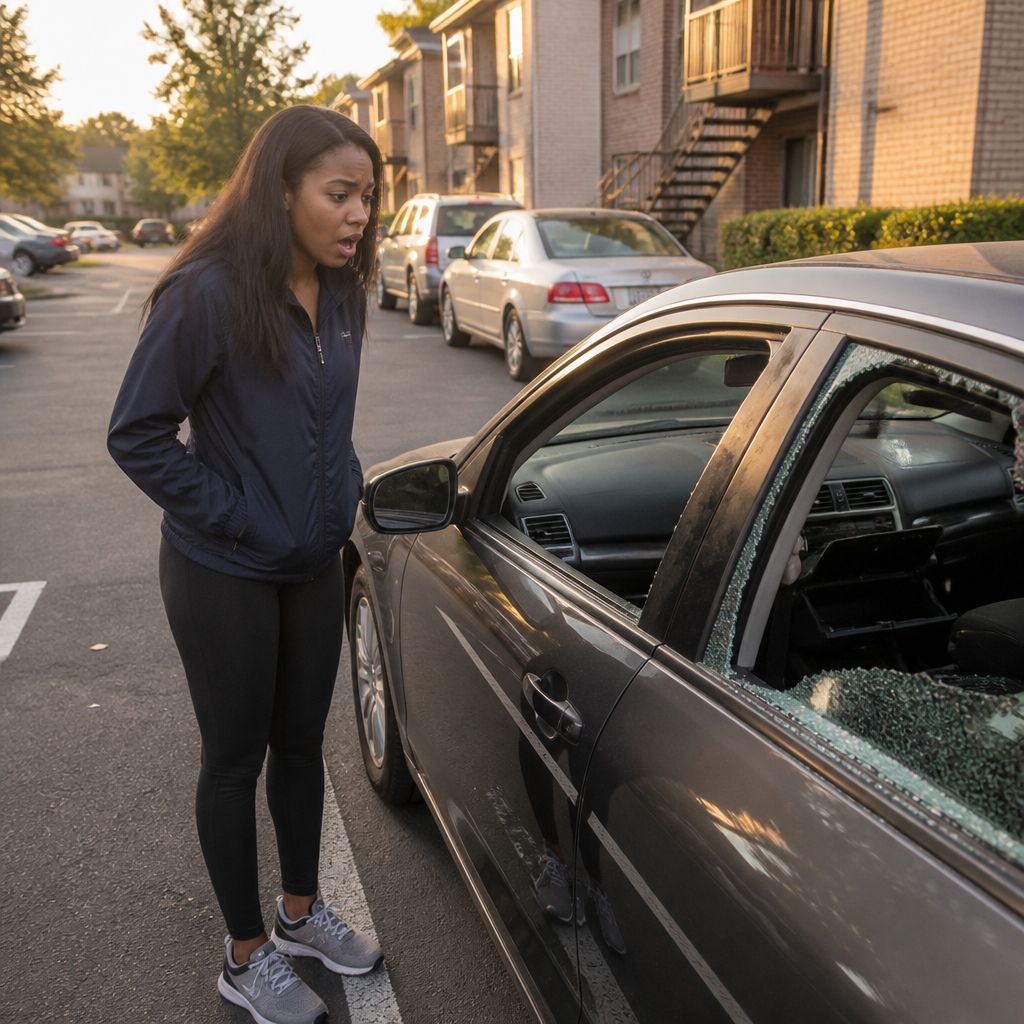
The next thing I knew, I was standing there with my mouth open. The passenger-side window was shattered. Safety glass covered the seat like rough sugar. The glove box was hanging open. The center console was dumped out.
I yanked the door wider and leaned in, my fingers hovering over the glittering shards. My funeral folder was gone. The neat stack of papers, the little sympathy cards, and the key I’d been guarding like it was my last thread to Mom.
I stood in the parking lot breathing too fast, looking up and down the row of cars like the thief might still be there. A neighbor’s door across the way was shut tight. No one came out. No one asked if I was okay.
I backed away from the car, my hands shaking, and all I could think was that someone had been waiting for the same court date I was.
A Duplicate Mark On Metal
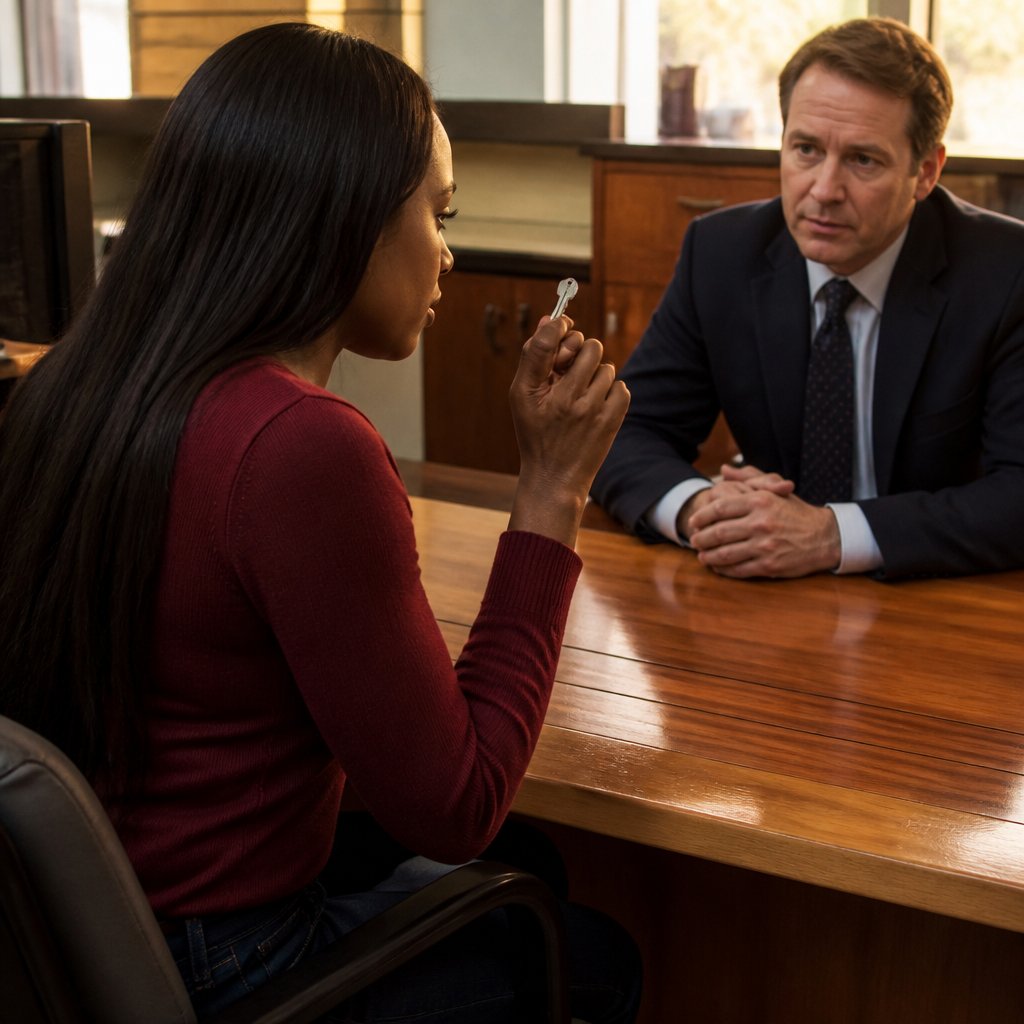
I slept in short bursts and woke up with my jaw clenched. In the morning I took the spare key ring I’d kept at home—just the empty tag from the funeral home and the bank key’s twin I’d never trusted myself to carry. I hadn’t told anyone I’d made a backup. I’d done it the day after the funeral, on impulse, at a hardware store where the guy didn’t ask questions.
Now, holding the key between my fingers, I noticed something I hadn’t wanted to notice before: a small duplicate mark stamped near the head. Not big, not obvious, but enough to tell me this wasn’t the first copy. Or the second.
I went back to the bank and asked to speak to the manager again. He looked tired when he came out, like my family had become his problem. I told him my car had been broken into and the key stolen. I watched his face change, just a flicker.
He hesitated, then said quietly that there had been an attempt to request after-hours access. Not access to the box itself, he clarified, but a “locksmith service inquiry” tied to a safe-deposit box number. It had been flagged and denied.
“Who requested it?” I asked.
He pressed his lips together and glanced toward the back offices. “I can’t disclose that,” he said, but his eyes didn’t stay on me long enough.
I walked out gripping the key so hard it hurt. Someone had tried to get in without me, and the only person bold enough to wave fake paperwork at a bank counter was Darlene.
The Box Felt Too Light
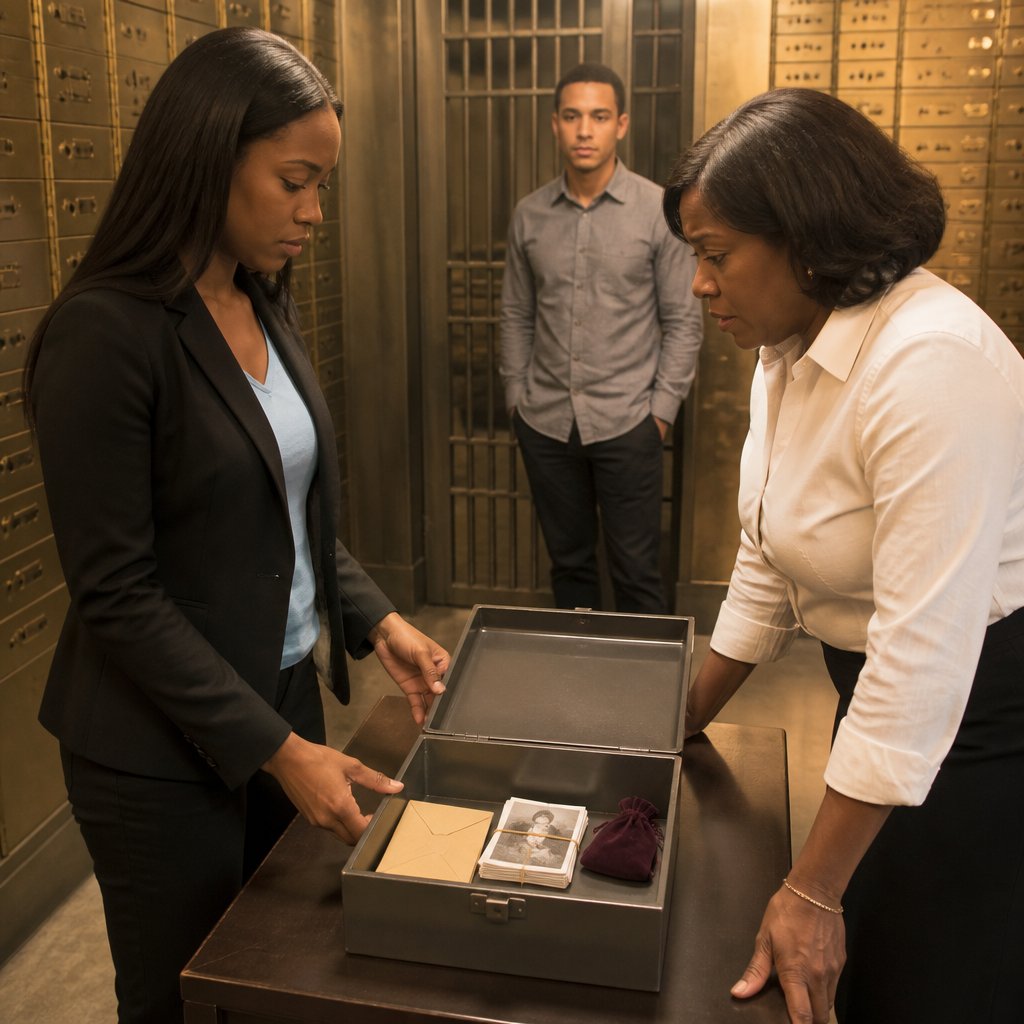
The supervised opening happened two days later. A bank employee led us down a narrow hallway that smelled like carpet cleaner and metal. The attorney the court assigned met us at the vault, along with the manager, all of them acting like they were handling a fragile animal. Darlene arrived in a crisp white blouse and dark skirt, her hair smooth, her face set. Vince came too, hanging back near the door, eyes darting.
They brought out Box 1147 on a tray. It looked ordinary, dull metal with a small latch. When the employee set it in front of me on the little table, I noticed scuff marks along one side that looked fresh, like someone had scraped it against something hard. I put my hand on it and felt the cold through my palm.
It was too light. I knew it before it even opened. I’d carried enough heavy things for Mom—laundry baskets, grocery bags, boxes from her closet—to know when something that should have weight didn’t.
The attorney nodded for the employee to open it. The lid lifted with a soft metallic click. Inside wasn’t empty, but it might as well have been. There was a sealed envelope, thick paper, no visible writing from where I stood. A small packet of photos held together with a rubber band. And a ring in a little pouch, the kind you’d keep in a jewelry box.
No stacks of documents. No bundle wrapped in cloth. No mysterious object that would justify all the secrecy and the Friday trips.
Darlene leaned in a fraction, her breath catching so quietly I almost missed it.
Darlene Went Pale At Once
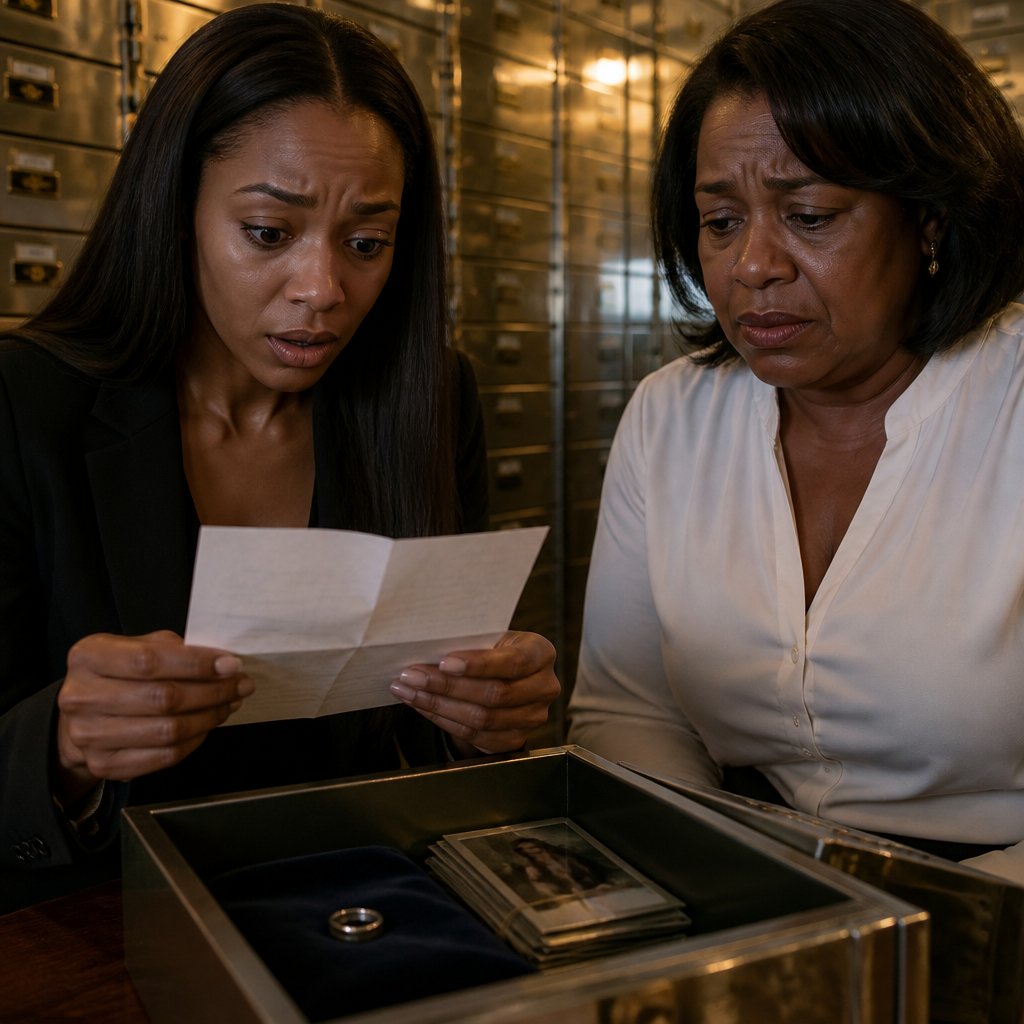
The ring was the first thing Darlene’s eyes locked onto. Her face drained so fast it looked like someone had wiped it clean. She caught herself a second later and straightened, but I’d already seen it. The attorney noticed too, his eyebrows lifting before he went neutral again.
“That’s not mine,” Darlene said quickly, like she was answering a question nobody asked. “I’ve never seen that.”
I didn’t touch it yet. The pouch sat open on the table, and I could see a dull gold band with a dark stone set in it. It wasn’t flashy. It looked old, like something you’d keep because it meant something, not because it was worth something.
The envelope was sealed shut. The attorney instructed me to open it there, in front of everyone. My fingers felt clumsy as I broke the seal. Inside was a letter from my mother, handwritten. I recognized her loops and the way she pressed too hard on downstrokes.
I read silently at first, then my throat tightened and I had to swallow. Mom wrote that the box used to hold something that could “undo what Darlene has planned.” She said she moved it when she started feeling watched. She said if anything happened to her, I needed to go to a second bank.
Then she wrote a name I didn’t recognize. Not mine. Not hers. Not Darlene’s. Not Vince’s.
I looked up, holding the letter with both hands, and Darlene’s eyes flicked to the name like it burned.
A Dead Man’s Active Account
I left the bank with copies the attorney allowed and drove straight to the county records office, then to the second bank Mom named, moving on instinct and caffeine. By the time I got answers, my head was buzzing.
The unknown name from Mom’s letter belonged to a man who’d been dead for twenty years. I confirmed it in a file room that smelled like dust and paper. The clerk slid a folder across the counter, and I stared at the dates until they blurred.
At the second bank, they wouldn’t let me into anything without proper paperwork, but they did confirm something that made my stomach turn: there had been activity within the last year. Not a dusty, forgotten account. Something that had been touched recently.
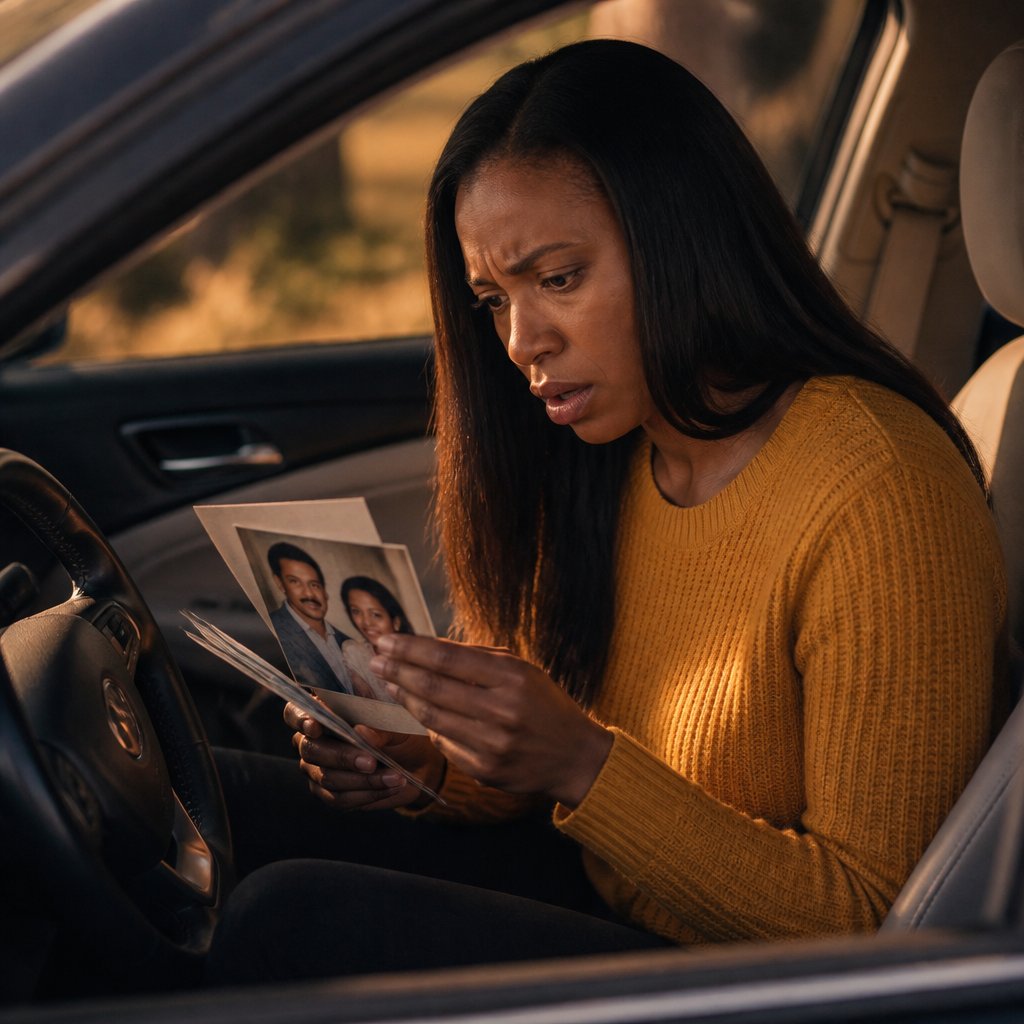
Back in my car, I opened the photo packet from Box 1147 with shaking hands. The rubber band snapped against my finger. The photos were old, glossy, edges curled. In one of them, my mother stood beside a man I didn’t know—broad shoulders, neat mustache, a face that made my throat go tight because it looked like Vince. Not the same person, but close enough to be blood.
There was also a small notarized note tucked behind the photos. No readable details from where I held it, just the stamp and the weight of it. One sentence was clear enough as I skimmed: “Vince’s father is not who you think.”
I sat there gripping the steering wheel, picturing Vince’s face, and realizing someone had built his whole life on a lie that Mom had carried alone.
The House Wasn’t Mine Today
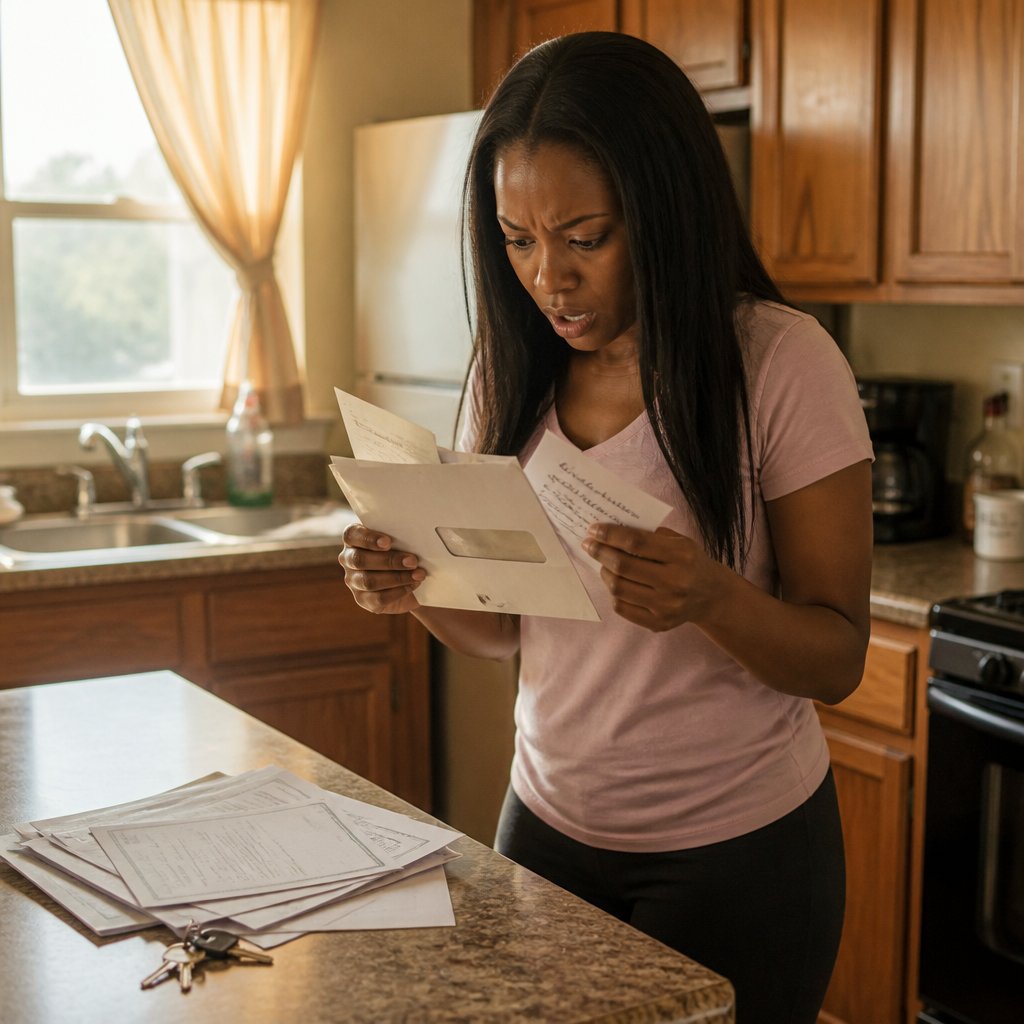
The letter from the court came by courier, not the regular mail, like they wanted to make sure it landed hard. I stood on my porch holding the envelope with both hands, feeling the thick paper and the weight of what it meant before I even opened it. Inside was the notice: an outside administrator was being appointed to manage the house and the estate until the dispute resolved.
I read it twice, then a third time, like the words might change. I was still living there, still paying utilities, still sleeping in my childhood room when I could stand it, but now I didn’t get to decide anything. Not repairs. Not access. Not who came and went. The house felt colder just from reading it.
I went inside and found the administrator’s card stuck under the magnet on the fridge. No phone calls I could make would fix this today. I set the papers on the counter and tried to breathe through the tightness in my chest.
Later, when I was sorting the stack of church papers people had handed me after the funeral, I found a bulletin folded small, tucked inside another sheet. There was a handwritten note in the margin in my mother’s careful hand. No readable words from where I first saw it, just the shape of her writing and the way she underlined once.
I unfolded it slowly, my fingertips catching on the cheap paper. The message was simple: “Ask Pastor Ken about the envelope I left him.”
I stared at it, hearing Mom’s voice in my head like she was standing behind me, and I realized she’d hidden something where Darlene couldn’t reach it.
Pastor Ken Had Kept It
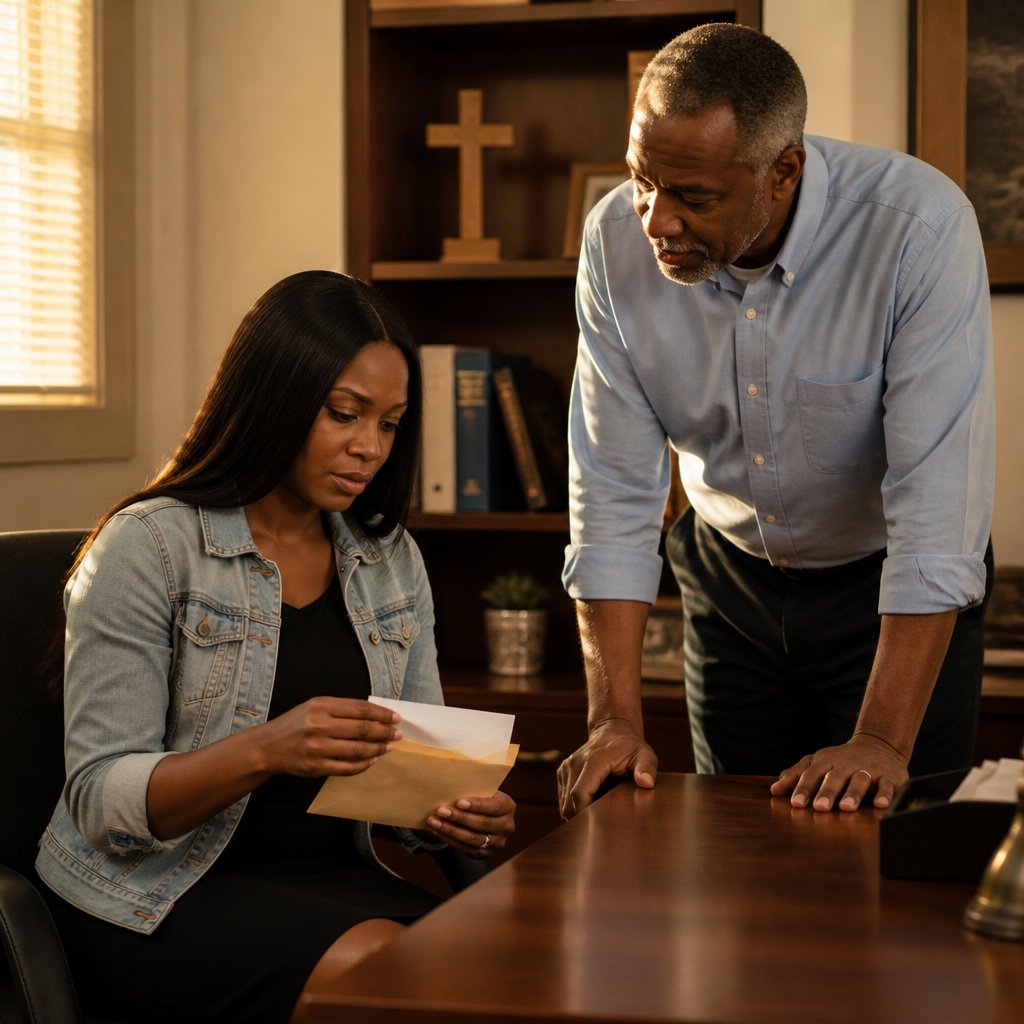
Pastor Ken met me in his church office the next afternoon. The room smelled like old books and lemon cleaner. He was a tall Black man in his late 50s with gray at his temples and a calm face that looked heavier than it used to. He wore a simple button-down shirt with the sleeves rolled up, like he’d been doing work that didn’t show.
He didn’t make me sit through small talk. He opened a filing cabinet and pulled out a sealed envelope, thicker than the one from the bank, and held it in both hands like it mattered. He said Mom had asked him to keep it safe “in case things got messy.”
We opened it together at his desk. Inside was a newer will, properly witnessed. The signatures were there. The dates were there. And it cut Darlene out. Alongside it was Mom’s statement describing how Darlene had pressured her after her stroke, how she’d been confused and scared, how she’d signed things she didn’t understand.
My hands shook as I held the pages down so they wouldn’t curl. I felt like I was finally holding something solid—something that could protect what Mom wanted.
Darlene didn’t wait long to strike back. When her attorney showed up at the emergency hearing, she sat upright in a navy dress, lips tight, eyes sharp. She claimed the envelope had been tampered with. Then she turned and pointed straight at me.
“Mara forged it,” she said, loud enough for the whole room to hear, and the judge’s eyes shifted to my face as if he was already weighing which of us looked more believable.
The Name On The Trust
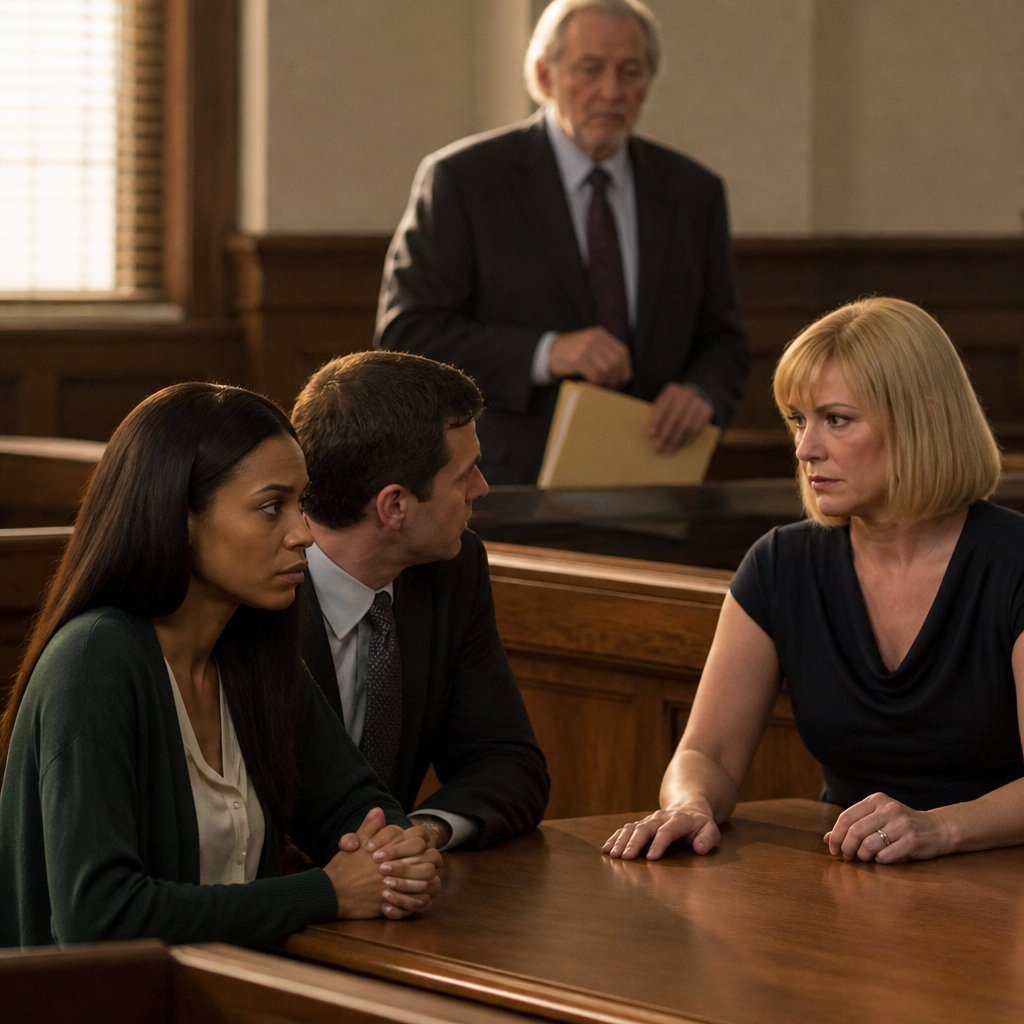
The judge didn’t let me ramble. He asked for facts, dates, documents. My mouth felt dry, like I’d been chewing paper. Darlene sat with her arms folded tight, her wedding ring flashing every time she shifted.
My lawyer asked to call one witness we’d just located that morning. A retired trust attorney named Harold Quill stepped up slow, in a tan sport coat that didn’t quite match his pants. He was white, late 60s, heavy-lidded eyes, and his hands shook when he held the Bible for the oath.
He said my mother came to his office years ago, alone, with a manila folder and a calm face. She asked for a trust “to protect a child not listed on any paper.” He said she repeated that line twice, like she was afraid she’d forget it. He didn’t say the child’s name. He said she didn’t give him one.
Then he looked down at his notes and told the court who she named as successor trustee if anything happened to her. He didn’t say “Darlene.” He said a married name I’d never heard in my life.
Darlene’s chin lifted like she’d been slapped, and my lawyer turned to her with a flat look. The name was hers. The legal name on her marriage license. Meaning she’d had control of the second box this whole time, and Harold said, almost apologetic, that trustees often “move items for safekeeping” while no one is watching.
I stared at Darlene’s hands, at the way her fingers tightened around the edge of the table, and I realized she’d been touching my mother’s things for years while I was grieving in the dark, and the judge asked her, very quietly, when she first accessed the box—
What Darlene Said Wrong
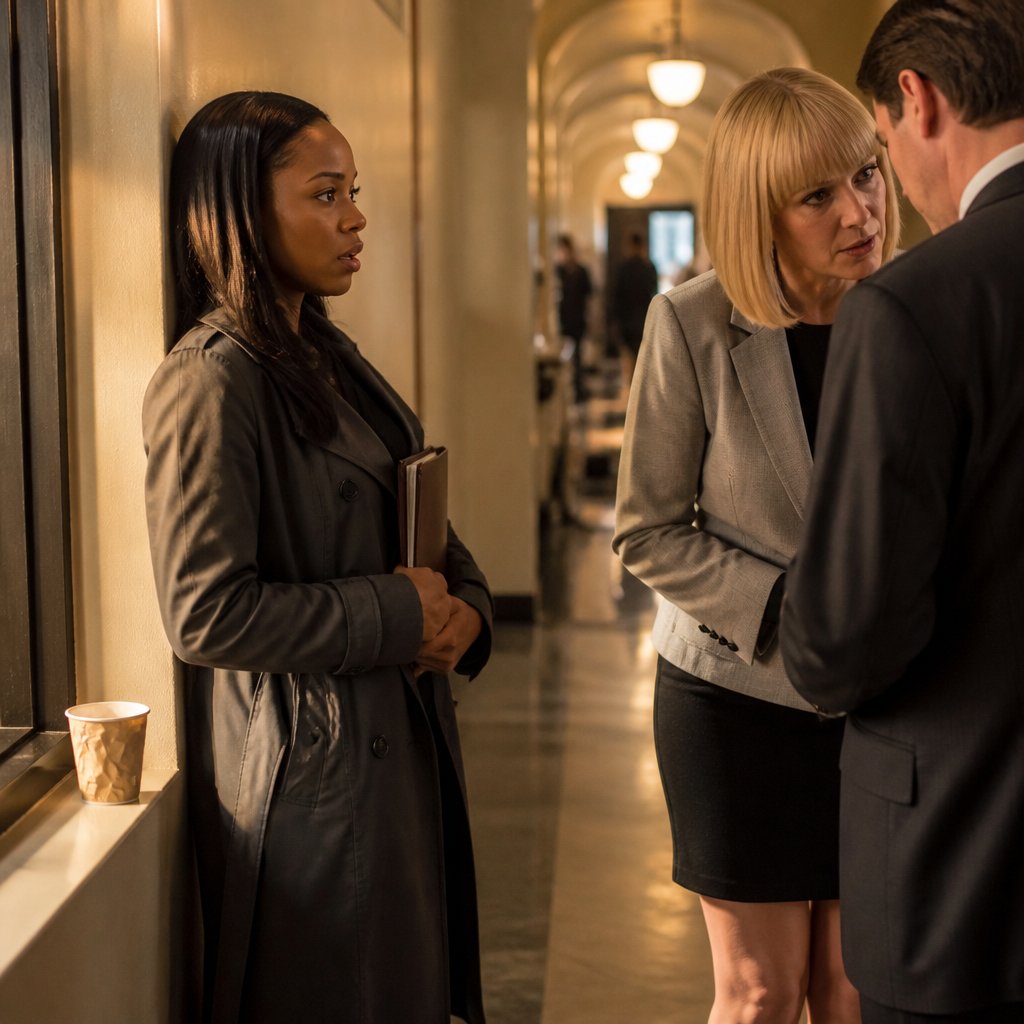
The hearing turned into something urgent fast. The judge called it “an emergency matter,” and the bailiff brought in a pitcher of water that tasted like metal in paper cups. My lawyer slid a yellow legal pad toward me, but I couldn’t write. My hand wouldn’t stop trembling.
Darlene finally spoke when the judge asked about access. She was careful at first, like she’d practiced in a mirror. She said she “handled things” after my mom got sick. She said she didn’t take anything that didn’t belong to her. She said she was “protecting the family.”
Then she slipped. It was small, just one sentence, and it came out sharper than the rest. She said, “That’s why I kept the handwritten addendum separate.”
My lawyer’s head snapped up. I felt my stomach drop, because nobody had said the word addendum in court. Not Harold. Not us. The only reason I knew there was a handwritten note at all was because I’d seen the edge of it in Box 1147 before the bank officer tucked it back under the envelope. No copies, no mention, no record yet.
The judge leaned forward, eyes locked on Darlene. “Explain how you know there is a handwritten addendum,” he said, slow and flat.
Darlene’s mouth opened, closed, then opened again. Her cheeks went red in patches. Her attorney started to stand, but the judge held up a hand and shut him down.
He ordered both banks to preserve every access log, every signature card, every camera record they had. He set a date for a supervised opening of the second box, with both sides present, no items removed until inventoried. When he said the time and place, Darlene’s eyes flicked to me like a warning, and I saw her swallow hard as if she’d just tasted something bitter, and I realized whatever she’d moved was already gone—
Was Darlene’s secret move a betrayal or protection?