




The Rule That Locked Everything

We stuck the "no yelling" rule on the fridge that morning. Mark carefully wrote it out on a magnetized piece of paper, neat and final. I thought it was a good idea at first—less noise, less tension. But almost immediately, I felt the weight of it like a chain. It wasn’t just a guideline anymore; it became a strict law he enforced relentlessly. Every time I tried to explain or defend myself, Mark threw the rule back in my face like a shield. It felt like I’d signed something invisible, agreeing to silence in any conflict even when I didn’t understand what that meant exactly.
That afternoon, I sat at the kitchen table, my fingers twisting the edge of the rule paper. The hum of the refrigerator was the only sound. I wanted to say something—anything—but the rule kept me frozen. Mark glanced over, eyes calm but sharp, as if waiting for me to slip up. The room felt smaller, the quiet more suffocating than peaceful.
Sticky Notes On My Things

One morning, I opened my jewelry box to find a yellow sticky note stuck to a silver bracelet. It said, "Too loud this morning." Another note was on my coffee mug: "Left dirty again." Mark had started writing on little pieces of paper and placing them on my personal belongings. It wasn’t just ordinary reminders; they felt like silent accusations that I couldn’t respond to out loud without breaking the rule.
I walked through the house, finding snippets of criticism on everything — the bathroom mirror, my laptop bag, even my favorite cookbook. Each note made me feel more isolated, like the objects around me were turning against me silently. Mark never spoke these thoughts anymore; he let the sticky notes do the talking. I kept wondering how to answer without yelling, but the notes didn’t give me a chance.
Rules I Never Signed Up For

That evening, I discovered a shared folder on the kitchen laptop labeled "House Standards." Curious, I clicked into it and found a list of new rules. Hours earlier, Mark had updated it with things like "No interruptions during messages" and "Weekly mood check-ins required." I never agreed to these rules, but Mark acted as if my silence was consent. When I asked about them, he said, "You were silent, so you accepted."It felt like I was trapped in a system I didn’t understand, where silence meant agreement even when I wasn’t sure what I was agreeing to.
I sat on the couch, the laptop warm on my knees, staring at the screen. The rules seemed to pin me down, and I couldn’t find any way to push back without breaking the "no yelling" rule or seeming difficult. The quiet wasn’t peace. It was a trap.
Writing Only, For 'Calm' Talks

Mark told me all serious discussions had to happen in writing now "to keep things calm." I agreed hesitantly, but I soon noticed him screenshotting every reply I sent. I’d write carefully, choosing my words to avoid any hint of anger, but I knew my messages were being archived like evidence. The quiet exchanges felt like a courtroom, not a conversation.
One night, I left my note on the kitchen counter, a careful response to his questions. Mark read it silently, then looked at me with that unreadable expression. I wondered if he’d added my words to some hidden file. The house felt colder, the silence more accusing. I wanted to talk face-to-face, but the rule and his silent surveillance tightened around me.
The Fridge Rule As A Barrier

I tried to talk to Mark directly one afternoon, hoping to break the cycle. When I started to explain how overwhelmed I felt, he just pointed at the "no yelling" rule on the fridge. It was like a wall between us. Any spoken defense of myself suddenly looked like breaking the rule. I bit my tongue but felt my frustration rising anyway. There was no safe way to speak without being framed.
He didn’t say a word, just held his gaze steady. The fridge rule glared at me, the laminated paper a cold reminder of my silence. I stared back, trapped by the paradox of needing to speak but being forbidden. The room seemed to shrink around us, the quiet thick and heavy.
Binder Of Silent Evidence

When the mediator session started, I felt the weight of the quiet pressing against me. Mark sat across the table, clutching a thick binder filled with screenshots, chat logs, and timestamps. He arranged them methodically, like a prosecutor setting a case. The mediator, a calm middle-aged woman with silver-streaked hair pulled back in a low bun, nodded approvingly as she praised our no-yelling rule. "This approach helps keep communication respectful," she said, glancing at me with a gentle smile, though I felt anything but respected.
I tried to explain my side, but every word seemed to be caught between pages of the binder or reduced to a footnote in a shared document. Mark's silent arsenal made me feel outnumbered even in a room dedicated to fairness. The mediator kept steering the conversation back to the logs and message timestamps, leaving my voice barely more than a whisper.
The air smelled faintly of brewing coffee from a pot in the corner, untouched. The room felt like a courtroom where my feelings were footnotes in Mark's documented facts. I was speaking, but they weren’t really listening. The binder thudded closed like a verdict—I wondered how I would navigate this new battlefield.
Timer Dictates Our Talks

Back home, I noticed Mark had brought out a small digital timer. He set it on the kitchen counter, clicking it on as soon as we began talking about weekend plans. Each word felt measured, like currency to be spent wisely.
He would glance at the timer, sometimes tapping his wrist as if taking notes. When it beeped softly, he declared, "Session concluded," then immediately opened the group chat on his phone, typing the phrase there. The words sat in the chat like a closing statement, final and cold. The kitchen smelled faintly of burnt toast—small domestic details felt amplified in the quiet.
I tried to ask about the timer, but he just nodded and said it helped keep our conversations efficient. I felt like I was performing under a microscope, living inside procedures and time limits instead of a home. The air felt heavy, and I wondered how much longer I could pretend this was normal.
Notes Pushed Under Doors
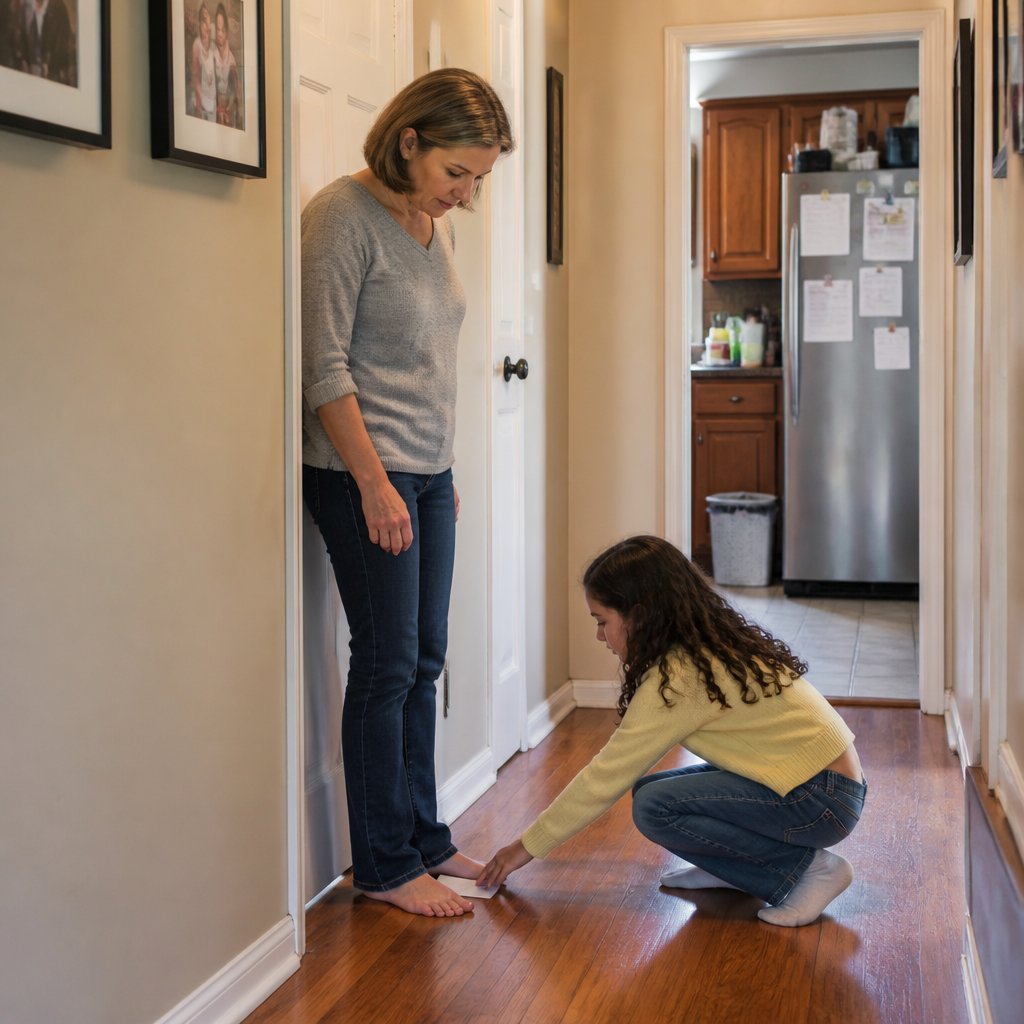
One evening, Mark started slipping notes under the guest room door where Lily sometimes stayed. I found myself peeking down the hallway as she slid one back, her fingers trembling slightly. The notes were brief—reminders, rules, or sometimes questions—but the silence between them said more.
Later, I discovered a new "Parenting Protocol" document pinned up on the fridge. It outlined new rules for Lily’s schedule and behavior—rules Mark had written and shared in the family group chat without asking me. The kitchen smelled like the lemon-scented cleaner I’d used that morning, but the room felt colder somehow.
I stared at the protocol, feeling blindsided. The guest room door was closed, a note still resting beneath it. I didn’t know what Lily was feeling, but the distance between us all was growing.
Evaluator Sees The Whiteboard

The evaluator arrived on a chilly Thursday morning. I had made sure the kitchen was tidy—pots washed, the table cleared except for the whiteboard leaning against the wall. Mark had spent the previous night filling it out meticulously: bullet points, rules about conversations, times for sticky-note exchanges. It looked clinical, not like a home. The notice board was plastered with color-coded rules, including "No interruptions" and "Speak only in notes during conflicts." Mark called it "structure," insisting it kept things calm.
During the visit, he slipped a fresh sticky note to me while the evaluator was out of the room. I wanted to refuse but knew all communication was monitored. The evaluator sat across from me in the living room, eyes steady and kind. When she asked if I felt free to disagree, I hesitated. My voice had been stifled so long that even the thought of speaking up felt foreign. I looked down at the sticky note in my hand, the familiar texture sharp against my skin.
As the evaluator packed her things, I caught Mark’s glance—calculating, unreadable. What was he controlling with this silent system? The walls, the words, or something deeper?
Mark’s Voice Breaks Silence

The final mediation was held in a small conference room. I sat across from Mark, our mediator in between us, recording everything. Mark had been silent for much of the session, his words clipped and carefully measured. When I played back a recording of him saying, "If you talk, I’ll log it," his face tightened. It was soft, but the threat was clear.
When the mediator pressed him to explain, something slipped. Mark’s voice rose, cracking the calm he’d worked so hard to maintain. The sharp edge in his tone surprised us all. His carefully curated image shattered in a blink. I felt something shift in that moment—a crack in the armor he’d built with silence and notes.
As the mediator prepared to make the decision, I watched Mark’s eyes flicker, uncertain. The quiet rules were unraveling, but what would come next?
Mark Wants To Talk Like Adults

After the separation and custody terms were finalized, Tessa was cut out of our communications to keep things clear. Lily’s voice was finally protected, and I felt a fragile relief. But Mark kept sending messages through a corporate app—formal, distant, and cold. It was like seeing the old control flicker back in a new form.
Then, unexpectedly, Mark asked if we could "talk like adults"—out loud, face-to-face, without notes or logs. His message came late one evening. I stared long at my kitchen counter, hands wrapped around a still-warm mug of tea. What was he trying to change now? Was it a genuine attempt to communicate, or another way to rewrite the rules before everything became permanent in the record?
The kettle hissed quietly nearby, and the silence in the room was heavier than ever.