



What He Left At 12:47
I watched Grant’s face on the doorbell footage like it could bite me through the glass. 12:47 a.m. My custody night. His truck headlights swept my porch, and there he was—Grant, forty-two, tall, clean-cut with that practiced calm—crouching like he owned the place.
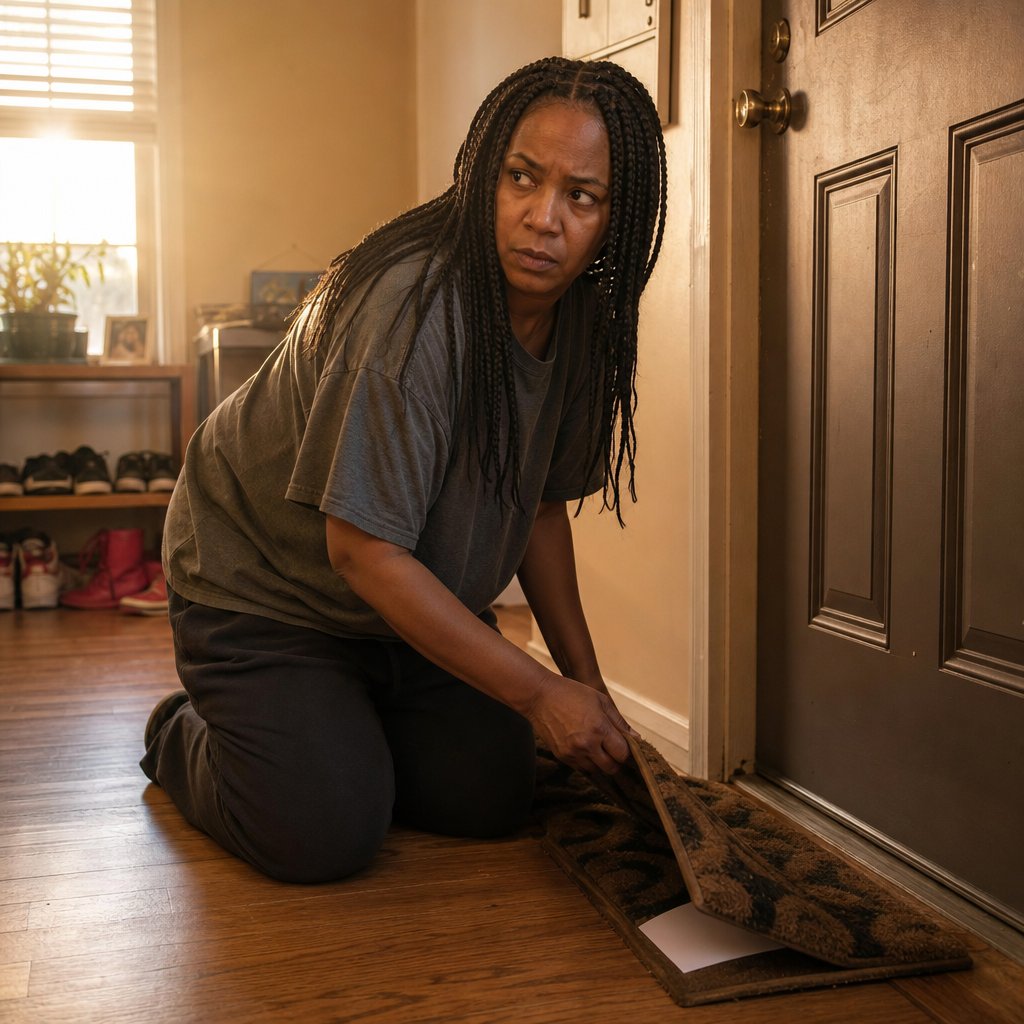
He didn’t knock. He didn’t text. He didn’t call out the way a normal person would if it was “about the kids.” He glanced over his shoulder, then slid something thin under my doormat with two fingers, like he was planting evidence at a crime scene.
I stood in my kitchen in an old T-shirt and sweatpants, my long box braids pulled into a loose knot, and my stomach turned cold in that specific way it did when I realized I was being played. The house was quiet except the refrigerator hum and the faint rattle of the air vent. My son was asleep down the hall. My daughter too. They hadn’t heard the doorbell chime—thank God.
Grant stood up, smoothed his jacket like he’d done nothing, and walked back into the dark. Before he got off my porch, he turned and looked straight at the camera lens, like he wanted me to see him seeing me.
I grabbed my keys with shaking hands and went to the front door, already knowing whatever was under that mat wasn’t meant for me alone.
When I lifted the doormat, the paper edge peeked out—folded once, crisp, deliberate—and I felt my throat tighten as if it already had my name on it.
The Texts I Never Sent
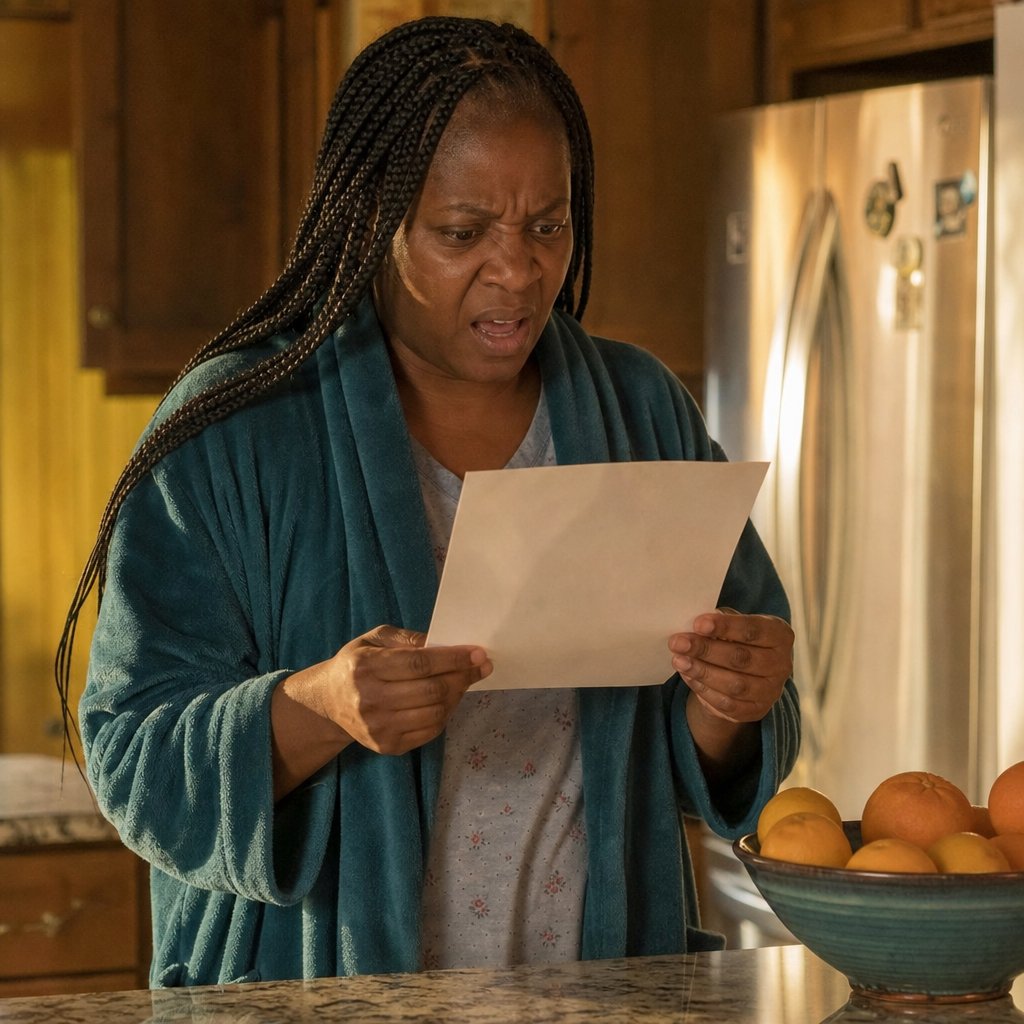
The paper was a printed screenshot—grainy, cropped tight, like someone had trimmed it with scissors until only the ugliest parts remained. My name sat at the top like a punch to the mouth. Under it, “my” messages stacked in bubbles, and the words were vicious in a way that made my skin prickle.
I read them once and my chest went hollow. I read them again and got angry enough to taste metal. I didn’t talk like that. I didn’t write like that. And I sure as hell had never sent those words to Grant.
The worst part wasn’t the insults. It was the little details meant to sound believable—references to the kids, to “your apartment,” to “your precious schedule”—as if whoever made this knew exactly how to mimic our lives. Whoever made it understood what would sound real to an eight-year-old who only caught pieces of adult fights.
I pressed the paper flat on my kitchen counter, next to a bowl of oranges, and stared at it until my eyes burned. The citrus smell suddenly felt sharp and wrong, like a cleaner. My fingers left faint smudges on the ink.
At the bottom, there was a time stamp—cropped but still there—and a tiny sliver of the thread above, just enough to suggest I’d been ranting for hours.
Someone wanted this to be found. Someone wanted it to be waved around like proof. I imagined my son’s face reading it, his mouth tightening, his little shoulders going stiff.
I flipped the page over, hoping—stupidly—for an explanation, and found nothing but clean white paper.
Then I heard the soft creak of the hallway floorboard, and I froze with the printout in my hand.
My Lawyer’s Sudden Silence
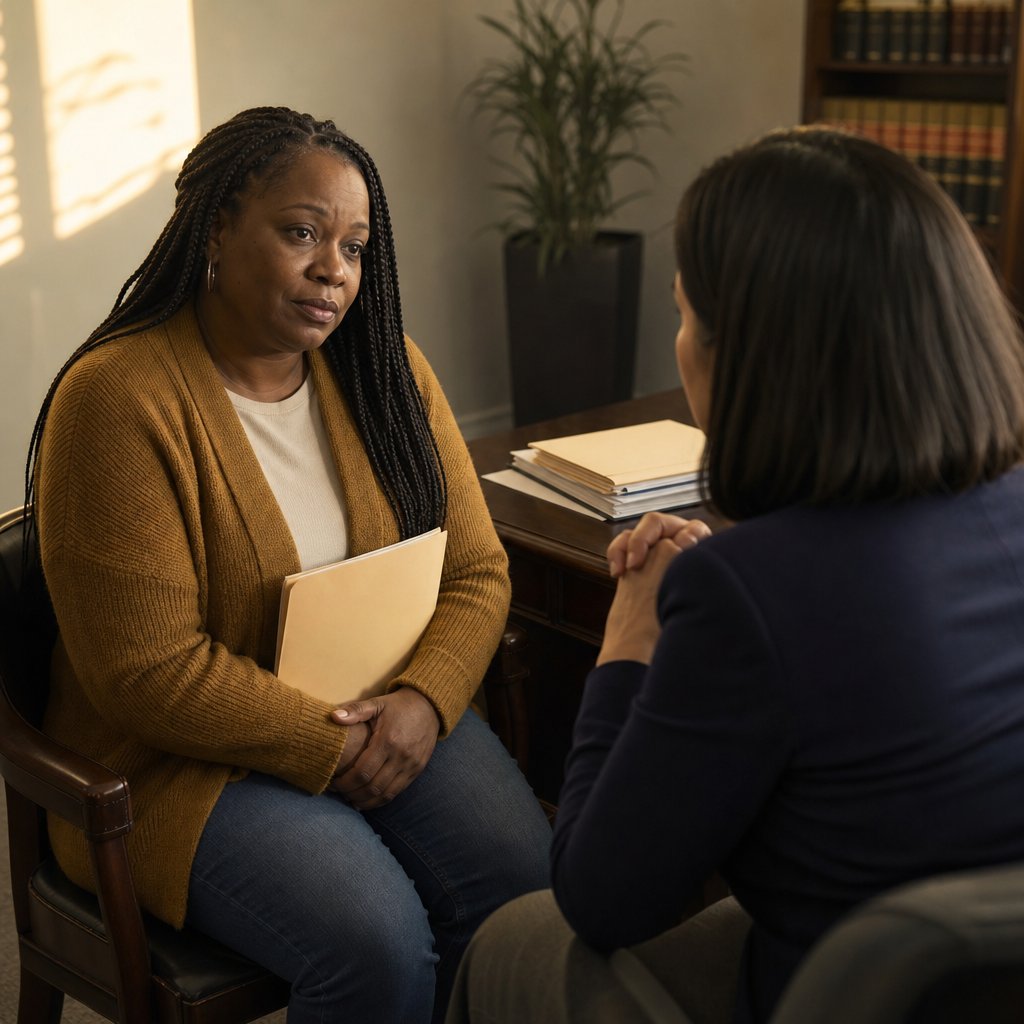
My attorney, Marisol Vega, didn’t react the way I wanted. She was in her late thirties, sharp eyes, sleek dark bob, always dressed like court could happen at any moment. I sat across from her in her office, the fake screenshot in a plain folder, my knee bouncing so hard the chair squeaked.
She read it once. Then again. Then she went quiet—so quiet I could hear the faint click of a ceiling fan chain and the distant murmur of someone laughing in the hallway outside her door.
“This is… constructed,” she said finally, like she was choosing each word with tweezers. Her gaze lifted to mine. “He’s building a narrative.”
I leaned forward. “So we file something. We tell the judge he’s making things up. We—”
Marisol raised a hand, palm out, and it felt like being stopped at a crosswalk while a car sped past. “Not yet. Not without proof he fabricated it. If you confront him directly, and he records you, and you sound angry—”
“I am angry,” I snapped, then swallowed it back because I could hear my own voice climbing.
She nodded like she’d been expecting that. “He wants you angry. He wants you to look unstable. He wants you to look like the kind of mother who would send those texts.”
I stared at the folder, at the crisp edge of the paper inside, and felt trapped in a maze where every turn was a camera angle. If I didn’t confront him, he kept doing it. If I did, he used my reaction as Exhibit A.
Marisol slid the folder back to me. “Document everything. Don’t give him a scene.”
I tightened my grip until my knuckles ached, because all I could think was: he already gave me the scene.
And my next custody exchange was in the morning.
Briefed Like Little Witnesses
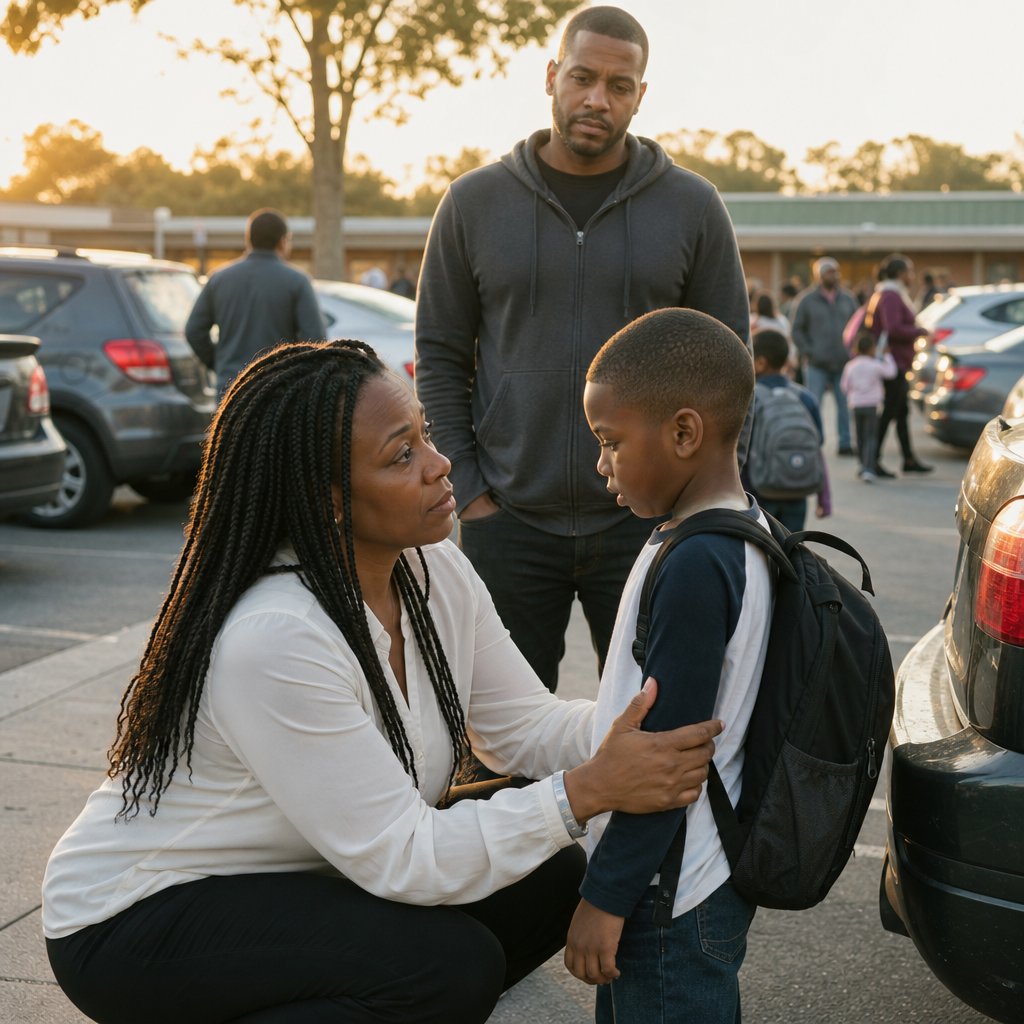
The pickup happened in daylight, which somehow made it worse. Grant’s parking lot was full of ordinary life—shopping carts, parents with coffee cups, kids whining about snacks—like my world wasn’t cracking open.
My son came out first, eight years old, small for his age with a close-cropped haircut and big eyes that usually lit up when he saw me. That day, he hesitated at the curb like the air between us might sting.
Grant followed behind him, keys in hand, that calm face turned up just enough to look concerned. He wore a charcoal hoodie and dark jeans, the kind of outfit that screamed “hands-on dad.” He didn’t even look at me when he said, “They’re a little emotional. Be gentle.”
My son’s fingers tightened on his backpack straps. He leaned toward me, but not into me, and whispered so quietly I barely caught it.
“Dad says you’re going to take our house.”
The words hit like I’d been slapped. Not because they were new—divorce always came with fear—but because they were packaged. Delivered. Like he’d been coached on what to say and when to say it.
I crouched to his level, forcing my face into something soft. My hands hovered, unsure if a hug would be welcomed or weaponized later. “Honey, nobody’s taking your house,” I said, keeping my voice steady even as my throat burned.
Grant’s shadow fell across us, long and casual. “Let’s not confuse them,” he said, loud enough for other parents to hear, like I was the one spreading panic.
My son flinched at the word “confuse,” and I saw it then: they weren’t just scared. They were being prepared. Like witnesses before a trial, rehearsing the story they were supposed to believe.
My daughter stepped out behind them, clutching her jacket, eyes fixed on the ground—until she looked up at me with a face I didn’t recognize.
The Phrase She Memorized
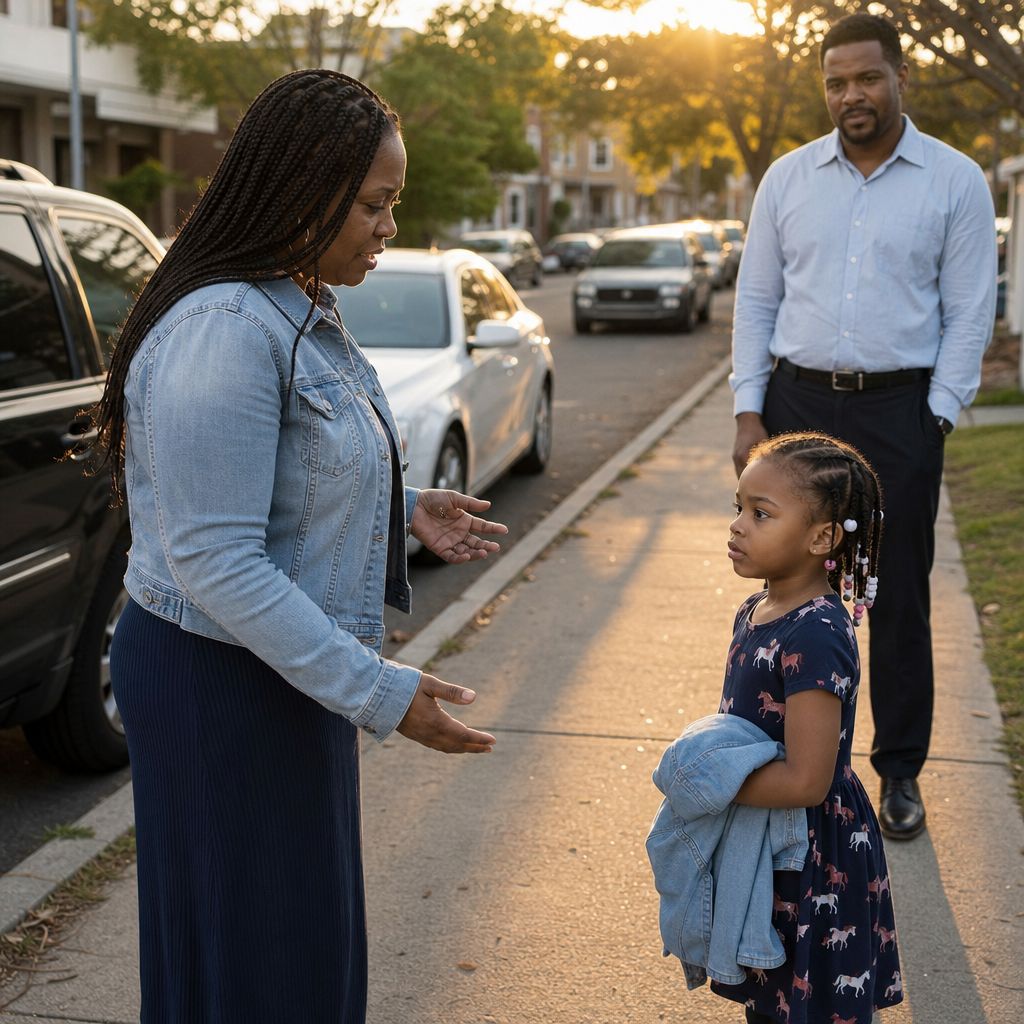
My daughter used to run at me like I was a finish line. That day she walked, slow, like her feet were dragging through syrup. She was six, with neat beads at the ends of her braids and a gap-toothed smile that normally made strangers smile back.
She didn’t smile. She didn’t lift her arms. She held her jacket in front of her like a shield and stopped just far enough away that I couldn’t scoop her up without making a scene.
“Hi, baby,” I said, keeping my voice light. “I missed you.”
Her eyes flicked past me—toward Grant—then back, and her mouth tightened like she was remembering lines. “Mommy breaks promises,” she said.
It wasn’t even the accusation that gutted me. It was the cadence. The way she said it flat and practiced, like she’d repeated it in a mirror. Like it came with a gold star if she delivered it right.
“What promise did I break?” I asked softly, trying not to sound panicked, trying not to sound defensive, because I could already hear Marisol’s warning in my head: don’t give him a scene.
Grant sighed dramatically, like I was exhausting. “Don’t interrogate her,” he said, loud. “She’s sensitive.”
My daughter’s chin lifted a fraction, like she’d been told she was brave. She still didn’t hug me. Her small hand stayed clenched around the jacket zipper, knuckles pale.
I swallowed hard and nodded, like I agreed, like I wasn’t being carved open in public. “Okay,” I whispered. “No interrogation.”
Grant’s eyes met mine for the first time, and there was something sharp there—satisfaction dressed up as concern.
Then my daughter added, almost as an afterthought, “Dad said you’re lying,” and I felt my face go hot because I knew exactly what word was coming next.
The iPad That Wasn’t Mine
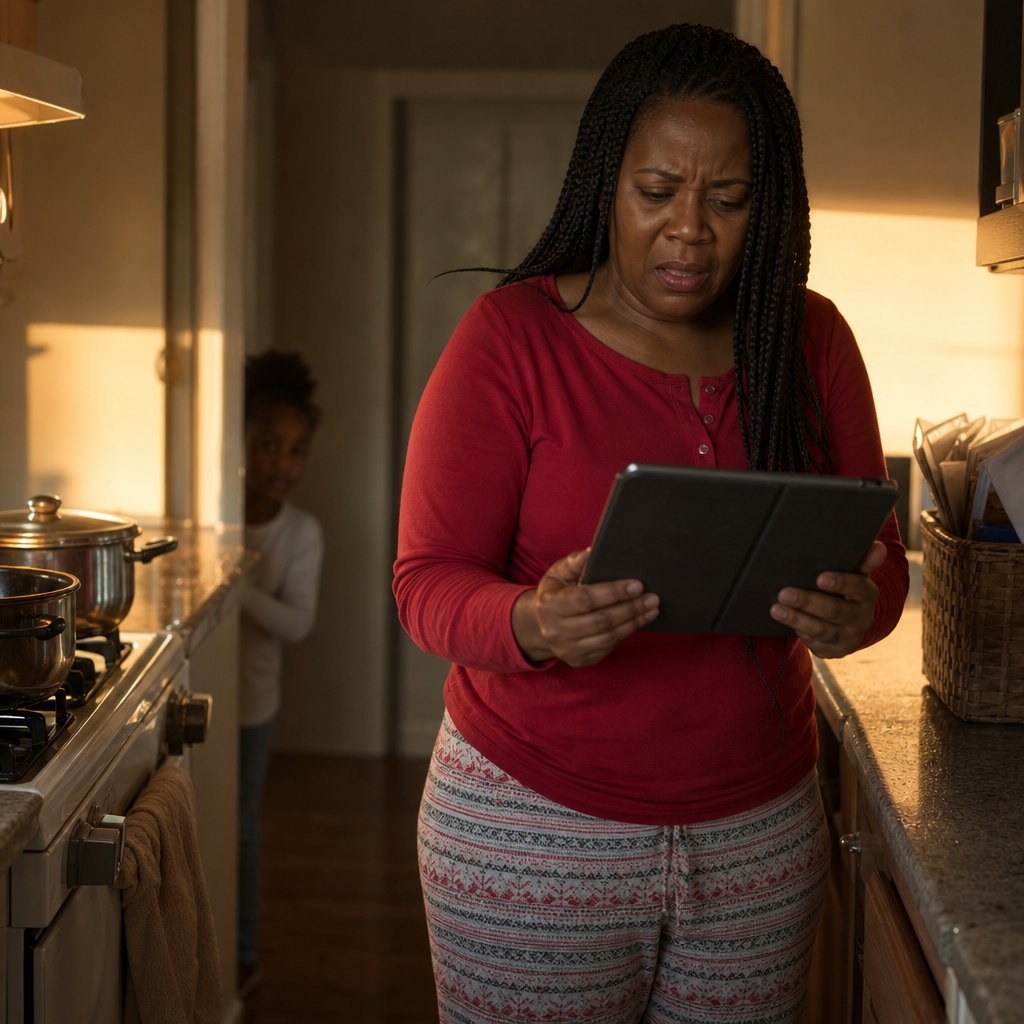
That night, I found it like a trap left in the open.
An iPad sat on my kitchen counter, tucked beside the mail basket like it had always belonged there. It was clean, new enough to still smell faintly like plastic when I picked it up. My son hovered in the doorway, chewing his lip, eyes darting between me and the device.
“Dad said it’s for homework,” he said quickly, like he’d been told to say it first. “He already set it up.”
My stomach sank. Grant didn’t “set things up” for me. Grant didn’t send gifts without strings. I turned it over and saw a bright sticker on the back—some cartoon animal—something chosen to look harmless, kid-friendly, generous.
“Okay,” I said, forcing calm. I set it down gently, like it might explode. “We can talk about homework after dinner.”
My daughter climbed onto a stool and watched me with that new, guarded expression, as if she was waiting for me to mess up. I could smell tomato sauce simmering on the stove, the sweet-acid scent suddenly cloying.
Later, when the kids were in the living room, I picked up the iPad again and opened it just enough to see the child profile—already named, already organized, already curated by someone who wanted access to my house through my children.
I went to the browser history and my breath caught. Searches—over and over—about divorce and moms and dads. About what happens when “moms take dads away.” About who kids should live with.
Not curiosity. Coaching.
I heard my son’s laugh from the next room, too high and forced, like he was performing normal for me.
Then a soft voice behind me said, “Dad said you’d be mad,” and I turned, iPad still in my hands.
The Meetings I “Refused”

The next week, Grant started talking about “family meetings” like he’d invented stability.
He told the kids they were gathering at his apartment to “check in” and “make sure everyone feels safe.” He said it with that therapist-adjacent vocabulary he’d never used in our entire marriage, the kind he’d picked up somewhere and decided to weaponize.
My son mentioned it over cereal, eyes down. “Dad said you didn’t come because you didn’t care,” he mumbled.
I nearly dropped the spoon. “What meeting?”
My daughter shrugged, like it was obvious. “The one where we talk about feelings. Dad says you don’t like feelings.”
I gripped the edge of the counter until my fingertips went numb. Grant hadn’t invited me. Not once. No date, no time, no message. Just a story he could tell afterward: She refused.
I could picture it perfectly—him on his couch, leaning forward, looking earnest, the kids sitting with their knees pulled up. Him saying, “I asked your mom to be here. She chose not to.” And then letting the silence do the rest.
It was a trap where my absence became evidence. If I showed up unannounced, I was intrusive. If I didn’t, I was indifferent. Either way, he got to narrate my motherhood like a documentary he directed.
I called Marisol from my car after drop-off, gripping the steering wheel so hard my wrists ached. “He’s telling them I refused meetings I never knew about,” I said.
Marisol exhaled. “Don’t show up there. Not yet.”
Not yet. Again. Always later. Always after he’d already done the damage.
That evening, my son asked, “Are you coming to the next one?” and the way he looked at me made it feel like a test I’d already failed.
The Drawing That Escaped Home

The email from my daughter’s teacher landed like a brick in my stomach.
“Just wanted to share something from art today,” it said, polite and careful. No accusation. No alarm. Which meant she didn’t know she was handing me proof of something rotten.
I drove to the school after work because I couldn’t stand waiting. The hallway smelled like pencil shavings and disinfectant, that clean-sour scent that made me feel like I was back in childhood, small and powerless. The teacher, Ms. Adler—white woman, early thirties, curly blonde hair pulled into a clip—met me outside the classroom with a folder tucked to her chest.
“She’s been a little quiet,” Ms. Adler said gently, eyes searching my face like she was trying to decide what kind of mother I was. “But she’s very sweet.”
She opened the folder and slid the drawing out.
Our house was split clean down the middle with a jagged line, like a crack in glass. On one side, a stick-figure dad stood inside the fence. On the other, a stick-figure me was outside it, separated by thick black marker. My daughter had drawn herself and her brother on the inside with him.
I stared too long. I knew I did because Ms. Adler’s expression tightened with concern.
“She said you were ‘taking things,’” the teacher added softly, like she was repeating a phrase she didn’t understand. “I wasn’t sure what she meant.”
I swallowed, my throat suddenly dry. Grant’s story had left our living room and walked into a classroom. It had a desk now. A crayon box. An audience.
Ms. Adler hesitated, then asked, “Is there… anything we should be watching for?”
I opened my mouth to answer, but my phone buzzed in my purse—Marisol’s number—and I knew before I even picked up that something had shifted again.
The Emergency Motion Bomb
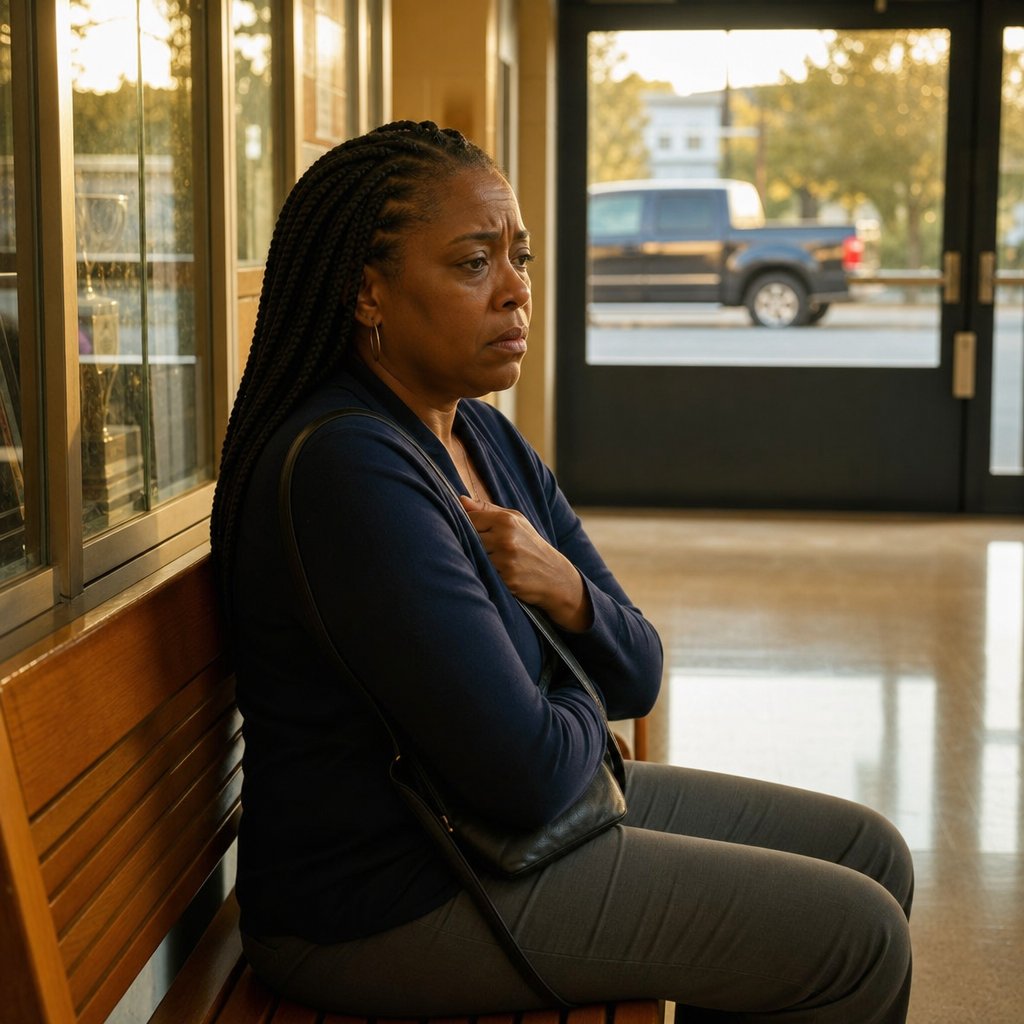
I didn’t even make it back to my car before Marisol went to voicemail. I listened with my back against the cold cinderblock wall, the school’s sounds muffled behind me—distant kids’ voices, a squeak of sneakers, a door closing.
Her voice was low and tight. “Call me as soon as you can. Grant filed an emergency motion.”
My knees actually weakened. I slid down onto a bench by the trophy case and gripped the strap of my purse like it could anchor me to the planet.
Marisol kept going, each word a controlled detonation. “He’s claiming you’re unstable. He’s alleging you’re emotionally harmful to the children. He’s asking for immediate temporary changes.”
Unstable. Emotionally harmful. The phrases were familiar—like the same vocabulary from those “family meetings,” the same careful language that made him sound responsible while painting me as a risk.
My mind raced through the last weeks: the planted screenshot. The coached lines. The new iPad. The teacher’s drawing. It wasn’t chaos. It was a campaign. And now he was cashing it in at court like a stack of chips.
I forced myself to breathe through my nose, slow, because I could feel panic trying to climb into my voice. I couldn’t give him what he wanted. Not even in private.
Marisol’s voicemail ended with, “Do not contact him. Do not post anything. Call me.”
I stared at my hands, palms damp, and for a second I pictured the judge reading those words—unstable, harmful—like they were facts instead of strategy.
Then I looked up and saw Grant’s truck turning into the school parking lot, like he’d timed it to my heartbeat.
She Held Their Jackets
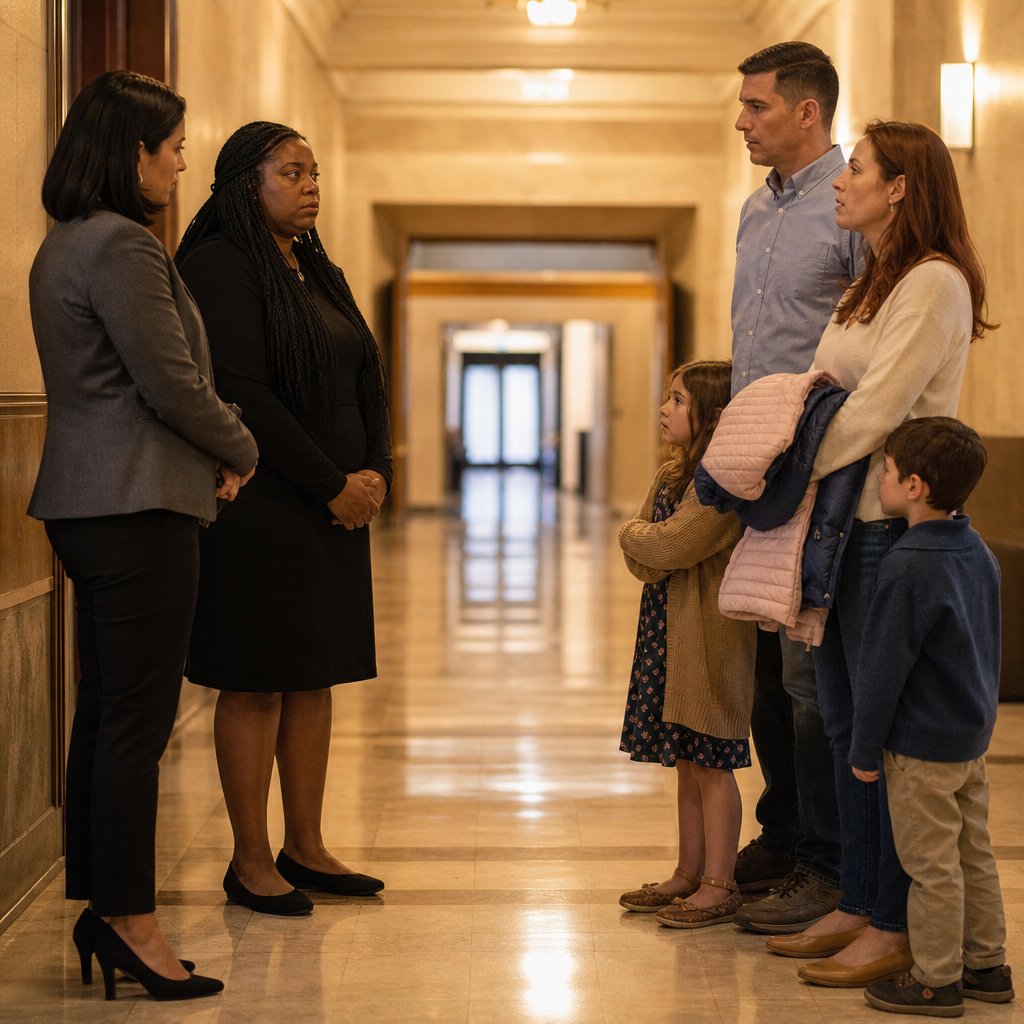
The courthouse smelled like old paper and burnt coffee, like a place where hope went to get processed. I walked in wearing a simple black dress and flats, my long box braids tucked behind my shoulders, trying to look calm while my heart punched at my ribs.
Grant was already there.
He stood near the hallway outside the courtroom with that same clean-cut composure, like he was waiting for a dentist appointment, not trying to rewrite our children’s lives. And beside him was a woman I had never seen before—white, mid-thirties, long auburn hair, slim build, wearing a cream sweater and dark jeans.
She was holding my kids’ jackets.
Not just carrying them. Holding them folded neatly over her arm like she’d packed snacks and remembered permission slips. Like she belonged in the orbit of my children. Like she’d done this before.
My son stood close to her hip. My daughter leaned toward her like she trusted the warmth of her body. The sight hit me so hard I almost lost my balance.
Grant’s eyes flicked to me and he smiled—small, contained, the kind you could deny later. The woman looked up too, and her expression wasn’t apologetic. It was assessing. Like she’d heard all about me and had already decided what role I played.
Marisol touched my elbow, grounding me. “Don’t react,” she murmured.
My daughter saw me and didn’t move. No wave. No run. Just that watchful stillness, like she was waiting to see which “mom” would win.
Grant leaned down and whispered something to the auburn-haired woman. She nodded once, then stepped forward—toward me—still holding my kids’ jackets like a trophy.
They Came Back Rehearsed

The new woman stepped forward with my kids’ jackets like she was the one who knew where their bodies belonged. She was white, late thirties, sleek dark bob, gold hoops—her hand already pinching my daughter’s sleeve to straighten it. Grant stood behind her in the doorway, tall in a navy quarter-zip, mouth relaxed like he was watching a show he’d paid for.
“Okay,” my son said, before I even spoke. Twelve years old, lanky, eyes too steady. “We don’t feel safe when you interrogate us.”
I blinked. “Interrogate you?” My voice came out small, like air leaking from a tire.
My daughter, nine, hugged her backpack and recited, “We need boundaries. We’re not comfortable answering questions about Dad’s house.” The words didn’t fit her mouth. Like she’d swallowed someone else’s teeth.
I crouched to their level anyway, braids falling over my shoulder, palms open. “Baby, I asked what you ate and if you did your homework.”
Grant’s new woman cleared her throat—soft, managerial. “They’ve expressed they need space,” she said, as if she was translating a foreign language called My Children.
Grant’s eyes flicked to me, and I saw the trap set cleanly: one more question and I’d be “harassing” them. My son lifted his chin, repeating the last line like a closing argument—
“Stop interrogating us, Mom.”
My Name Vanished Overnight
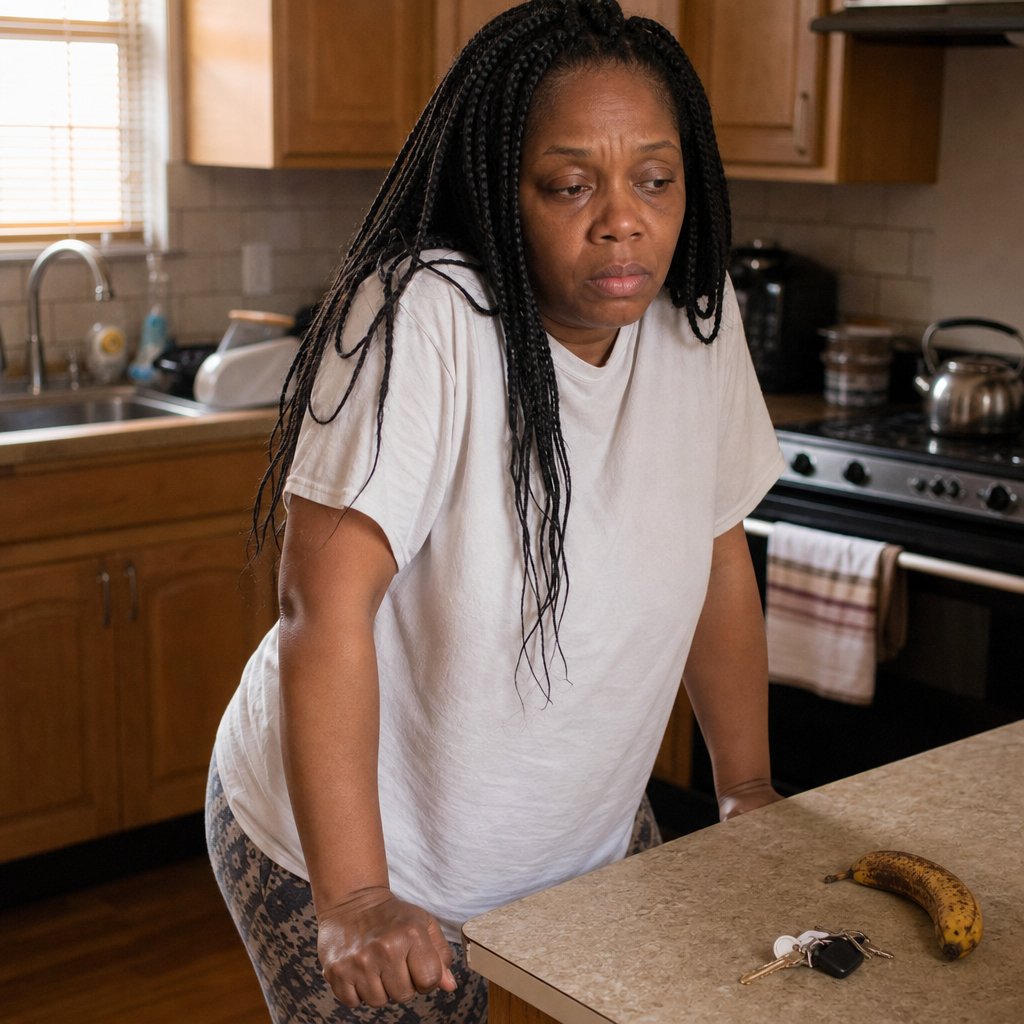
By Tuesday, I knew why Grant had looked so calm.
I stood in my kitchen with the fridge humming and a banana going brown on the counter, trying to confirm the kids’ school concert time the way I always did. Habit. Survival. I opened the calendar and my stomach dropped so fast it felt like my body forgot how to be upright.
I wasn’t on it.
Not “limited access.” Not “view only.” Just… gone. Like I’d never been the woman who packed lunches and signed permission slips and knew the difference between pajama day and picture day.
I refreshed. I checked my email. I searched spam. Nothing. No invite. No removal notice. Just a clean erasure.
I called Grant. He didn’t answer. I left a voicemail with my voice measured so he couldn’t use it later: “Hey. I can’t see the shared calendar. Can you re-add me?”
He texted back an hour later—short, surgical. “You were using it to monitor. The kids need boundaries.”
Monitor. Like I was a stranger casing their lives.
I stared at the message until my eyes burned, imagining all the events still happening without me—teacher conferences, field trips, the concert—existing in a place I couldn’t see. Grant didn’t have to keep me away physically anymore. He could just let me show up late, or not at all, and then hold up my absence like proof.
My hand shook on the countertop as I realized the next time the kids asked, “Why weren’t you there?” I wouldn’t even know what to say.
The Credit Line Was Gone

The bank alert hit while I was in the carpool line, sun baking the steering wheel and my patience thin as paper.
I didn’t open anything on-screen. I didn’t need to. The subject line alone was enough to make my throat close: joint line of credit—closed.
Closed without my authorization.
I pulled out of line, parked crooked, and called the bank with my heart banging like it wanted out. The woman on the phone kept saying “we show a request” and “we have a recorded confirmation,” and every time she said “we,” I heard Grant.
When I finally reached him, he answered like he’d been waiting for the call.
“It’s handled,” he said.
“You closed it,” I said, keeping my voice low because my daughter’s booster seat was empty but her ghost felt present, listening.
“I protected us,” Grant replied. “From your spending.”
I actually laughed—one sharp sound—because it was so cleanly insane. I bought groceries. I paid for cleats. I covered the dentist when his card ‘declined’ and he acted embarrassed in front of the kids.
“You can’t do that,” I said. “My name is on it.”
“Not anymore,” he said, like he was reading a weather report. “And before you start, this is exactly why the kids don’t feel safe.”
Safe. He turned finances into fear, paperwork into parenting.
I looked at my hands on the steering wheel—brown skin, short nails, the faint indentation where my wedding ring used to sit—and realized he wasn’t just trying to bankrupt me. He was trying to make me look reckless in a courtroom and unstable in my children’s eyes.
Then he added, almost gently, “Don’t make a scene at school today.”
A List In His Pocket
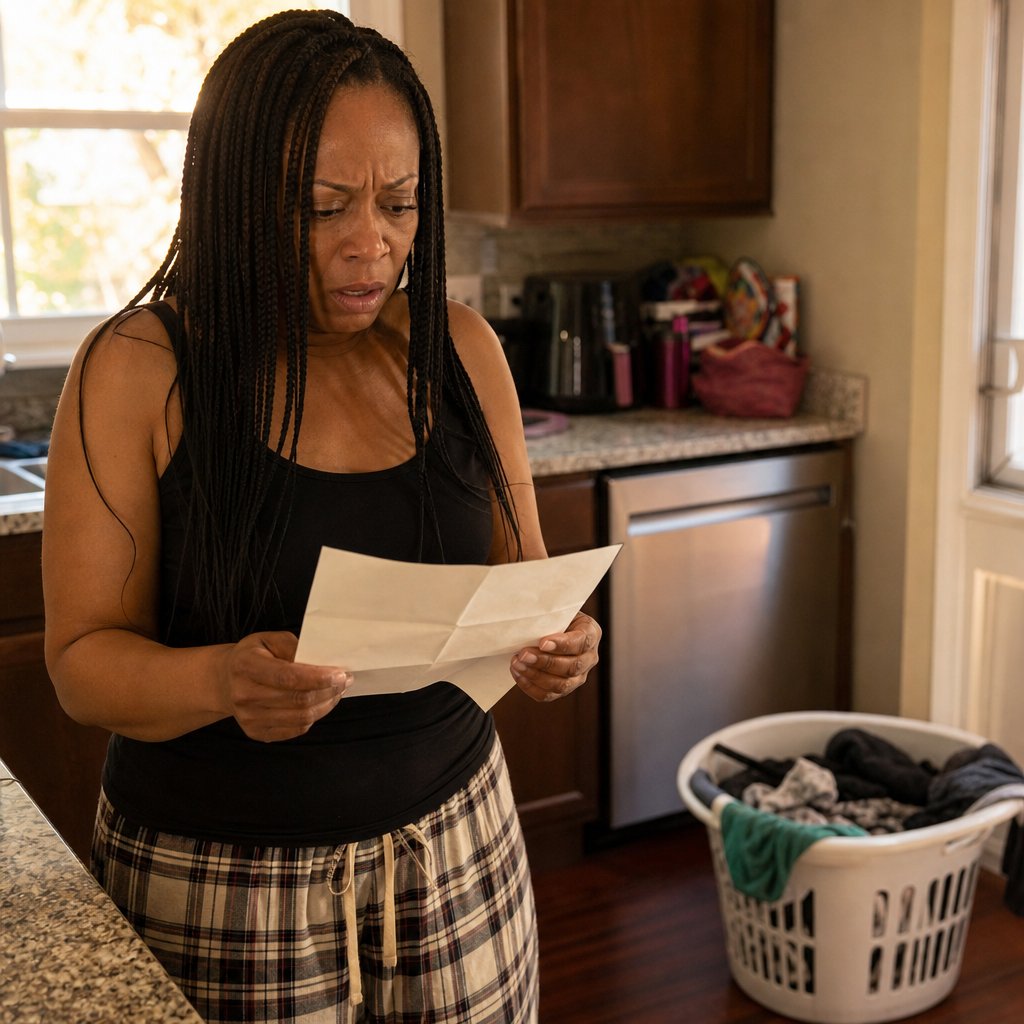
That night I did laundry like a person trying to keep the world from collapsing through sheer routine.
Warm cotton and detergent filled the hallway as I turned out my son’s jeans. My fingers caught something stiff in the pocket—paper folded into a tight square, like it had been handled a lot. I almost put it back. Almost. Because I was tired of learning new ways my life could hurt.
I unfolded it at the kitchen counter, smoothing it flat with my palm.
At the top, in blocky, adult handwriting—too steady, too spaced—was a title that made my vision tunnel: Things Mom Lies About.
Bullet points marched down the page. Not kid spelling. Not kid grammar. Full sentences with legal-sounding words. The kind of language people use when they’re building a case, not expressing a feeling.
My name was in it like an accusation: “She says she can’t afford things but buys herself stuff.” “She says Dad is mean but he is calm.” “She lies about why the divorce is happening.”
I held the paper up to the light, looking for pencil marks, erased lines, anything that felt like my son. But it was clean. Deliberate. Prepared.
My chest tightened with a grief that turned instantly into rage. Someone had put this in his hands. Someone had made him carry it against me, close to his body, like a weapon he didn’t understand he was holding.
I heard his bedroom door creak down the hall and froze, the paper trembling between my fingers.
“Mom?” he called, sleepy, suspicious. “Why are you doing laundry this late?”
I swallowed hard, staring at the list like it might bite me, and tried to decide in one heartbeat whether to confront him—or hide the evidence and confront the person who wrote it.
He Whispered, ‘He’s Listening’
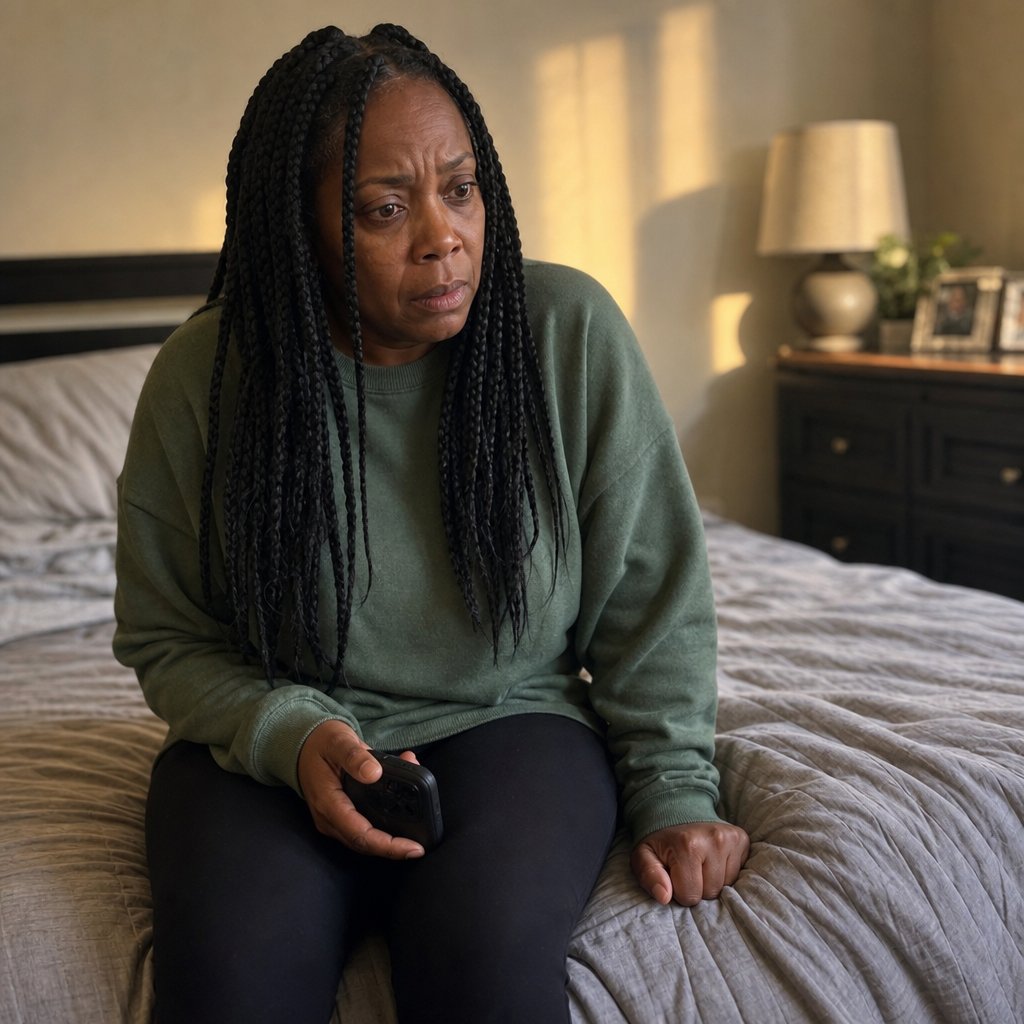
On Grant’s nights, the silence wasn’t peaceful. It was curated.
I would call at the agreed time and get nothing—straight to voicemail, then a text later: “Kids are busy.” Busy doing what? Breathing without me? Learning how to flinch at my name?
On the third night, I tried again and again until my fingers ached. When the call finally connected, my daughter’s face wasn’t there. No little wave. No background noise. Just my son’s voice, low and careful like he was in a library.
“Hey,” I said, forcing brightness, forcing normal. “Baby, I just wanted to—”
“Don’t,” he cut in, and my stomach clenched. Then, quieter: “He’s listening.”
I sat down hard on the edge of my bed, the quilt rough under my palm. “Who’s listening?” I whispered back, like I was the one sneaking around.
“Dad,” he said. A breath. “He said if we talk to you, you’ll twist it. So… I’m not supposed to.”
I closed my eyes and saw that folded list again. Things Mom Lies About. A script. A muzzle.
“Are you okay?” I asked. “Is your sister okay?”
There was a pause long enough for me to hear a faint shift on his end—fabric, a footstep, someone moving closer.
My son’s voice dropped to almost nothing. “Mom, I have to go. He’s right here.”
“Wait—” I said, panic rising, because I could feel the door closing on us.
And then, before the line went dead, he added one more sentence, like he was slipping me contraband: “Don’t tell him I said that.”
The LLC I’d Never Heard
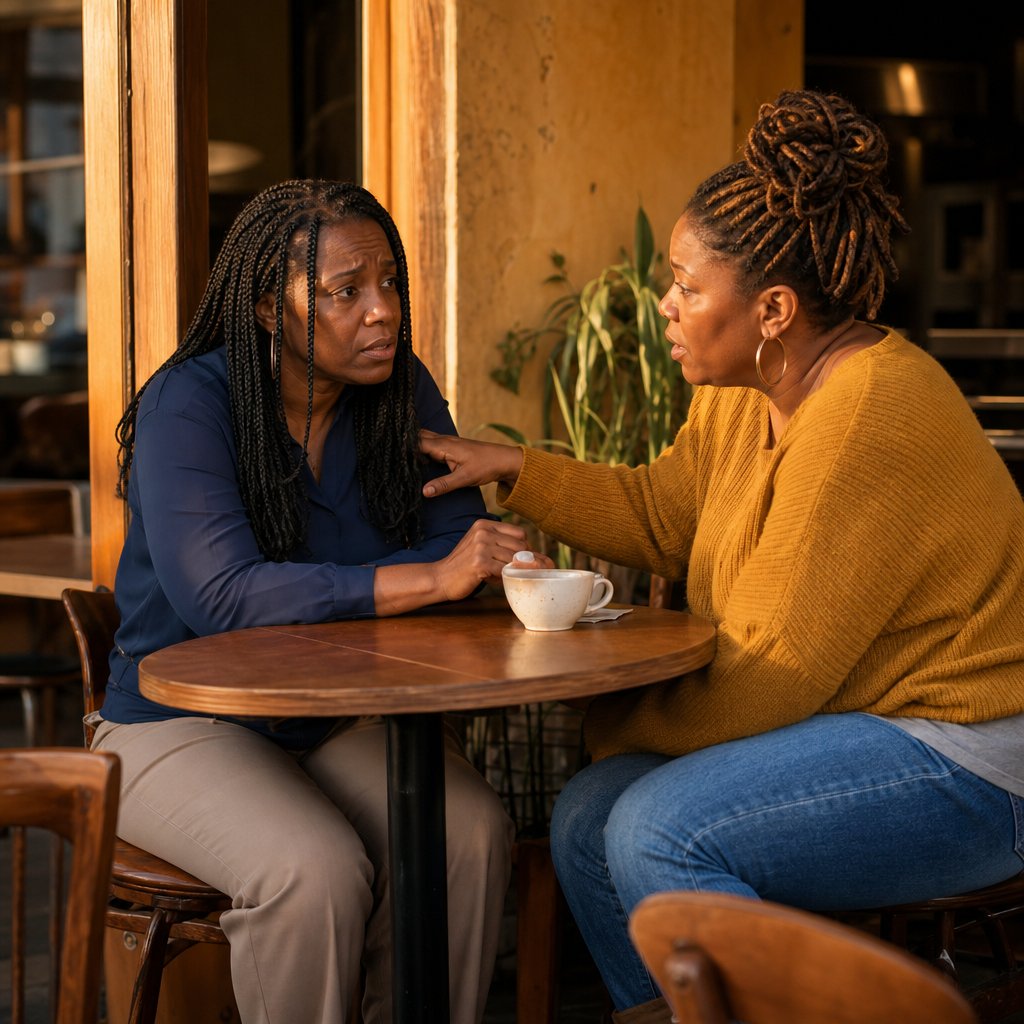
My attorney’s office smelled like coffee that had given up.
I sat across from her conference table, braids pulled back with a clip, trying to look like someone Grant couldn’t dismiss as “emotional.” She flipped through his disclosures with the kind of calm that only comes from seeing men lie for sport.
“He listed a consulting LLC,” she said, tapping a page with her pen. “Do you know about it?”
“No,” I said instantly. “We filed taxes together. I would’ve seen it.”
She didn’t look surprised. That was the part that made my skin prickle. “It’s not on the returns you provided. But he’s claiming it’s separate.”
Separate. Like our marriage hadn’t been a joint account, a joint bed, a joint set of children he was now trying to repossess.
When I left, I drove straight to meet my friend Tasha at a little café. She took one look at my face and leaned in, voice sharp. Tasha was thick-built, honey-brown, locs in a messy bun—she didn’t do subtle.
“I didn’t want to say it,” she murmured, “but Grant ran his mouth at Devin’s birthday. He was bragging. Said he had a ‘commission workaround’ now that he’s ‘not letting you take him for everything.’”
I felt my pulse in my teeth. “A workaround… with a consulting LLC.”
Tasha’s eyes narrowed. “You didn’t know?”
Something cold settled in me. Because it wasn’t just hiding money. It was building an entire second pipeline while telling the court—and my kids—that I was the unstable one.
My attorney’s words echoed: separate. My friend’s words echoed: bragging.
And I realized the next step wasn’t asking Grant. It was proving it.
His Second Number Matched
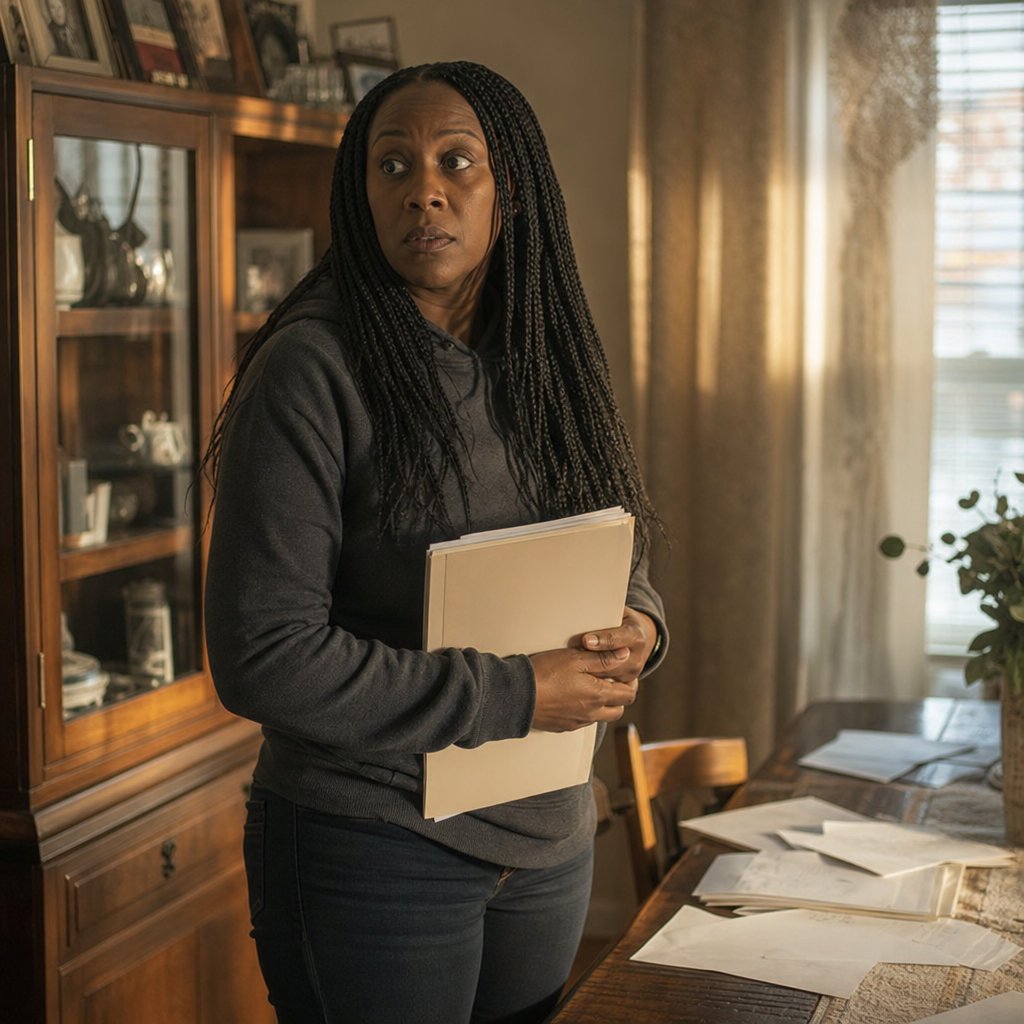
I didn’t sleep. I did what I always did when I couldn’t breathe: I gathered facts until the panic had edges.
In the morning, I went to the carrier store and asked for call records like my dignity depended on it—because it did. I sat in my car afterward with a thick envelope on the passenger seat, the paper inside heavier than it should’ve been.
At home, I spread the pages across my dining table. Dates. Times. A pattern so consistent it felt like a heartbeat. Then I saw it: a number I didn’t recognize, threaded through months of our marriage like a secret seam.
Not a one-off. Not spam. Repeated calls, long durations, always during “late meetings,” always when he told me he was “too busy” to pick up the kids.
I typed the number into my contacts, hands steady in a way my heart wasn’t. Then I cross-checked the LLC paperwork my attorney had flagged—the contact line.
It was the same number.
I stared at it until the room felt far away, like I was watching my own life through glass. Two lives. Two ledgers. One man smiling in family photos while building a back door out of our marriage.
My mind raced through every “work trip,” every “conference,” every time he’d acted offended when I asked a simple question. He hadn’t been offended. He’d been rehearsing outrage so I’d stop looking.
I gathered the papers into a neat stack, the way you handle something dangerous, and slid them into a folder. My hands didn’t shake until I heard my front door click—
—and Grant’s voice floated in from the hallway, casual as ever. “Hey. We need to talk about the kids.”
They Said They ‘Aren’t Allowed’

The school counselor smiled like she was trying to soothe a skittish animal. That animal was me.
We sat in a small office that smelled like pencil shavings and lemon cleaner. A box of tissues sat dead center on the table like a threat. I kept my back straight, hands folded, braids draped over one shoulder, refusing to give Grant the satisfaction of a story about me “falling apart.”
“The kids have shared,” the counselor said carefully, “that they feel caught in the middle.”
“I’m not putting them there,” I replied. “I’m trying to stay in their lives.”
She nodded, eyes soft. “They also said there are things they’re not allowed to tell you.”
My stomach clenched. “Not allowed… by who?”
The counselor didn’t answer directly. That was answer enough.
She slid her hands together, choosing her next words like they were glass. “Grant has filed a motion to appoint a guardian ad litem. He’s alleging you are manipulating the children.”
I felt heat rise behind my eyes, but my voice came out cold. “He’s accusing me?”
“It’s a neutral party,” she said quickly. “To help the court understand—”
Understand what? That my son’s new vocabulary included “boundaries” and “unsafe” and “interrogation”? That my daughter looked over her shoulder before hugging me? That I’d been erased from the calendar and blamed for not showing up?
I pictured Grant in his calm courtroom voice, presenting my reactions as proof. I pictured his new partner waiting outside school events with the jackets, the snacks, the smile that said I’m the stable one.
My hands tightened together under the table. “When did he file?”
The counselor glanced at her notes. “This morning.”
And then she added, almost apologetically, “He requested the children be interviewed without you present.”
Something Was In My Outlet
I noticed it because my living room had started to feel… watched.
Not in a ghost way. In a petty, human way. Like someone knew when I cried and when I didn’t. Like my private moments had an audience.
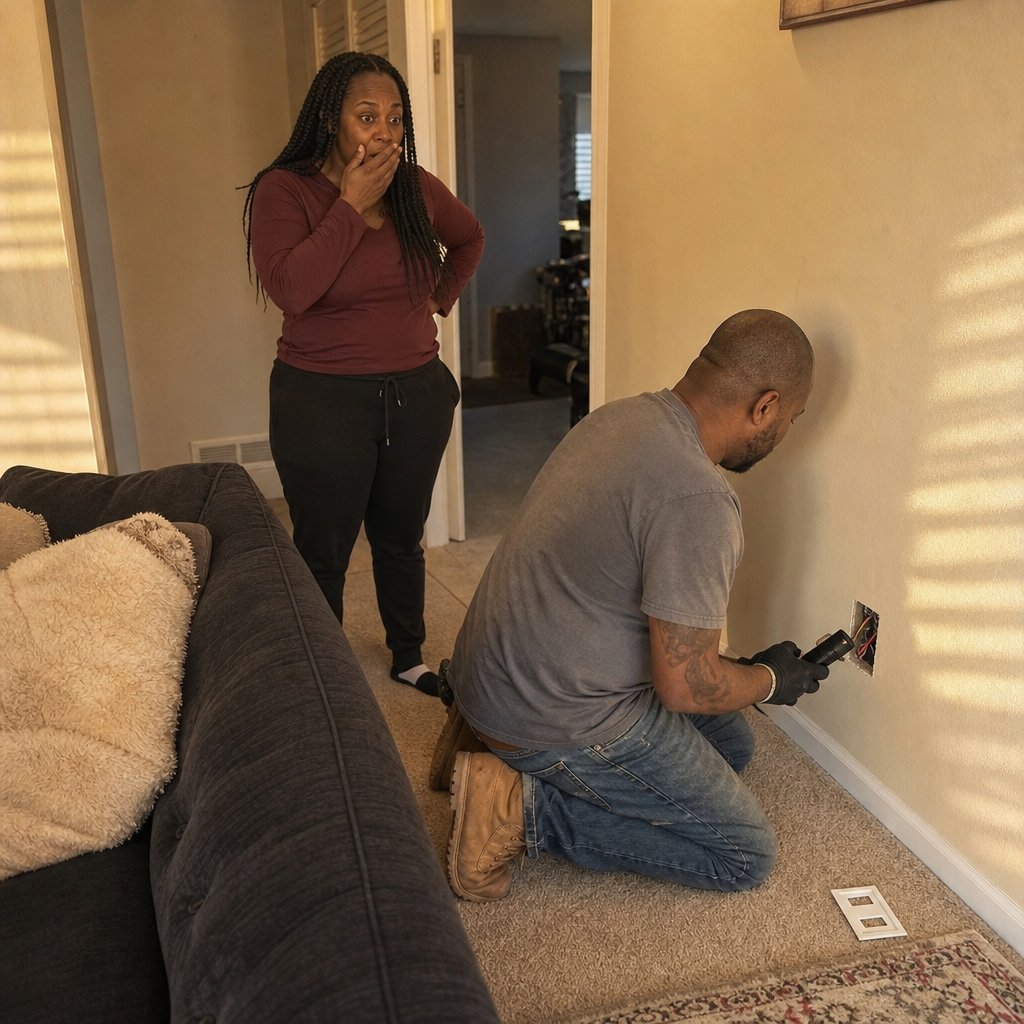
I was vacuuming along the baseboard when I saw the outlet behind the couch—one I never used—look wrong. The plate sat a hair crooked. The screw wasn’t the same as the others. A tiny dark dot where there should’ve been blank plastic.
I crouched, heart thudding, and ran my fingernail along the edge. It shifted.
I didn’t touch it again. I backed up like it could bite me. Then I called an electrician and told him I thought I was being dramatic. He showed up in work boots and a faded T-shirt, took one look, and his face changed.
He shut off the breaker and removed the plate with careful fingers. Behind it, tucked tight like a secret, was a small device—black, round, with a pinhole opening that made my skin crawl.
“Is this… mine?” I asked, even though I knew it wasn’t. My voice sounded far away.
He glanced at me, then back at the device. “No, ma’am,” he said, flat and certain. “This isn’t standard. This is not part of your electrical.”
My mouth went numb. Grant had been in this house. During the separation. During “pickups.” He’d hugged the kids in this room. He’d stood exactly where I was standing now.
The electrician held the device in a gloved hand, like evidence.
“Do you want me to bag it?” he asked.
And I realized I didn’t just have a divorce. I had a crime scene.
The Album Named ‘Court’

I didn’t go digging through the kids’ tablet because I wanted to spy. I did it because I was tired of being the only one playing by the rules.
It was on the couch cushion, forgotten after they’d gone to bed. I held it like it was contaminated, my thumb hovering over the buttons, my stomach tight. I wasn’t looking for secrets from my children. I was looking for the adult fingerprints on their lives.
I opened the photo gallery and scrolled—birthdays, pets, blurry selfies. Normal. For a second, hope tried to rise.
Then I saw a folder icon that didn’t match the others. Hidden. Titled, in neat plain letters: Court.
My hands went cold.
Inside were photos taken in my house. Close-ups. Not kid curiosity—evidence angles. My mail spread on the counter. The label side of my medication bottle. My therapy appointment card on the entry table. Shots framed tight, like someone had coached them to avoid capturing anything “unnecessary.”
I could almost hear Grant’s voice: Just take a picture for Dad. This is important. I could almost see his new partner hovering, making sure the lighting was good and the camera was steady.
A sour, metallic taste flooded my mouth. They weren’t just turning my kids against me. They were using them as little investigators inside my home.
I set the tablet down on the coffee table, palms flat, breathing hard through my nose. My living room looked the same—throw blanket, toy basket, a faint crayon mark on the wall—but it felt violated in a new way.
Behind me, a floorboard creaked in the hallway.
The Friday Deposits No One Mentioned
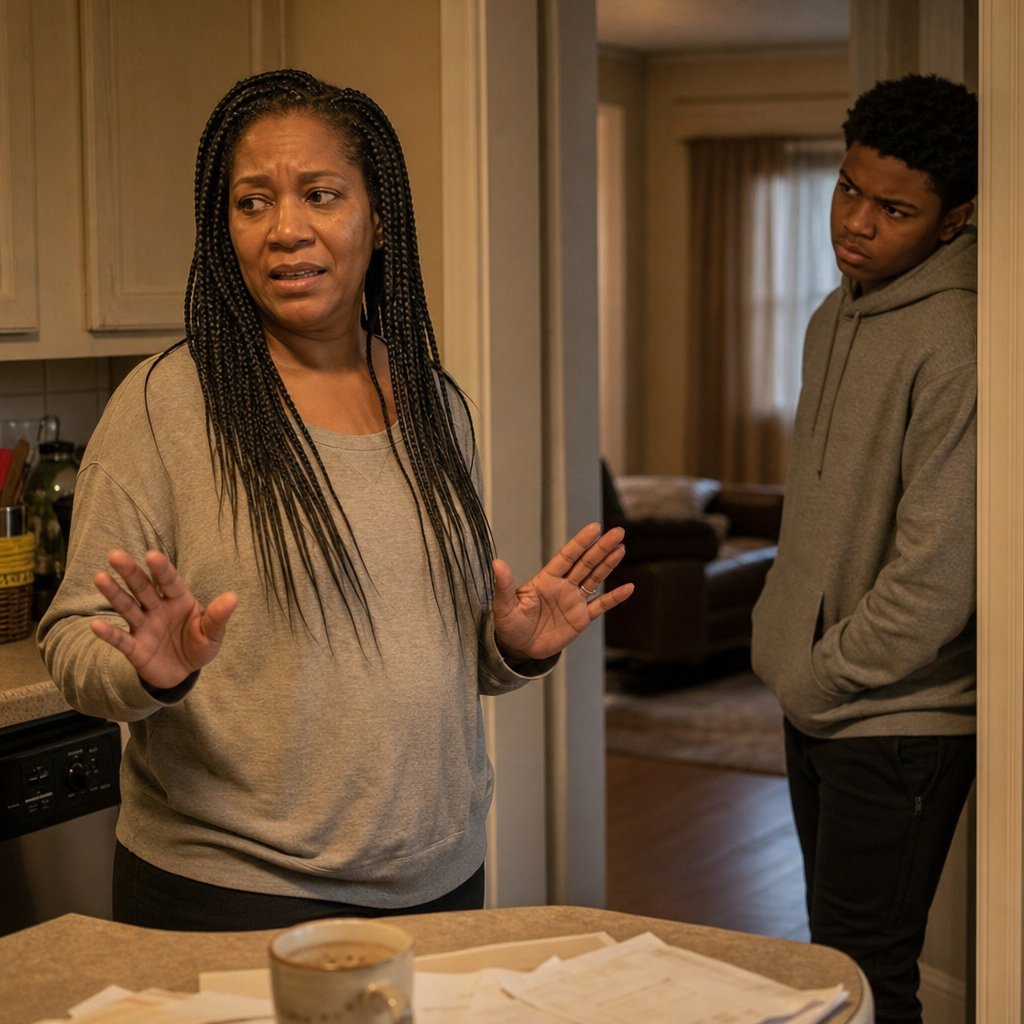
My son stood in the doorway, eyes locked on the tablet like it was about to bite. My throat went dry anyway.
“That’s… that’s not what you think,” I said, and I hated how guilty my voice sounded, like I was the one with something to hide. He didn’t move. He just stared at the rows I’d pulled up—dates, amounts, the same description stamped over and over like a joke nobody else was in on.
Friday. Every Friday.
“Mileage reimbursements,” he read out loud, slow. His mouth tightened on the word reimbursements like it tasted sour. “You said you didn’t know where Dad’s money went.”
I forced my hands to stay open at my sides, palms up, like I could physically show him I wasn’t holding a lie. “I didn’t. I subpoenaed these. They just came in.”
He took one step into the room and the air changed—less kid, more jury. The smell of his grape sports drink clung to his hoodie, sickly sweet against the sharp tang of my cold coffee. “So why is it every week?” he asked. “And why is it not in the divorce papers?”
In court that afternoon, the judge let me have the statements—but only a narrow slice. Limited discovery. Enough to glimpse the account number, enough to see the pattern, not enough to follow it to where it ended.
Grant’s attorney smiled like she’d done me a favor.
When we got back to the car, my son’s voice dropped to a whisper. “Are you gonna tell me the truth now,” he said, “or are you still gonna be… the liar?”
When Her Eyebrows Finally Lifted
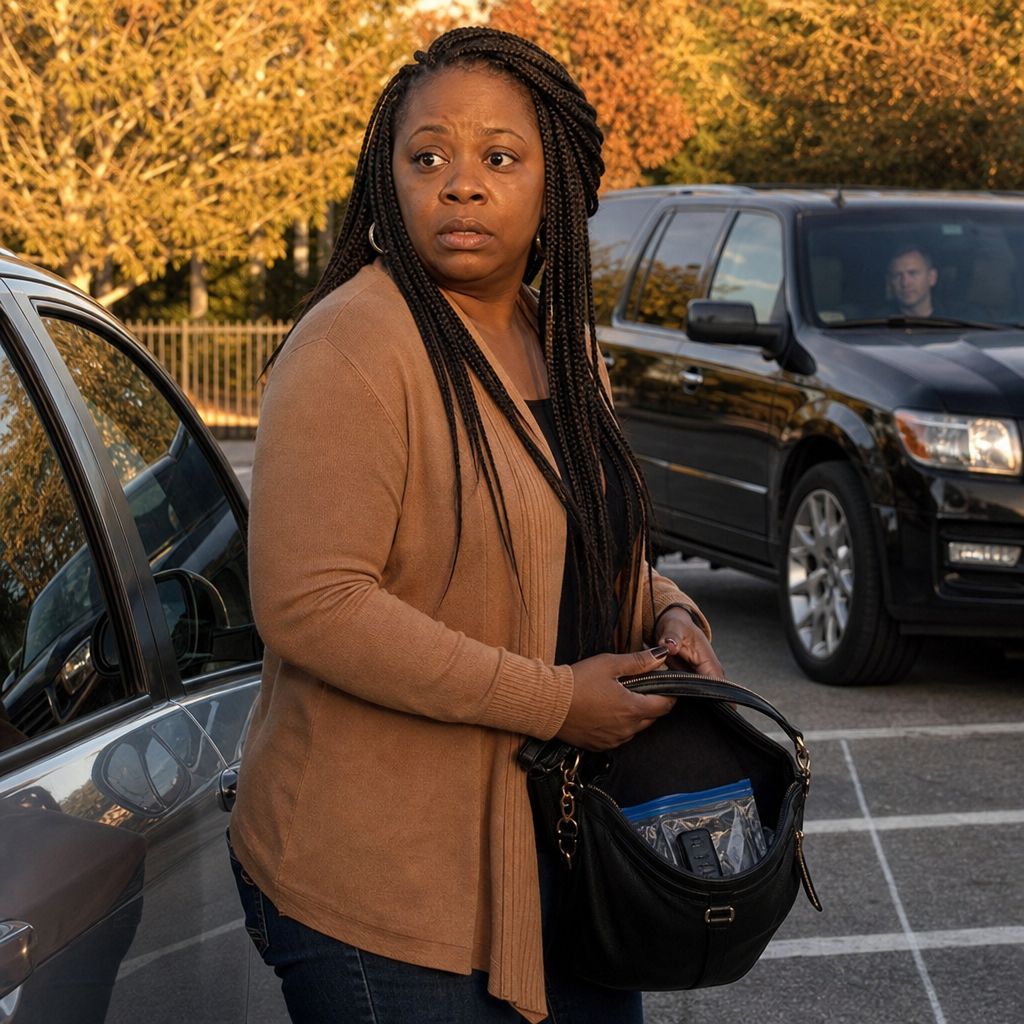
The guardian ad litem didn’t look at me like a villain. Not even politely.
She sat across from me in a cramped conference room that smelled faintly like lemon cleaner, flipping through my stack with the bored efficiency of someone who’d heard every sob story. Then I slid the zip-top bag onto the table—clear plastic, the tiny black puck inside, the kind of thing you could lose in a couch cushion and never find again.
Her eyes stopped. Actually stopped.
“Where did you find this?” she asked, and her voice changed—sharper, awake.
“In my car,” I said. “Under the passenger seat. The week Grant started telling the kids I was ‘unstable.’” My nails dug crescents into my palm. “And I have doorbell footage from the night he ‘returned’ their backpacks. He lingered by my car like he was looking for something.”
She held the bag up, turning it between her fingers like it weighed more than plastic. “Bring the footage,” she said. “Send it to my office. And don’t touch this again.”
For the first time in months, somebody’s eyebrows went up for me, not at me.
I walked out with my legs shaking, clutching my purse like it was a life raft. In the parking lot, my phone buzzed in my hand. A message from Grant—no greeting, no pretense.
“Make sure they say the line about feeling unsafe.”
I read it twice, my stomach dropping through the asphalt, because there was only one “they.”
And because it wasn’t a mistake.
I looked up and saw Grant’s SUV at the far end of the lot, idling like it had nowhere else to be.
Her Objection Broke Midword

In the courtroom, Grant’s lawyer objected so fast her voice cracked, like her throat betrayed her before her client did.
“Ob— objection, Your Honor,” she rasped, one hand already halfway up, fingers trembling. Grant didn’t look at her. He stared straight ahead, jaw working, like he could grind the truth into dust if he clenched hard enough.
The judge didn’t blink. “Denied,” he said, calm as a metronome. “We’re ordering a phone extraction.”
I felt my whole body go hot, then cold. A phone extraction meant timestamps, locations, drafts, deleted messages—every little puppet-string he’d been yanking in the dark. Grant finally turned his head and met my eyes, and the look he gave me wasn’t fear. It was warning.
We broke into the hallway after, the air thick with old carpet and stale breath. Grant stepped close enough that I could smell his mint gum over the courthouse’s disinfectant. His voice softened into that practiced, reasonable tone he saved for when he wanted to sound like the adult in the room.
“Let’s end this,” he said. “I’ll be generous.”
I didn’t answer. I watched his mouth move and waited for the hook.
“Sole decision-making,” he continued, like he was ordering coffee. “You move. Start over. Without the kids. You can visit. We’ll keep it peaceful.”
My ears rang. Peaceful. Like he wasn’t trying to erase me with a pen stroke.
He leaned in, lower now. “Say yes today,” he whispered, “or I make sure they never forgive you.”
Then his lawyer came out of the courtroom, face too pale, and called his name like something had already gone wrong.
His Mother’s Name Was On It

The forensic accountant didn’t raise his voice. He didn’t have to. He just slid the summary across the table and let the numbers do what numbers do—cut clean.
“Those Friday deposits?” he said, tapping once with a capped pen. “They trace back to the LLC. Same originating source, consistent timing. And then they move.”
I swallowed. The conference room air tasted like dust and toner. My hands hovered over the paper, afraid to touch it like it might burn.
“To where,” my attorney asked, already knowing the answer by the tightness in her shoulders.
The accountant looked up. “A second account,” he said. “In Grant’s mother’s name.”
It landed like a slap. Not just hiding money—hiding it behind a smiling grandmother who baked for school fundraisers and hugged my kids like she hadn’t been part of a slow-motion kidnapping.
Then my attorney pulled out the printed messages we’d gotten in discovery—no screens, just cold paper, redactions like bruises. Mara’s name at the top. Her words underneath, neat as bullets.
“Keep it simple,” one message said. “When she asks questions, you say you feel unsafe. Repeat it.”
My chest tightened so hard I couldn’t breathe. Mara—the new partner with the perfect carpool smile—helped draft scripts for my children like they were actors in Grant’s show.
“We have enough to argue coercion,” my attorney murmured, but her eyes flicked to the clock. “The court still hasn’t ruled.”
My phone buzzed against my thigh—an exchange reminder. Hours away. My son would be in Grant’s car soon.
I stood up too fast, chair legs scraping, and my attorney grabbed my wrist. “If you confront him before the exchange—” she started.
Because outside the conference room glass, I saw Grant in the lobby, already smiling like tonight was going to go exactly how he planned.
Would you have confronted him before the child exchange?